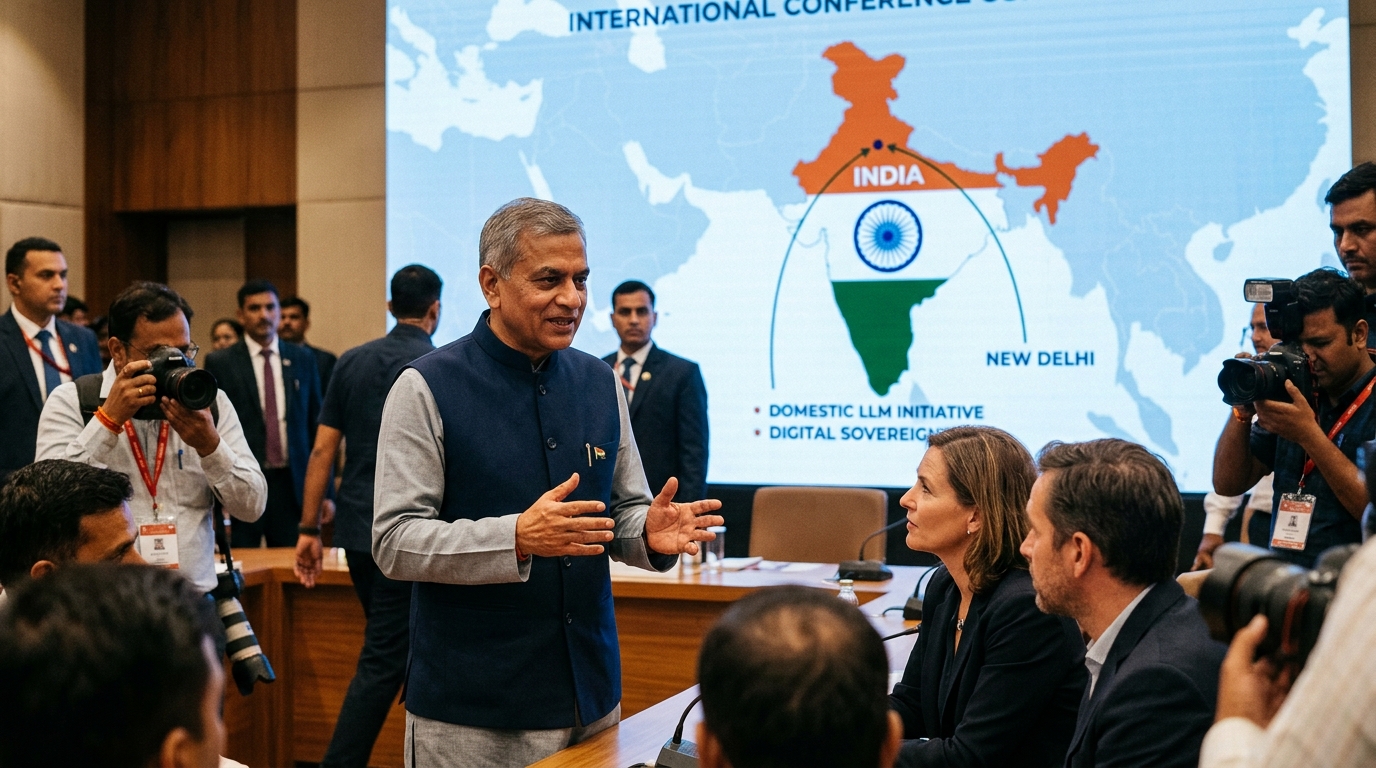
At the heart of the digital revolution, India stands at a critical crossroads. While the country has established itself as the "back office" of the world, providing the workforce behind the planet's largest tech companies, the current AI boom highlights a troubling dependency. The dominant Large Language Models (LLMs), such as OpenAI's GPT-4 or Google's Gemini, have been trained primarily on Anglo-centric data, sidelining the linguistic richness of India's 1.4 billion people. The debate over developing domestic models is no longer a theoretical exercise but a strategic imperative for national sovereignty.
The Linguistic Challenge and the Bhashini Initiative
India officially recognizes 22 languages, but the number of dialects exceeds hundreds. For a country where the majority of the population does not use English as their first language, reliance on Western models creates a new digital divide. The Indian government, through the Bhashini initiative, is attempting to bridge this gap. Bhashini aims to create an AI ecosystem that allows citizens to access digital services in their mother tongue, primarily using voice commands to bypass literacy barriers.
However, developing a "BharatGPT" faces a massive data hurdle. While the internet is flooded with English content, data for languages like Hindi, Tamil, or Marathi is limited and often of low quality. Collecting and digitizing this data is the first major challenge for Indian data scientists, who must ensure that models replicate not just words, but the deep cultural context of India. Without this, AI remains a foreign entity, incapable of truly serving the local population.
Infrastructure and the GPU Bottleneck
The ambition for domestic AI hits a hard wall: the lack of raw computing power. Training cutting-edge models requires thousands of Graphics Processing Units (GPUs), which are almost exclusively controlled by Nvidia. India, despite its progress in electronics manufacturing, still imports all the high-performance chips needed for AI. The government's recent announcement of a $1.2 billion investment under the "IndiaAI Mission" is a step in the right direction, but many analysts believe the amount is meager compared to the tens of billions being poured in by Microsoft and Google.
The private sector, however, is stepping up. Mukesh Ambani's Reliance Group, in collaboration with IIT Bombay, is developing "Hanooman," a series of models designed to support multiple Indian languages. Simultaneously, Bhavish Aggarwal's Krutrim became India's first AI startup to reach unicorn status, promising models trained on indigenous datasets. The battle is now being fought on two fronts: securing the necessary GPUs and retaining top-tier talent that often migrates to Silicon Valley for better infrastructure and pay.
Geopolitics and Digital Autonomy
The drive for domestic LLMs is deeply geopolitical. In a world where AI will govern economies, defense, and education, India is unwilling to be a mere consumer of foreign technology. There is a profound fear that models developed in the US or China embed the values, biases, and political leanings of their creators. For New Delhi, "Sovereign AI" is a guarantee that decisions affecting Indian citizens will not be made by algorithms that fail to understand Indian reality.
"AI is the new electricity, and no nation can afford to have its grid controlled by a foreign power," says a senior official from the Ministry of Electronics and IT.
Key strategic goals include:
- Data Protection: Preventing the exploitation of Indian user data by foreign entities for model training.
- National Security: Mitigating the risk of AI-driven misinformation or foreign interference in democratic processes.
- Economic Resilience: Building a domestic ecosystem that retains high-value intellectual property within the country.
In conclusion, India's effort to develop its own Large Language Models is a race against time and structural deficits. If successful, it will serve as a blueprint for the "Global South," proving that technological progress is not the exclusive privilege of a few superpowers. The success of BharatGPT will not be measured solely by its parameter count, but by its ability to speak to the heart and the native tongue of the average Indian citizen.