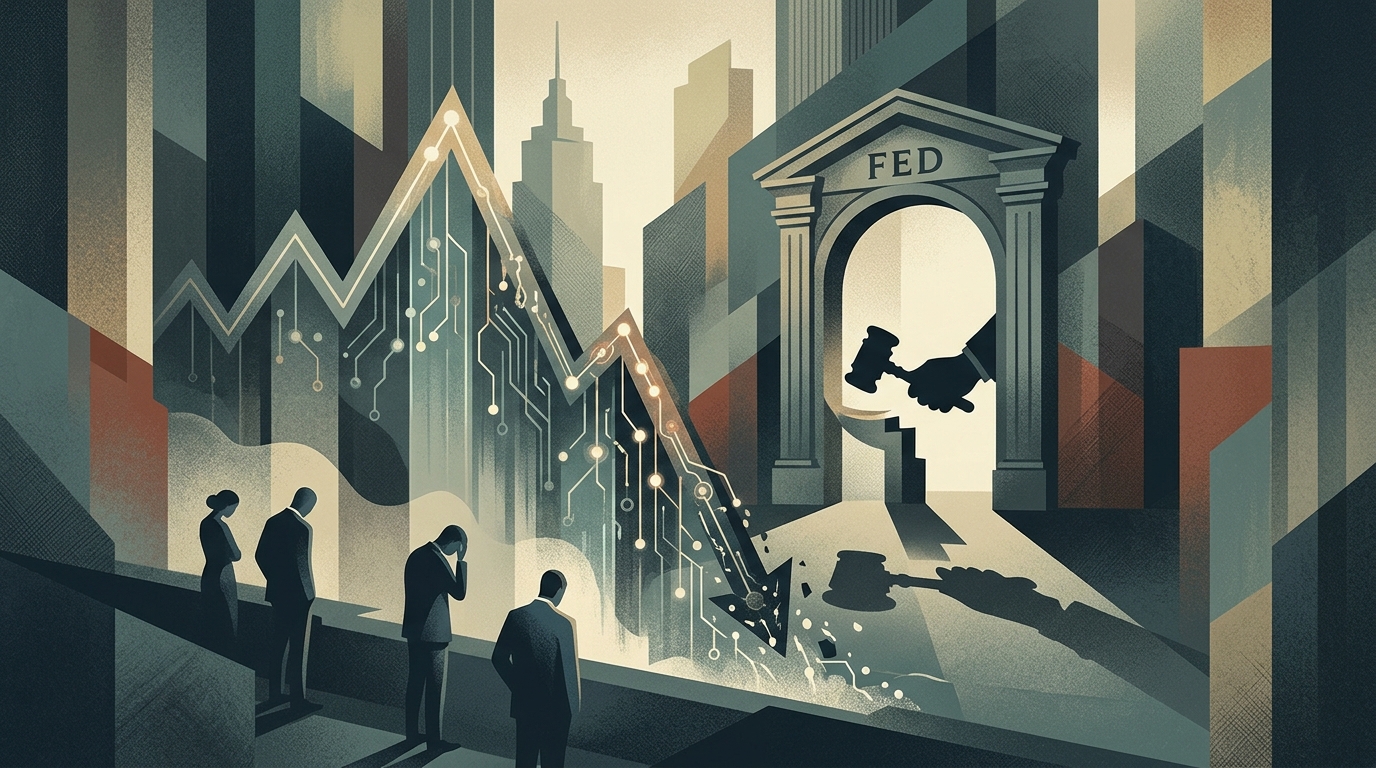
The promise was seductive: a digital brain, free from the shackles of fear and greed, capable of processing billions of data points in milliseconds, would revolutionize the world of investing. However, the reality of Wall Street and global markets in 2026 is proving far more nuanced. According to recent analyses from top investment executives, Artificial Intelligence (AI), while unbeatable at data processing, remains a remarkably "lousy" fund manager when tasked with making strategic decisions under conditions of true uncertainty.
The Rearview Mirror Trap and Overfitting
The fundamental problem with AI models in investment is their structural dependence on the past. Machine learning models are trained on decades of historical data, searching for patterns that repeat. But markets are not a closed system like chess or Go. They are a dynamic, chaotic environment where "tomorrow" rarely looks like "yesterday." When a "black swan" event occurs—be it a geopolitical crisis in the Middle East or a sudden pivot in central bank policy—AI often freezes or reacts erratically.
Analysts point to the phenomenon of "overfitting." AI becomes so adept at explaining what happened in the past that it loses the ability to predict structural shifts in the future. In its attempt to find logic within the noise of the data, it constructs correlations that have no real economic basis, leading to investment strategies that crumble at the first sign of a regime change in the markets.
The Paradox of Uniformity and the Death of Alpha
Another critical issue is the mass adoption of similar algorithms by major investment houses. If every fund manager is using variations of the same Large Language Model (LLM) or the same quantitative framework to analyze the markets, the competitive advantage vanishes. What economists call "Alpha"—the ability to outperform the market benchmark—becomes an impossibility when the "collective intelligence" of machines leads to identical trades.
This uniformity also creates systemic stability risks. When algorithms simultaneously identify a sell signal, they can trigger "flash crashes" as liquidity evaporates in seconds. The lack of heterogeneity in decision-making, which was traditionally ensured by the diversity of human judgment, makes the financial system significantly more brittle and prone to cascading failures.
The Intuition Gap and the Human Element
Investing, at its core, is a social science rooted in human psychology. AI can analyze a balance sheet with surgical precision, but it cannot "read the room" during a CEO’s earnings call, nor can it grasp the subtle political undertones of a closed-door meeting in Brussels. Intuition, often described as the ability to synthesize disparate and unstructured information, remains an exclusively human prerogative.
Furthermore, AI suffers from the well-documented problem of "hallucinations." In the financial world, a single piece of fabricated information generated by a model can result in billion-dollar losses. Fund managers who blindly trusted AI found that machines often misinterpret nuance, irony, or the ethical dimensions of corporate decisions—factors that long-term investors know are crucial to a company's terminal value.
Conclusion: The "Centaur" as the Only Path Forward
The failure of AI to dominate as an autonomous fund manager does not render it useless. On the contrary, the industry is moving toward the "Centaur" model: the combination of a machine's computational power with a human's critical thinking and ethical judgment. AI is an extraordinary assistant, a tireless data analyst, but a dangerous captain. For investors, the lesson of 2026 is clear: technology can augment performance, but responsibility and strategic foresight cannot—yet—be automated.