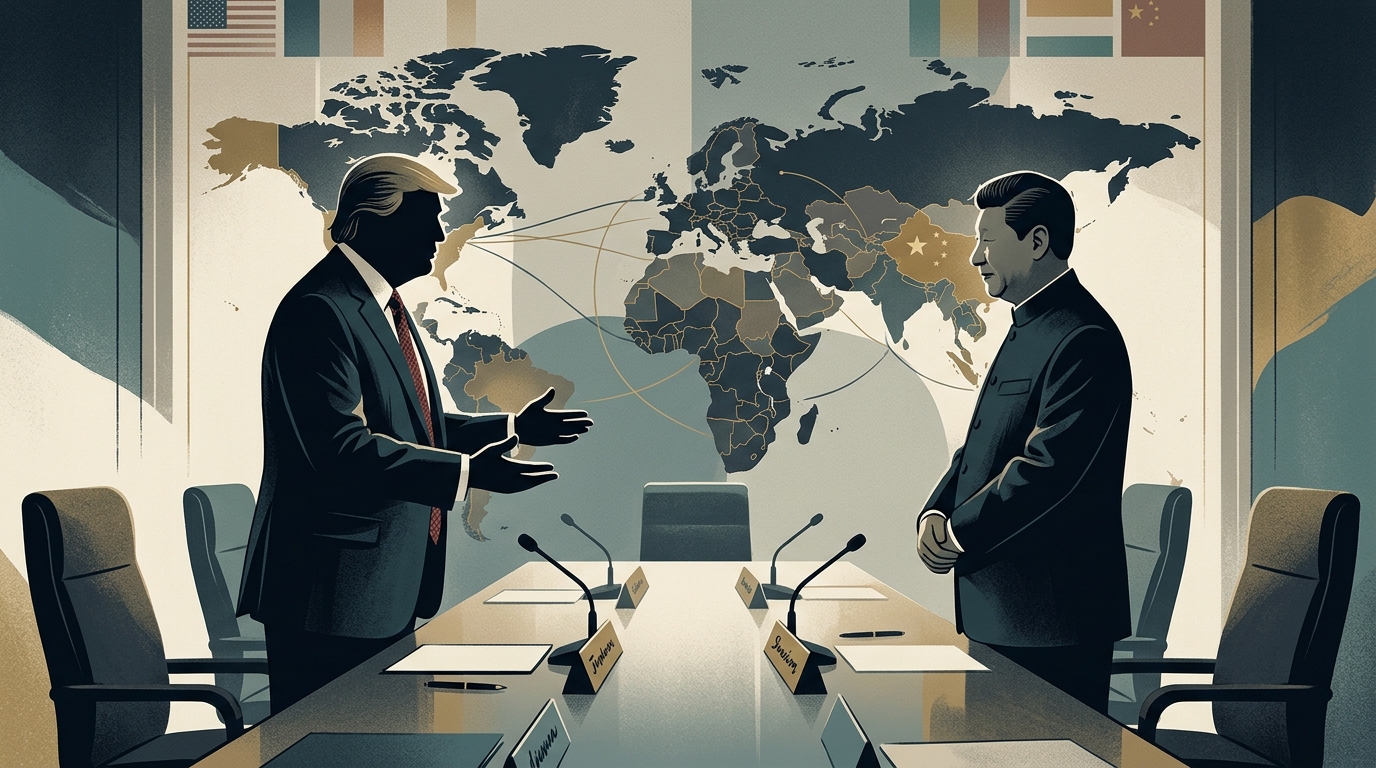
As we navigate through 2026, the global geopolitical chessboard remains locked in the aftermath of decisions made nearly a decade ago. The "historic" meeting between Chinese President Xi Jinping and then-U.S. President Donald Trump in Beijing stands as the quintessential reference point for understanding the transition from an era of globalized cooperation to one of "strategic competition." It was a moment where the roses of diplomatic courtesy in the inner sanctum of Chinese leadership could not conceal the thorns of deep structural rifts.
The Symbolism of the Forbidden City
Trump's reception in the Forbidden City in 2017 was more than a gesture of hospitality. It was a calculated display of power by Xi Jinping, intended to show that China had returned to the world stage as a peer superpower. For the first time in the history of the People's Republic, a foreign leader dined within the walls of the palace of the Ming and Qing emperors. The symbolism was clear: China was no longer the "poor relation" of the West, but a cultural and economic titan demanding parity.
However, behind the camera flashes, the agenda was heavy. Trump, with his "America First" rhetoric, pushed for a reduction in the trade deficit, while Xi sought to ensure that China's rise would not be derailed by American sanctions. That meeting laid the groundwork for what we now call "de-risking" or "decoupling," as it became evident that the two economies had fundamentally conflicting interests in high technology.
The Taiwan Thorn and the Shadow of AI
While the 2017 discussions centered on steel and soybean trade, the true "thorn" remained Taiwan. Today, in 2026, we see that the tension surrounding the island is not just about sovereignty, but about controlling the production of the world's most advanced semiconductors. The Xi-Trump summit demonstrated that China would not budge on its "red lines," despite pressures for trade deals.
"History will remember this moment not for the agreements signed, but for the mutual realization that competition is the new normal," noted Beijing-based analysts.
The rise of Artificial Intelligence has added a new layer of complexity. China, through the "Made in China 2025" plan which was a hot topic at the time, laid the foundations for its technological autonomy. The U.S., on the other hand, began a race to restrict Beijing's access to critical algorithms and hardware—a policy that continues with unabated intensity today.
Boeing's Small Basket and Aerospace Sovereignty
A central point of the meeting was the promise of massive aircraft orders from Boeing. It was China's "bait" to appease Trump's focus on trade numbers. However, the "basket" ultimately proved to be small. China used the time gained to accelerate the development of its own aircraft, the C919, which by 2026 is directly competing with American and European models in its domestic market.
- Boeing saw its market share in China shrink due to geopolitical frictions.
- China proved it could use commercial orders as diplomatic leverage.
- The technology transfer demanded by Beijing became the "bone of contention" for American industries.
In conclusion, the Xi-Trump summit was the final act of an era where "grand deal" diplomacy still seemed possible. Today, at the dawn of a new technological revolution, the two superpowers are on a collision course that began at those dinners in the Forbidden City. History teaches us that the "roses" of diplomacy are often fleeting, while the "thorns" of national interest are what truly carve the path to the future.