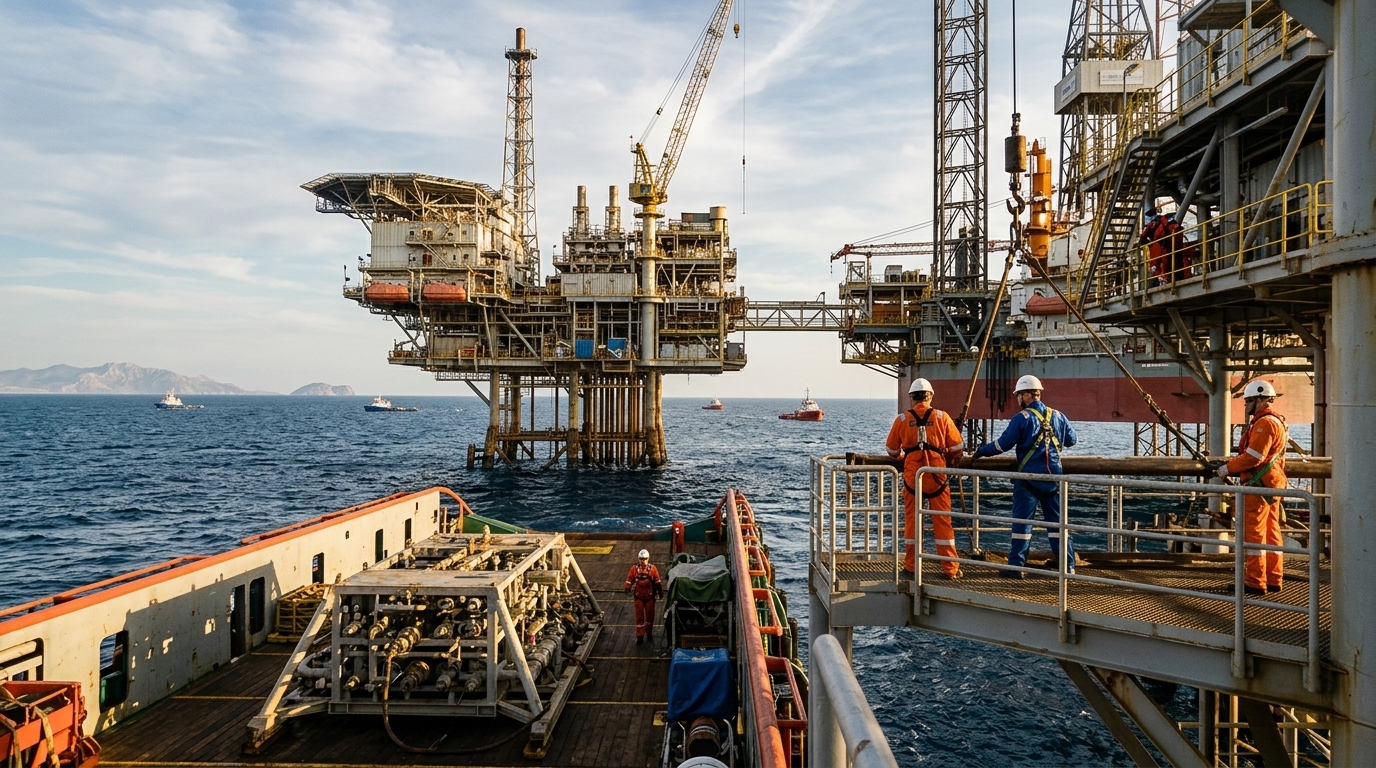
Geography has always been Greece's destiny, but at the dawn of the third decade of the 21st century, this geography translates into something much more tangible: energy power. Recent focus by the international press, from the Financial Times to Bloomberg, on Chevron’s moves in the Eastern Mediterranean and Greece is no coincidence. Following Russia’s invasion of Ukraine, Europe is desperately seeking alternative supply routes, and Athens appears to hold the keys to a new gateway.
The Strategic Return of American Giants
Chevron's presence in the region is not merely a business move; it is a geopolitical statement. The American giant, already maintaining a strong foothold in Israel’s Leviathan and Tamar fields, views Greece as the natural extension of the supply chain toward the heart of the Old Continent. Discussions regarding the exploitation of Greek offshore blocks, combined with ExxonMobil’s presence south and west of Crete, create a "wall" of American interests that shields the Greek Exclusive Economic Zone (EEZ).
According to analysts, Chevron is not only interested in extraction. Its interest extends to infrastructure. Greece, through the FSRU terminal in Alexandroupolis and pipelines like the IGB (Interconnector Greece-Bulgaria), now functions as the central distributor for the Balkans and Central Europe. This "Vertical Corridor" allows natural gas to flow from south to north, breaking the old monopoly of Gazprom.
The Role of Alexandroupolis and the 'Vertical Corridor'
Alexandroupolis has evolved from a regional port into a strategic reference point for NATO and the EU. The operation of the Floating Storage and Regasification Unit (FSRU) represents the culmination of years of effort. International investors see this city as the link that can supply not only Bulgaria but also Romania, Moldova, and even Ukraine in the future.
- The strategic importance of the Alexandroupolis FSRU for SE Europe.
- The interconnection of Greek infrastructure with the Central European grid.
- Chevron’s participation in regional LNG transport projects.
Chevron, recognizing this dynamic, seeks to integrate its production from the Eastern Mediterranean into this network. The American group’s "Gas-to-Europe" strategy inevitably passes through Greek territory, making Athens an indispensable interlocutor in Washington and Brussels.
Geopolitical Challenges and Relations with Turkey
Of course, Greece’s emergence as an energy hub does not occur in a vacuum. Turkey closely monitors the moves of Chevron and ExxonMobil, often challenging the sovereign rights of Greece and Cyprus. However, the presence of American companies of this magnitude acts as a deterrent. "Drilling diplomacy" has reached a new level: it is no longer just a bilateral dispute but a matter of protecting Western energy routes.
"Greece is no longer Europe's problem, but part of its solution," a Chevron executive recently noted, highlighting the paradigm shift.
In conclusion, Greece's position on the energy map is strengthened by the convergence of business interests and geopolitical necessity. Chevron is not just looking for profits; it is looking for stability. And in the turbulent region of the Southeastern Mediterranean, Greece offers the rarest currency: the reliability of an EU and NATO member state with modern infrastructure and a clear Western orientation.