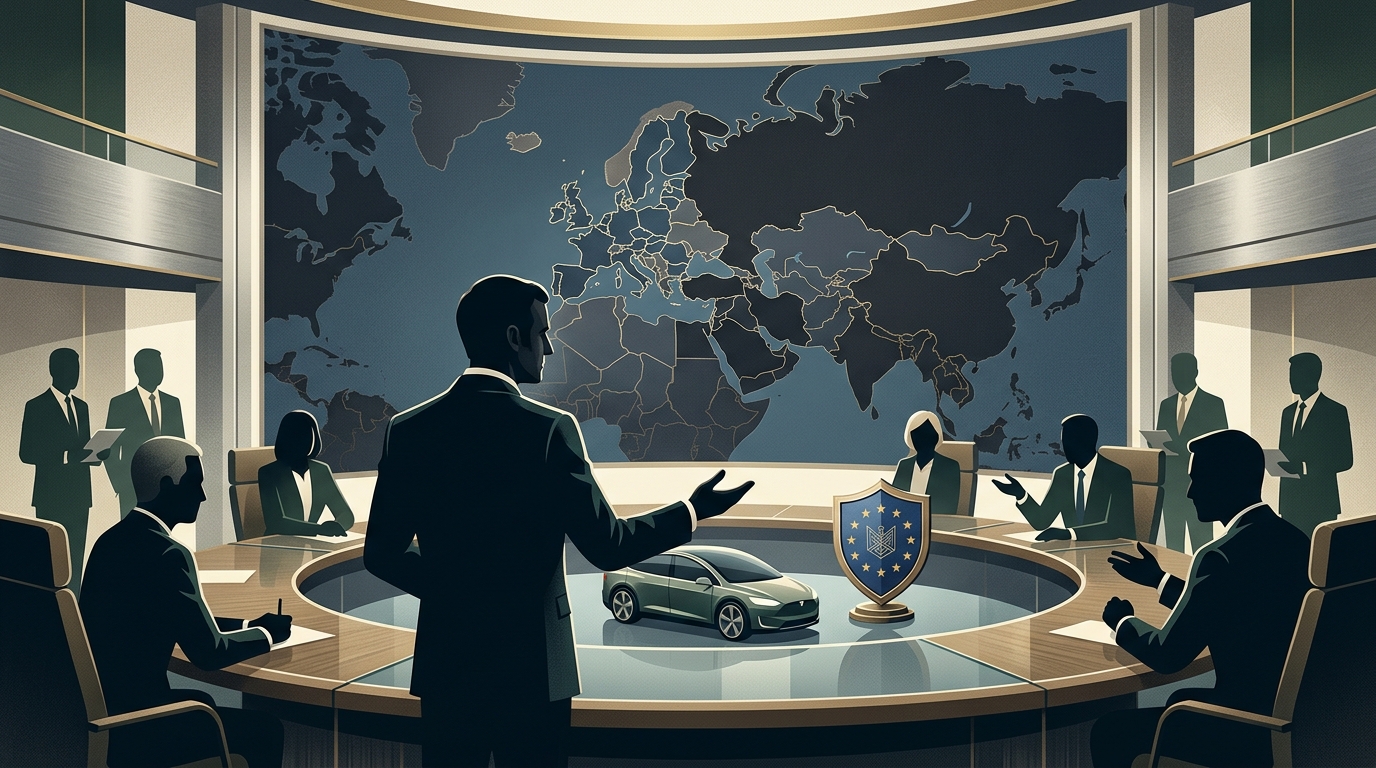
In a move that underscores a profound shift in European geopolitical strategy, French President Emmanuel Macron has raised the stakes by calling for the activation of the EU’s Anti-Coercion Instrument (ACI). This statement comes as a direct response to mounting concerns over potential new U.S. tariffs on European vehicles—a move that could destabilize the very foundations of transatlantic trade. Macron, a steadfast advocate for European "strategic autonomy," made it clear that the Continent can no longer remain a passive observer of the protectionist tides rising from Washington.
The ACI Mechanism: Trade’s "Nuclear Option"
The Anti-Coercion Instrument (ACI) is one of the most potent tools in the European Union's legislative arsenal. It was designed to allow the EU to retaliate when third countries attempt to pressure member states through economic restrictions. Should the U.S. proceed with unilateral tariff hikes, the ACI empowers the European Commission to impose countermeasures ranging from duties on American goods to restrictions on access to EU public procurement and capital markets.
Macron’s rhetoric is not merely a threat; it is a strategic positioning. The French President recognizes that the global order has fundamentally changed. The World Trade Organization (WTO) is in a state of paralysis, and traditional free trade rules are being superseded by "geoeconomics." In this environment, Europe must show its "teeth" to protect its industrial base, particularly in the vital automotive sector, which employs millions across the continent.
The Automotive Industry as a Geopolitical Pawn
Why cars? The automotive industry is the backbone of the European economy, especially for Germany, France, and Italy. The U.S. remains one of the largest markets for European premium vehicles. Any tariff increase would have devastating consequences for exports at a time when European manufacturers are already struggling with high energy costs and fierce competition from Chinese electric vehicles (EVs).
- German Vulnerability: German giants (BMW, Mercedes, VW) are the most exposed to a potential tariff conflict with the U.S.
- French Strategy: While France is less export-dependent on the U.S. in the auto sector than Germany, it views the issue as a matter of principle for European sovereignty.
- The U.S. Challenge: Following the Inflation Reduction Act (IRA), the U.S. has adopted an aggressive subsidy policy that favors domestic production, putting European partners at a disadvantage.
Beyond Economics: The Political Dimension
Macron’s intervention comes at a critical political juncture. With U.S. election cycles approaching and "America First" rhetoric remaining dominant across much of the American political spectrum, Europe is preparing for the worst-case scenario. The French President is attempting to rally European leaders, many of whom remain hesitant to openly clash with Washington.
"We cannot be the only region in the world that plays by the rules when no one else does," Macron has stated in the past—a sentiment that resonates strongly in the current crisis.
Activating the ACI would require a delicate balance. While the mechanism allows for swift reaction, the risk of a full-blown trade war is real. Such a conflict could lead to price hikes for consumers on both sides of the Atlantic and weaken the West at a time when the geopolitical challenge from China demands unity.
The Future of Transatlantic Relations
The question now is whether the EU will follow Macron’s lead. Germany, traditionally more cautious to avoid provoking retaliation that would hurt its exports, finds itself in a dilemma. However, the feeling that the U.S. is using its economic might as a weapon is gaining ground in Brussels. Macron is not just asking for tariffs; he is demanding a Europe that is treated as an equal partner, not a subordinate market. The outcome of this confrontation will determine not only the future of the automotive industry but also the shape of global economic governance for decades to come.