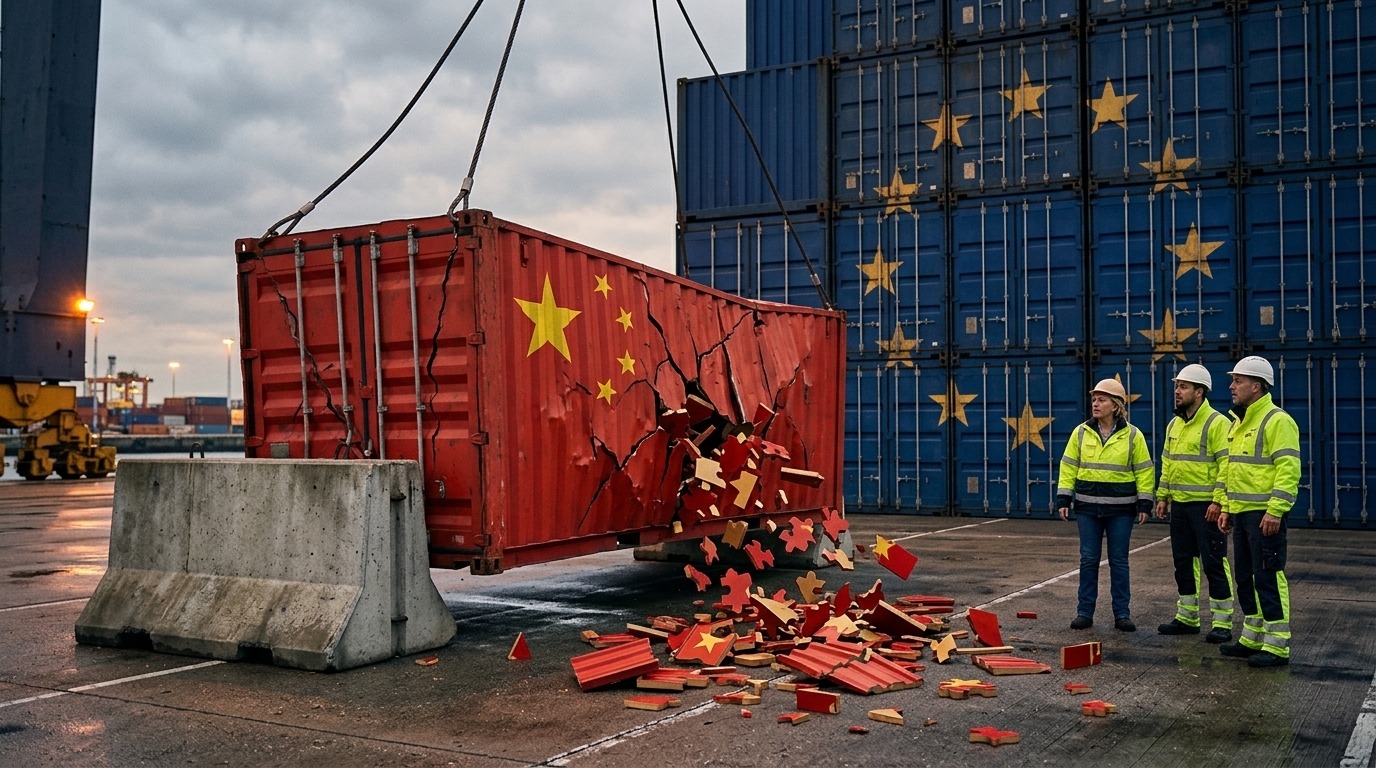
The era of 'trade innocence' for the European Union is effectively over. As we move through the first half of 2026, Brussels finds itself at a critical juncture, redefining its relationship with its second-largest trading partner: China. What began as a series of isolated anti-subsidy investigations is now evolving into a comprehensive strategy to curb Chinese economic expansion on the European continent.
The 'Flood' of Subsidized Goods and Brussels' Response
The primary point of friction remains China's industrial overcapacity. With domestic demand in China remaining sluggish, Beijing has funneled massive capital into high-tech production aimed at international markets. Europe, being one of the world's most open economies, has found itself in the crosshairs. From electric vehicles (EVs) and solar panels to wind turbines and medical devices, the Chinese presence is not just felt; it is dominant.
The European Commission, under the leadership of Ursula von der Leyen, has adopted the doctrine of 'de-risking.' This is not the full 'decoupling' advocated by certain circles in Washington, but an effort to reduce dependence on critical supply chains. New investigations launched in late 2025 and intensifying now focus on whether Chinese firms benefit from unfair state aid that allows them to sell below production costs, effectively strangling European competition.
The De-risking Strategy and Technological Sovereignty
The conflict is not merely commercial; it is deeply geopolitical. The EU has realized, perhaps belatedly, that the green transition—the cornerstone of European policy for the coming decades—risks becoming a hostage to Beijing. If solar panels, lithium batteries, and critical raw materials are controlled by a single power that often challenges Western values, then Europe’s 'strategic autonomy' remains a hollow phrase.
- Electric Vehicles: Tariffs imposed on Chinese EVs in 2024 and 2025 have already begun reshaping the market, forcing Chinese giants like BYD to invest in factories on European soil (e.g., in Hungary).
- Semiconductors and AI: The EU is tightening controls on dual-use technology exports, fearing that European expertise could be used to bolster China’s military capabilities.
- Public Procurement: For the first time, the EU is using the International Procurement Instrument (IPI) to restrict Chinese companies' access to European tenders, responding to the exclusion of European firms from the Chinese market.
Internal Rifts: Berlin vs. Paris
Despite the tough rhetoric from Brussels, the Union remains internally divided. France, a traditional proponent of protectionism and 'Fortress Europe,' is pushing for even harsher measures. Conversely, Germany appears hesitant. The German automotive industry (Volkswagen, Mercedes, BMW) remains deeply exposed to the Chinese market, both in terms of sales and production. A full-scale trade war could deal a decisive blow to German exports at a time when the country's economy is struggling to recover.
"We cannot build a green industry in Europe if we allow our base to be destroyed by subsidized imports," Commission sources state, while Beijing warns of retaliation in the agricultural and luxury goods sectors.
Beijing Strikes Back: The Retaliation Tactic
China is not a passive observer. Having already launched anti-dumping probes into European pork and brandy, Beijing is sending a clear message: every tariff will have its price. The targeting is deliberate. By hitting agricultural products, China targets specific political sensitivities in member states like Spain and France, attempting to fracture the European front. Furthermore, China holds the 'nuclear option' of rare earth elements, which are essential for every technological application, from smartphones to weapons systems.
In conclusion, the EU-China relationship is entering a phase of 'systemic rivalry.' The days when trade was viewed as a neutral space of mutual gain are gone. From now on, every trade deal will be weighed against national security and the strategic survival of European industry. The challenge for Brussels is to find the middle ground: protecting its market without triggering a global wave of protectionism that would make the green transition financially unfeasible.