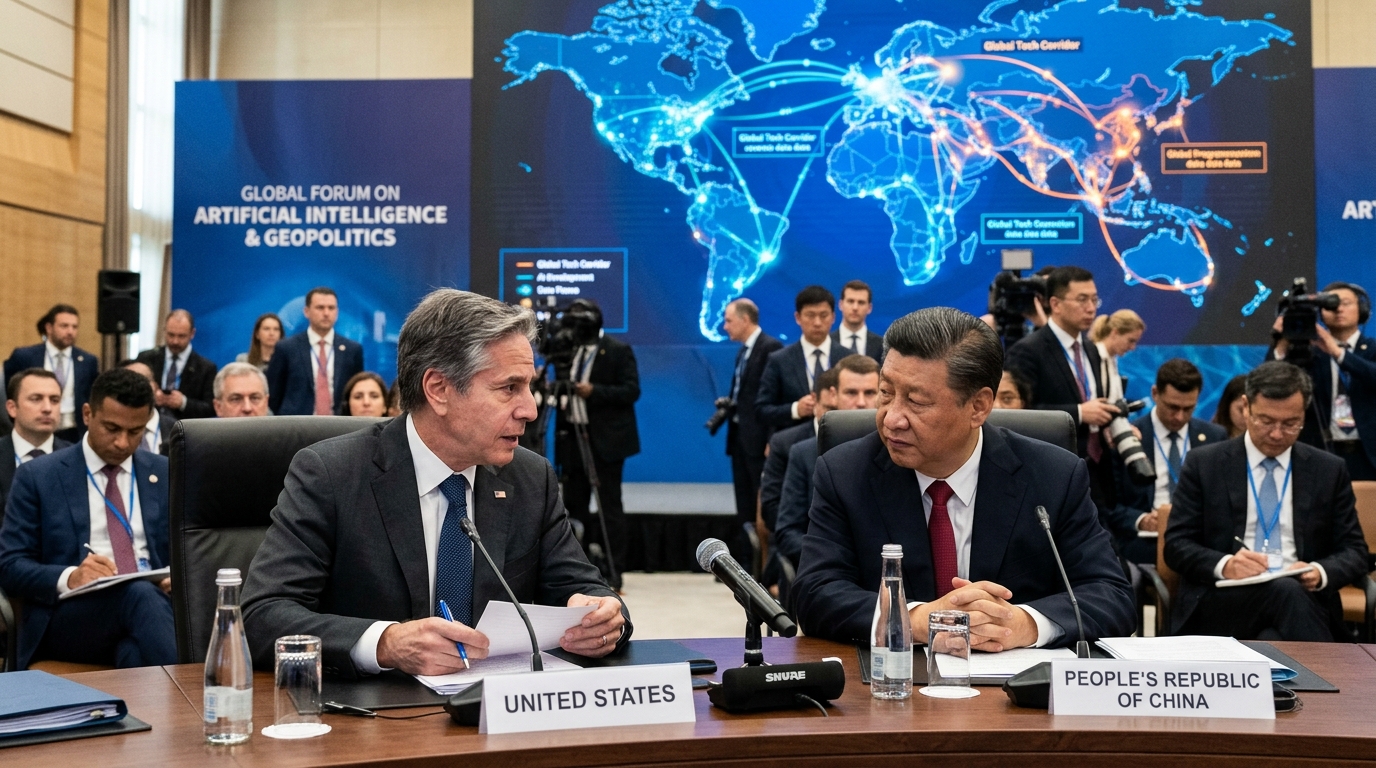
The global AI chessboard is trembling following the latest developments from Beijing, as DeepSeek announced the release of V4, a behemoth model boasting 1.6 trillion parameters. This achievement is not merely technical; it is profoundly political. DeepSeek V4 was trained and is executed entirely on Huawei infrastructure, utilizing domestic Ascend processors, completely bypassing any reliance on American NVIDIA chips. This news arrives at a moment when the U.S. government is escalating its rhetoric, directly accusing DeepSeek and other Chinese firms of systematic intellectual property (IP) theft from Western giants like OpenAI and Google.
A Technological Breakthrough: 1.6 Trillion Parameters on Chinese Silicon
DeepSeek V4 employs a sophisticated Mixture-of-Experts (MoE) architecture, which allows the model to maintain massive knowledge capacity without requiring the simultaneous activation of all its parameters. This approach is critical for efficiency, especially when the hardware being used—in this case, Huawei’s Ascend 910C processors—is still considered by many analysts to be inferior to NVIDIA's flagship H100 and B200 chips. However, DeepSeek's success suggests that software optimization can bridge the hardware gap.
Initial reports indicate that V4 competes directly with GPT-4o and Claude 3.5 Sonnet in complex coding, mathematics, and reasoning tasks. The fact that China has managed to reach this level of scale while under the strictest export controls in history sends a loud message to Washington: the 'technological iron curtain' the U.S. is attempting to build may already have significant cracks.
Allegations of IP Theft: A Clash of Narratives
While DeepSeek celebrates, the U.S. Department of Justice and the Department of Commerce are firing salvos. According to recent reports, there are strong indications that Chinese AI firms have used 'model distillation' techniques and extensive data scraping from Western platforms to train their own systems. The allegation is clear: China isn't just innovating; it is 'borrowing' the sweat and billions in investment from Silicon Valley.
- Use of GPT-4 outputs to train Chinese models.
- Reverse engineering of optimization algorithms.
- Illicit access to closed datasets through cyber operations.
DeepSeek categorically denies these allegations, maintaining that its progress is built on open research and unique architectural innovations. However, geopolitical pressure is mounting, with the U.S. government considering further restrictions on the use of cloud services by Chinese entities to prevent access to American compute power.
Huawei as the New Pillar of Chinese AI
Huawei’s involvement in this feat is perhaps the most concerning element for Western strategic analysts. After being blocked from 5G networks and access to advanced chips, Huawei evolved into a national champion covering the entire value chain: from chip design to operating systems and AI platforms. The success of DeepSeek V4 on Huawei hardware proves that China is building a parallel ecosystem, completely decoupled from Western influence.
"We are not just seeing competition between companies, but a head-on collision between two different technological civilizations," notes an industry analyst.
In the future, the AI market may split in two. On one side, the Western bloc centered around NVIDIA and OpenAI, and on the other, the Chinese bloc with Huawei and DeepSeek. This 'digital bipolarity' will have massive implications for the global economy, security, and the ethics of artificial intelligence.
Conclusion: One World, Two Intelligences
The launch of DeepSeek V4 marks the end of American complacency. Whether this success is based on primary innovation or controversial practices, the result remains the same: China now possesses the tools to lead in the AI race. Washington must decide whether to continue its policy of exclusion or seek a new framework for coexistence, at a time when technology is moving faster than diplomacy. DeepSeek V4 is not just an algorithm; it is proof that knowledge, like water, always finds a way to bypass obstacles.