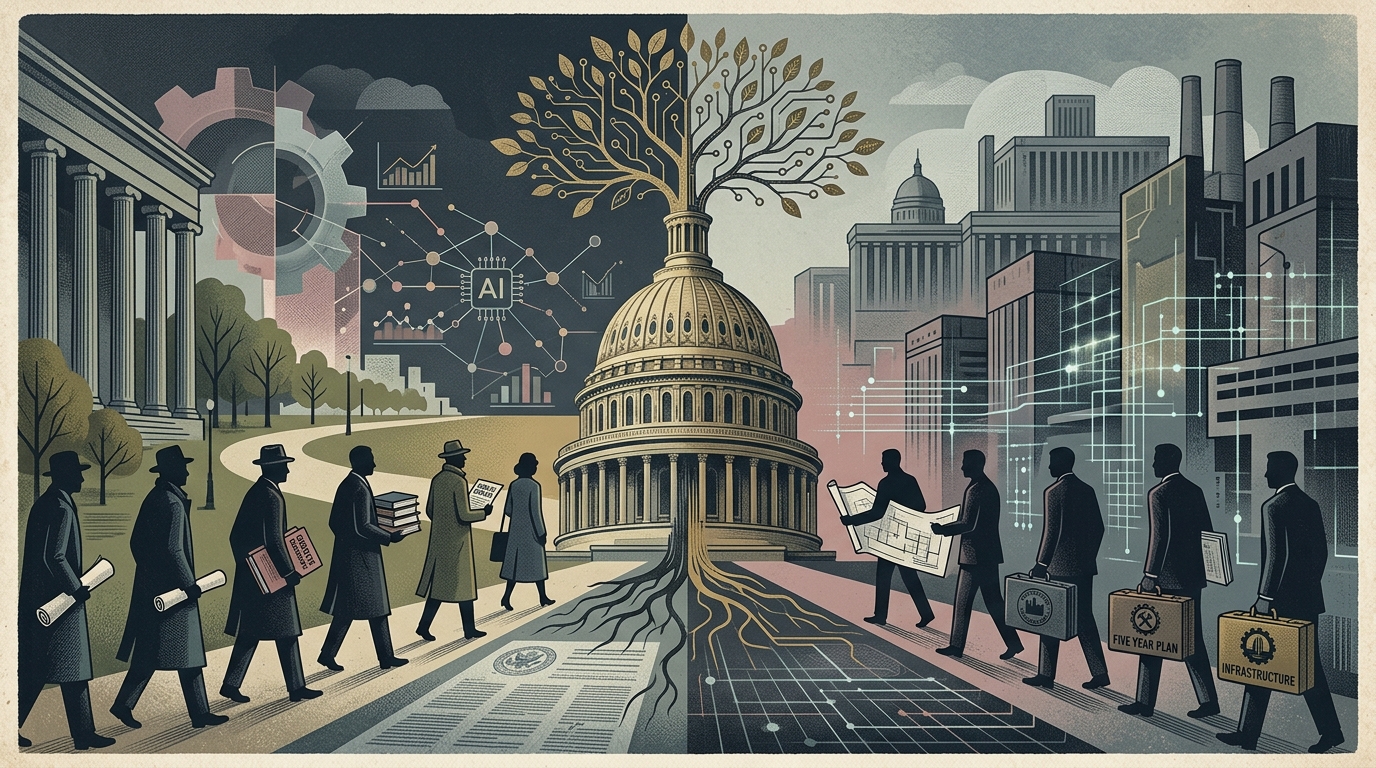
The global geopolitical chessboard of artificial intelligence has just been upended. DeepSeek’s announcement of its V4 model, fully optimized for Huawei’s Ascend chip architecture, is far more than a routine technical update. It is a bold declaration of technological sovereignty and a direct rebuttal to Washington’s efforts to throttle China’s access to high-end semiconductors. For the first time, we are witnessing a synergy of cutting-edge software and indigenous hardware capable of challenging Silicon Valley’s titans without relying on NVIDIA or AMD.
The Convergence of Software and Silicon: DeepSeek’s Strategy
DeepSeek, a firm that has already sent shockwaves through the industry with the efficiency of its V3 and R1 models, appears to have unlocked the “holy grail” of Chinese computing: achieving peak performance on theoretically inferior hardware. V4 utilizes a sophisticated Mixture-of-Experts (MoE) architecture, which allows the model to activate only the necessary subsets of its parameters for any given task. This approach is critical when the underlying hardware—in this case, Huawei’s Ascend 910C chips—faces power consumption and data transfer constraints compared to NVIDIA’s flagship H100s.
The close collaboration with Huawei allowed DeepSeek engineers to write code “close to the metal,” optimizing compute kernels specifically for the nuances of Chinese architecture. This level of vertical integration is reminiscent of Apple’s strategy, but applied on the scale of national industrial policy. The result is a model that not only rivals GPT-4 in benchmarks but does so at a fraction of the training and operational costs typically associated with such scale.
The End of the NVIDIA Monopoly and the Failure of Sanctions
For years, US strategy was predicated on the assumption that without NVIDIA’s GPUs, China’s AI progress would stall. The launch of DeepSeek V4 suggests this assumption may have been a strategic miscalculation. Instead of crippling Chinese innovation, sanctions acted as a catalyst for the creation of a parallel ecosystem. Huawei, once a telecommunications giant under siege, has transformed into the central pillar of Chinese sovereign compute.
Analysts note that V4 is not merely an academic exercise. It is a production-ready solution for Chinese enterprises and government agencies, offering a secure and domestic alternative. This means the “Silicon Curtain” is now a physical and digital reality. The global AI market is splitting: a Western ecosystem built on NVIDIA and CUDA, and a Chinese ecosystem built on Huawei and DeepSeek. The balkanization of technology is no longer a future risk; it is the current state of play, with profound implications for international AI safety cooperation.
Geopolitical Implications: The Battle for the Global South
This development carries immense weight for technological diplomacy. Many nations in the Global South, wary of over-dependence on American platforms or lacking the budget for Silicon Valley’s premium pricing, may find the DeepSeek-Huawei combination an attractive alternative. China is now positioned to export not just its ideology, but a complete AI stack that is cheaper, more accessible, and free from Western “alignment” constraints.
Furthermore, the success of V4 challenges the efficacy of future restrictions. If China can produce top-tier models with current-generation domestic chips, the pressure for even stricter controls on lithography equipment (such as ASML’s machines) will intensify. However, there is a risk that the US is already too late. DeepSeek’s ability to innovate at the algorithmic level compensates for hardware shortcomings, creating a new paradigm where intellectual ingenuity outpaces raw FLOPS.
Conclusion: A New Era of Competition
DeepSeek V4 on Huawei silicon marks the dawn of a new era. It is no longer a question of whether China can catch up to the West, but how it will surpass it using a different set of tools. The battle for AI supremacy will not be decided solely in California’s laboratories, but in the production lines of Shenzhen and the data centers running code optimized for survival under blockade. The West must now re-evaluate its strategy, as the monopoly on innovation has officially become a relic of the past.