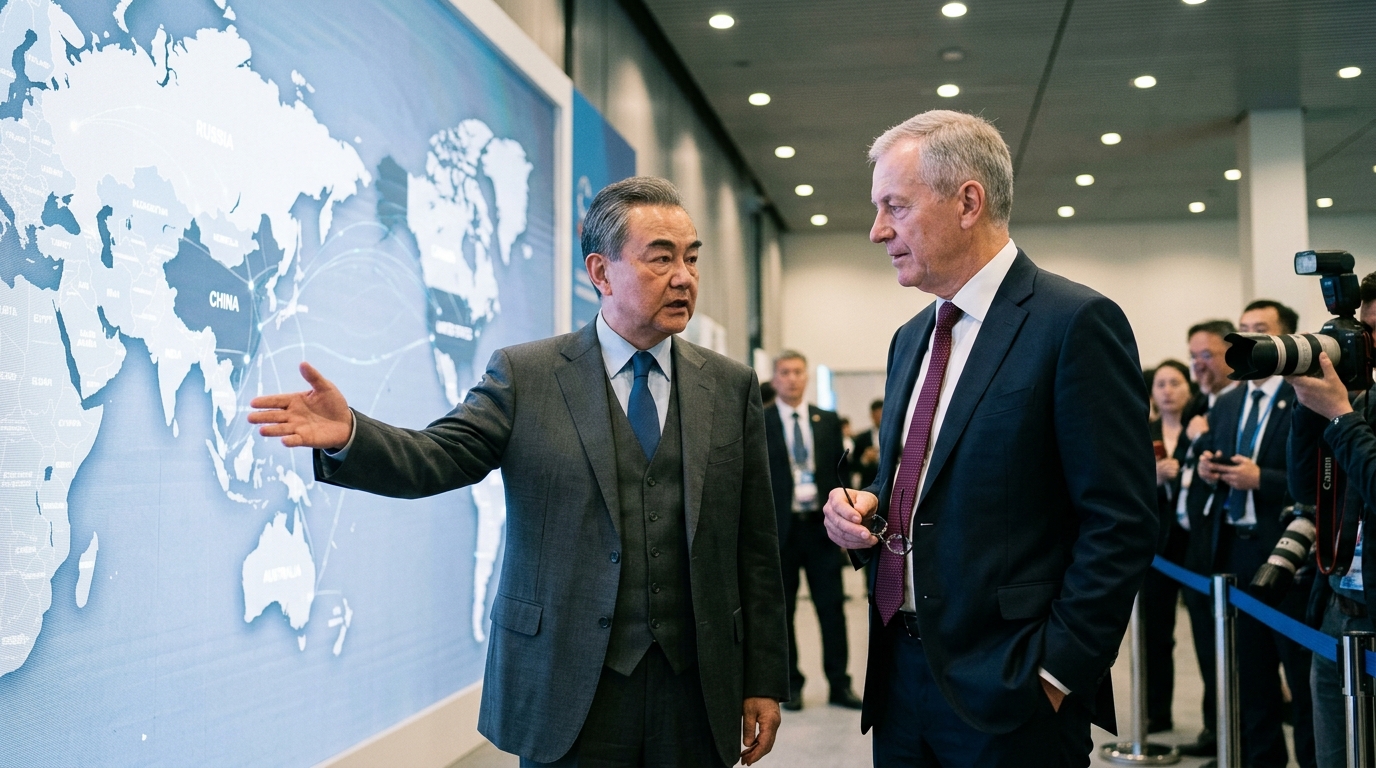
In the heart of Geneva, away from the spotlight but under the weight of a historic responsibility, the two superpowers of the 21st century, the United States and China, sat at the same table to establish the rules of a game that has yet to be fully defined. Artificial Intelligence (AI) is no longer a mere field of technological innovation or corporate profitability; it has transformed into the ultimate geopolitical lever, capable of upending the global balance of power. The recent opening of a communication channel for AI on strictly political terms marks a shift from chaotic competition toward a necessary, albeit suspicious, coexistence.
The Convergence of Necessity and the Clash of Values
This initiative does not stem from a sudden spirit of friendship, but from a shared fear of losing control. As AI systems become increasingly autonomous, the risk of an algorithmic error triggering a military escalation becomes terrifyingly real. The US seeks to ensure that AI will never make the decision to use nuclear weapons, a position that Beijing appears to adopt, at least rhetorically. However, beneath the surface of the safety agreement lies a deep ideological abyss.
For Washington, AI must be developed within a framework of democratic values, transparency, and human rights. For Beijing, technology is a tool for social stability, national sovereignty, and the consolidation of the Communist Party's power. This fundamental difference makes every "political term" of the agreement a battlefield for who will define the ethics of the future. Chinese officials insist that US semiconductor export restrictions are an obstacle to sincere cooperation, while Americans respond that national security is non-negotiable.
The Ghost of the Cold War and Digital Reality
Many analysts parallel these talks with arms control negotiations during the Cold War. But AI is far more complex than nuclear warheads. It is a dual-use technology that permeates every aspect of the economy and society. Creating an "AI red phone" is a positive step, but its effectiveness is questioned. How do you control something that evolves in seconds and whose code is often a "black box" even for its creators?
- The need for international standards in AI model safety.
- The role of private Big Tech giants that often possess more power than states.
- Avoiding autonomous targeting in armed conflicts.
- Protecting critical infrastructure from AI-enhanced cyberattacks.
China, through its Global AI Governance Initiative, is attempting to lead the Global South by offering an alternative development model that does not require the adoption of Western liberal values. This creates a multipolar digital world, where the US-China dialogue is not just about the two countries, but about which governance model will prevail globally.
The Economic Dimension and the Geopolitics of Chips
There can be no political dialogue on AI without mentioning the hardware. The battle for advanced semiconductors is the modern version of the battle for oil. The US uses its technological superiority as a diplomatic weapon, restricting China's access to Nvidia processors and lithography technologies. Beijing, on the other hand, is investing billions to achieve full self-sufficiency. The agreement for a communication channel may act as a pressure relief valve, preventing an all-out trade war that would paralyze the global supply chain.
"Artificial Intelligence is the new nuclear energy: it can light up the world or annihilate it. The difference is that this time, the switch is in the hands of algorithms that do not understand diplomacy," a senior UN official noted.
In this context, the move to open this channel is an acknowledgment that full decoupling is impossible and dangerous. The two countries are destined to compete and cooperate simultaneously. The bet is whether the "political terms" will be strong enough to restrain the momentum of technological evolution before it surpasses human crisis management capabilities.