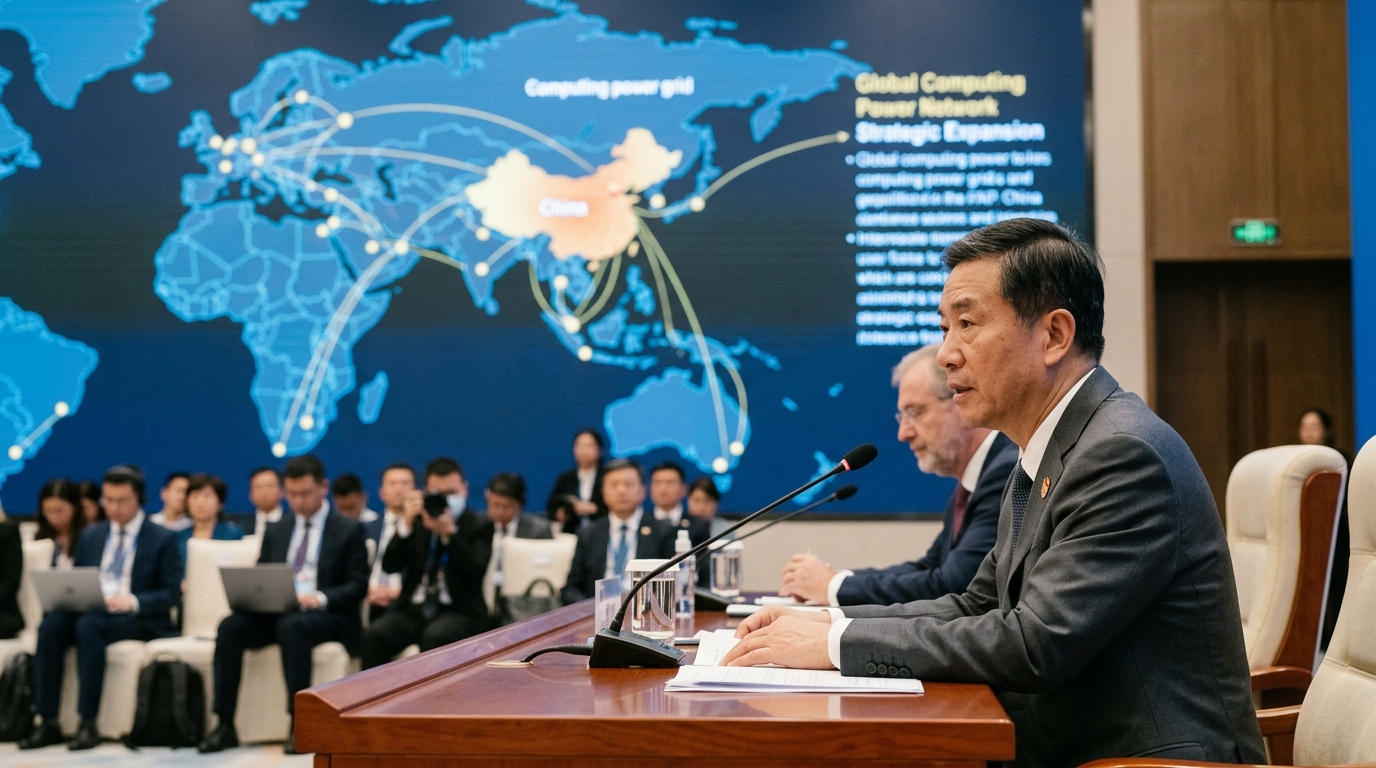
The global AI chessboard is undergoing a seismic shift as China implements its most ambitious infrastructure project to date: the complete unification and expansion of its national computing power network. As we move through 2026, the "East-to-West Computing" (Dongshu Xisuan) strategy has evolved from a theoretical blueprint into an operational reality, aimed at securing Chinese self-reliance in the face of persistent Western chip sanctions.
The Architecture of Digital Sovereignty
Beijing recognized early on that Artificial Intelligence is not merely a matter of algorithms, but primarily one of raw computing power and energy. The national network currently under expansion aims to funnel data from the economic hubs of the eastern seaboard—such as Shanghai and Shenzhen—to western provinces like Gansu and Inner Mongolia. In these regions, renewable energy is abundant and the cooler climate significantly reduces the costs of cooling massive data centers. This geographical redistribution is China's answer to the AI energy crisis currently straining Western economies.
"Computing power is to the 21st-century economy what electricity was to the 20th. Whoever controls the grid, controls the future," states a senior official from the National Development and Reform Commission (NDRC).
This expansion involves the establishment of ten national data hubs and dozens of computing clusters. The key here is not just quantity, but interconnectivity. Through ultra-high-speed fiber optics and novel data transfer protocols, China is attempting to create a "national computer," where processing power can be routed to where it is needed in real-time, much like electricity in a national power grid.
Scaling the Silicon Wall
The primary challenge for China remains the blockade on advanced chips from Nvidia and AMD. However, the expansion of the computing network reveals an alternative strategy: compensating for the lack of cutting-edge semiconductors through software optimization and massive parallel processing on domestic chips, such as Huawei’s Ascend series and Moore Threads' GPUs. While Chinese chips may lag in per-unit performance compared to their American counterparts, the Chinese government is betting that sheer scale and state-subsidized energy can bridge the gap.
- Investments in solar and wind farms dedicated exclusively to powering AI data centers.
- Development of domestic software frameworks that allow for model training across heterogeneous hardware (different chip types).
- State-mandated standards for data center interoperability, a level of coordination largely absent in the West's fragmented private sector.
Geopolitical Implications: A Bipolar AI World
China's move signals a definitive decoupling of technological ecosystems. If China succeeds in creating a functional, low-cost, and nationally unified computing network, it will offer an alternative development model for the "Global South." Countries participating in the Belt and Road Initiative may soon find themselves plugging into Chinese computing power, fostering a new form of digital dependency and diplomacy.
Furthermore, this unification allows Beijing to exercise absolute control over data and the trajectory of AI research. While AI development in the West is driven by capital markets and competition between giants like Microsoft and Google, in China, AI is treated as a public utility and a strategic weapon. Tech companies operate more as executive arms of state policy. This model of "State Capitalism in AI" will be severely tested in the coming years, as the inherent need for innovation often clashes with the state's need for control.
Conclusion
The expansion of China's computing network is more than an infrastructure project; it is a declaration of resilience. In a world where access to technology is wielded as a tool of foreign policy, China is building its own foundations. Whether sheer scale and state organization can triumph over the quality and free-market agility of the West remains the defining question of our decade.