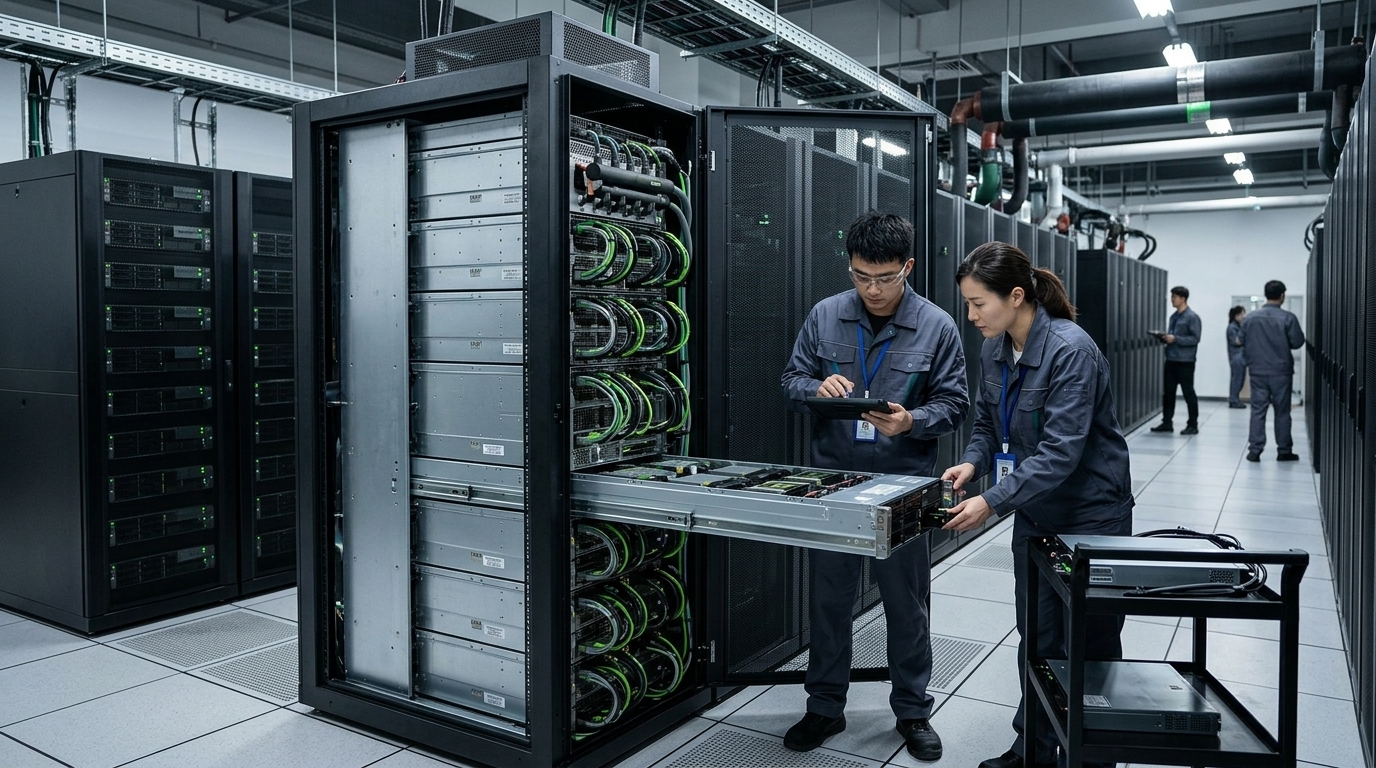
In the heart of the global technological race, China is experiencing a unique 'gold rush' where the precious metal has been replaced by silicon. Recent reports indicating that prices for Nvidia’s B300 servers have reached the staggering mark of $1 million within the country are not merely a financial anomaly; they are a symptom of a deeper geopolitical schism reshaping the 21st century. As Washington tightens its grip with export controls, the Chinese market is responding with a blend of desperation and ingenuity, fostering a secondary market where computing power costs more than ever before in history.
The Economics of Scarcity and the Black Market Premium
The surge in Nvidia server prices in China is not solely due to the technical superiority of the company's hardware, but primarily because of the artificial scarcity imposed by US sanctions. The Blackwell processors, specifically the B300 series, represent the cutting edge for training Large Language Models (LLMs). For Chinese tech giants like Alibaba, Tencent, and ByteDance, acquiring these systems is a matter of survival in the race for AI supremacy.
According to market analysts, the cost of a full server rack integrating the Blackwell architecture has skyrocketed due to the labyrinthine routes hardware must take to reach Chinese soil. Through intermediaries in jurisdictions like Singapore, the UAE, and Vietnam, servers are often transported disassembled or via shell companies, with each transit point adding a significant markup to the final price. The result is a price tag approaching $1 million—nearly double the official list price found in the United States.
The Geopolitical Chessboard: Washington vs. Beijing
The US strategy, led by the Department of Commerce, is clear: to deny China access to the high-end computing power necessary for developing AI for military and intelligence applications. However, reality on the ground suggests these restrictions are a double-edged sword. On one hand, they slow Chinese progress; on the other, they create massive incentives for the development of a domestic supply chain.
Beijing has already funneled billions into its 'Big Fund' to bolster domestic semiconductor production. Companies like Huawei, with its Ascend processor series, and Biren Technology, are striving to fill the void. While Nvidia remains the gold standard due to its CUDA software ecosystem, the pressure of high prices and supply uncertainty is forcing Chinese firms to adapt their code for domestic hardware—a move that could, in the long run, erode American technological hegemony.
Supply Chain Resilience and the Path Ahead
Despite the sanctions, the flow of Nvidia chips into China has not ceased entirely. The 'grey market' is thriving, and circumvention methods are becoming increasingly sophisticated. Nvidia, for its part, finds itself in a precarious position: it must comply with US law while simultaneously avoiding the loss of one of its largest global markets. The 'downgraded' versions specifically designed for China (such as the H20) do not seem to quench the thirst of Chinese AI labs, which prefer to pay the $1 million premium for top-tier hardware rather than compromise on performance.
In conclusion, the situation with Nvidia servers in China serves as a warning for the future of globalization. When technology is weaponized, market rules cease to apply, replaced by political expediency. The question is no longer whether China will achieve AI power, but at what cost and through which channels. The $1 million price tag is the cost of a world splitting in two, with a digital iron curtain rising over semiconductor production lines.