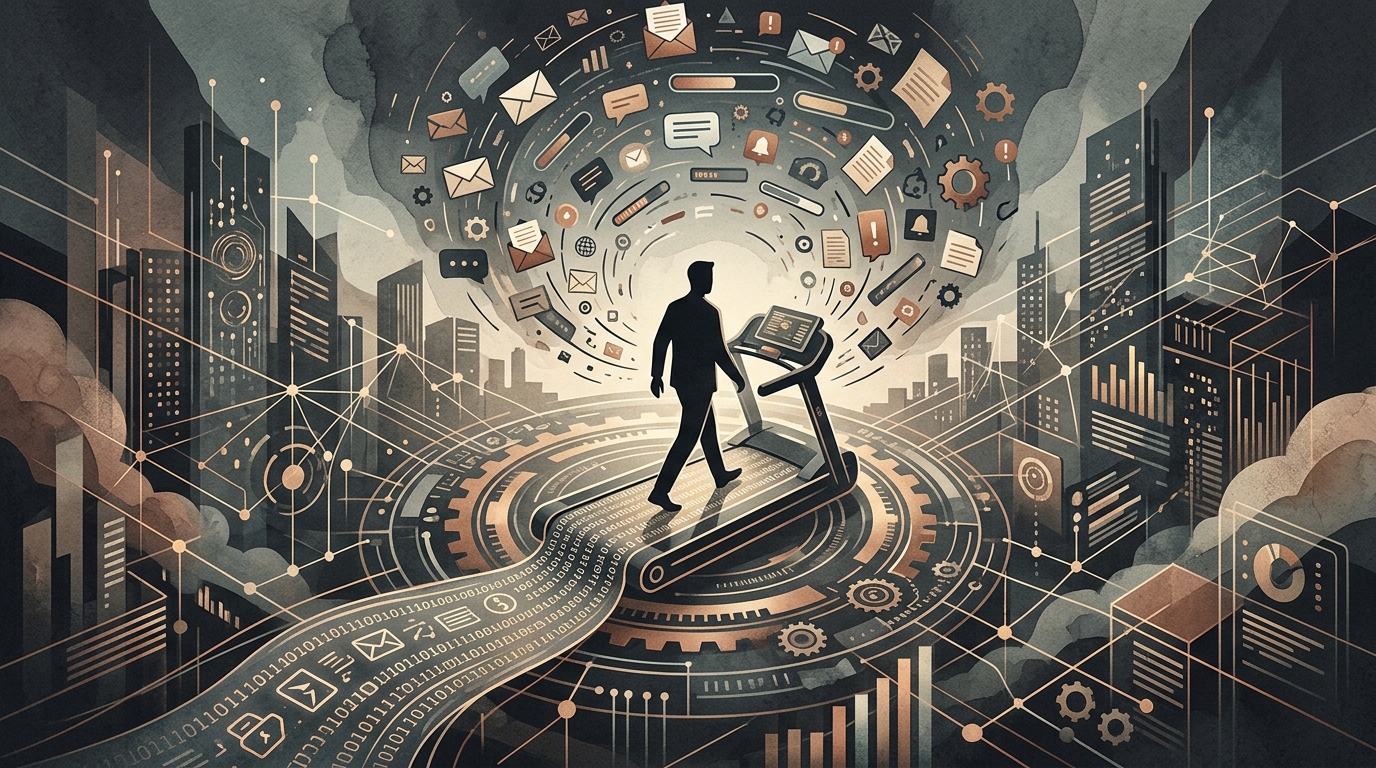
In the modern workspace, a paradox prevails that would make Sisyphus feel right at home. Despite possessing tools that should have decimated the time spent on mundane tasks, the average professional feels more overwhelmed than ever. It is not the core, creative labor that exhausts us, but the so-called "busywork"—the endless cycle of emails, Slack notifications, redundant meetings, and digital bureaucracy that now consumes an estimated 60% of our time.
The problem is not merely technical; it is structural and cultural. As highlighted by recent analysis in The New York Times, we have become trapped in a culture where "busyness" is frequently conflated with "productivity." Technology, instead of acting as a filter, has functioned as an accelerator for the information avalanche.
The Jevons Paradox in the Digital Age
In economics, the Jevons Paradox states that an increase in efficiency in the use of a resource tends to increase (rather than decrease) the rate of consumption of that resource. Applying this to labor: the easier it becomes to send a message or schedule a call, the more messages we send and the more calls we schedule. Ease of use has birthed communication inflation.
Three decades ago, sending a document required physical effort and deliberate thought. Today, the instantaneous nature of digital communication has lowered the barrier to entry so significantly that every trivial thought can be transformed into an "urgent" notification on a colleague's screen. The result? A fragmentation of attention that makes "deep work" nearly impossible.
"We are not drowning in work; we are drowning in the noise that surrounds the work."
The Promise and Peril of Artificial Intelligence
The advent of Generative AI is being marketed as the ultimate antidote. It promises to draft our emails, summarize meeting minutes, and organize our calendars. However, there is a profound risk: AI could become the greatest producer of busywork in human history. If content production becomes free and instantaneous, the volume of information we are required to manage will skyrocket.
- Automated Inflation: When AI can generate a 20-page report in seconds, managers may begin demanding more reports, not fewer.
- The Curation Trap: The time saved in drafting will be spent verifying and editing AI outputs—a task often more mentally taxing than original creation.
- Digital Noise: AI bots communicating with other AI bots will create an information ecosystem where humans become the bottleneck in processing, leading to further burnout.
The Need for a New Work Ethic
To escape this vicious cycle, we do not need more tools; we need fewer. We require a radical reassessment of what constitutes "work." Many forward-thinking organizations are already experimenting with "no-meeting Wednesdays" or the total abolition of internal email in favor of more asynchronous methods.
The solution lies in protecting the human psyche from digital fragmentation. We must accept that creativity requires "void time"—periods that are not filled with busywork. Political leaders and corporate executives must understand that an employee who answers 100 emails a day is not productive; they are simply an exhausted information traffic controller.
Ultimately, technology must serve the quality of our lives, not transform every spare second into an opportunity for micro-labor. The struggle against busywork is, in reality, a struggle to reclaim our autonomy and our attention in a world that is frantically trying to commodify both.