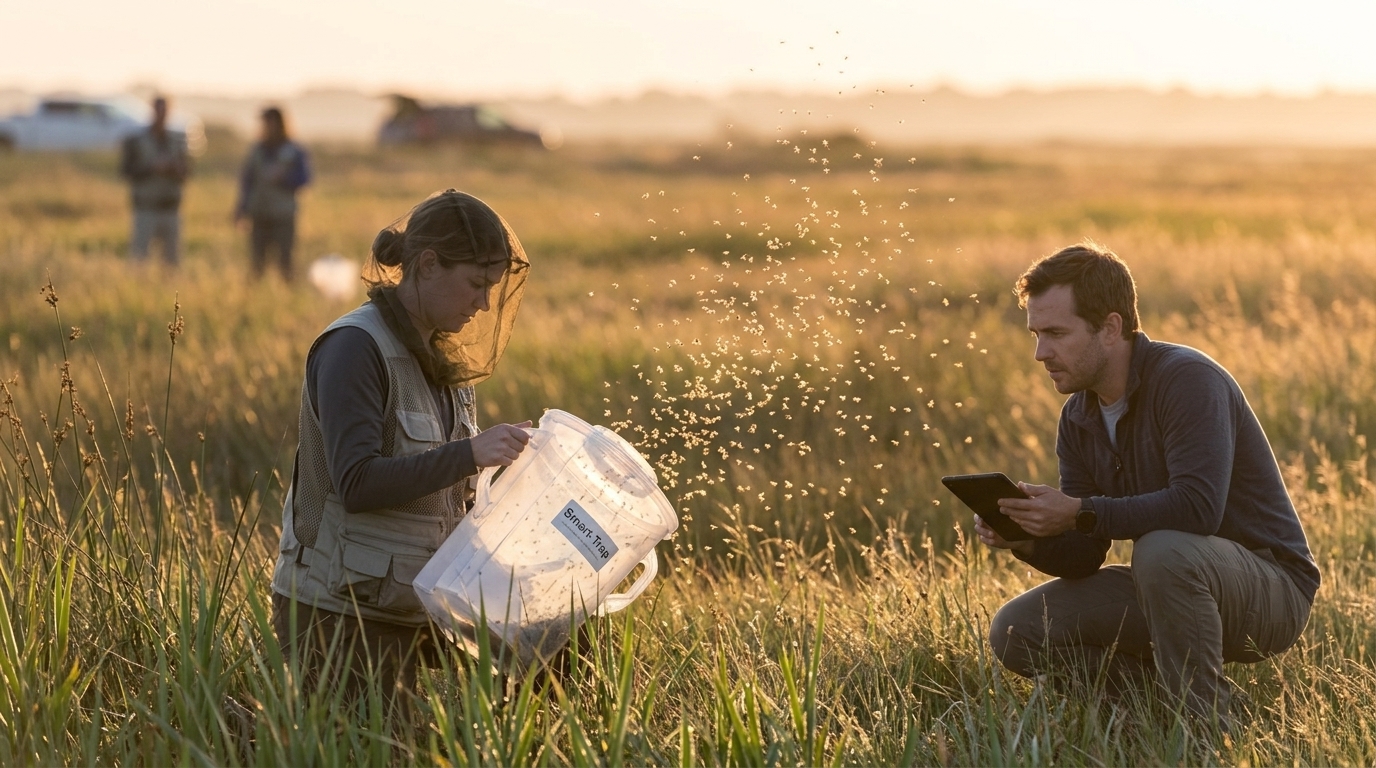
In the tech world, the term "debugging" traditionally refers to fixing errors in software code. However, for Alphabet, Google's parent company, this term is taking on a literal and profoundly ambitious meaning. Through its subsidiary, Verily Life Sciences, the tech giant has embarked on one of the largest biological experiments in U.S. history: releasing millions of laboratory-raised mosquitoes to eradicate deadly diseases.
The Science of Project Debug
The initiative, known as "Project Debug," targets the Aedes aegypti species, which is the primary vector for transmitting diseases such as Dengue fever, Zika virus, Yellow fever, and Chikungunya. Verily’s approach does not rely on genetic modification (GMO) but rather on a natural biological process called Cytoplasmic Incompatibility.
Company scientists infect male mosquitoes with a common bacterium called Wolbachia. When these males are released into the wild and mate with wild females (which do not carry the same strain of the bacteria), the resulting eggs never hatch. Since male mosquitoes do not bite humans, their release poses no public health risk but serves as an effective population control mechanism.
The Role of AI and Robotics
What sets Google’s efforts apart from similar academic experiments is scale and precision. Breeding and sorting millions of mosquitoes by sex is an incredibly labor-intensive process if done manually. This is where Alphabet’s computational expertise makes the difference.
- Automated Rearing: Verily has developed robotic systems that breed mosquitoes at an industrial scale, ensuring their health and fitness for survival in the wild.
- Computer Vision: Using advanced AI algorithms and high-resolution cameras, the system can identify and separate males from females with an accuracy rate exceeding 99.9%.
- Smart Release: Specially equipped vehicles traverse neighborhoods, using algorithms to calculate the exact number of mosquitoes to release at specific coordinates based on local population density and environmental data.
"Our technology allows us to transform a complex biological process into a scalable public health solution," Verily executives stated during recent briefings.
Results and Ecological Implications
Trials conducted in Fresno County, California, have shown remarkable results, with the population of biting female mosquitoes plummeting by over 95%. Despite this success, the project is not without its detractors. Ecological groups and some local residents have raised concerns about the long-term consequences of removing a species from the ecosystem.
However, scientists point out that Aedes aegypti is an invasive species in the United States, not native to the region, and does not serve as a critical link in the local food chain. Its removal from urban areas could save thousands of lives annually, particularly in the Global South where these diseases are endemic and often fatal.
The Future of Big Tech in Biotech
This move signals a broader shift as Big Tech companies pivot toward biology. Having conquered the digital realm, Google is now applying the principles of data processing and automation to the physical world. If Project Debug proves economically and operationally viable, Alphabet could become a dominant provider of public health services to governments worldwide, carving out a massive new market that merges technology with biosecurity. The era of "Software as a Service" is evolving into "Biology as a Service."