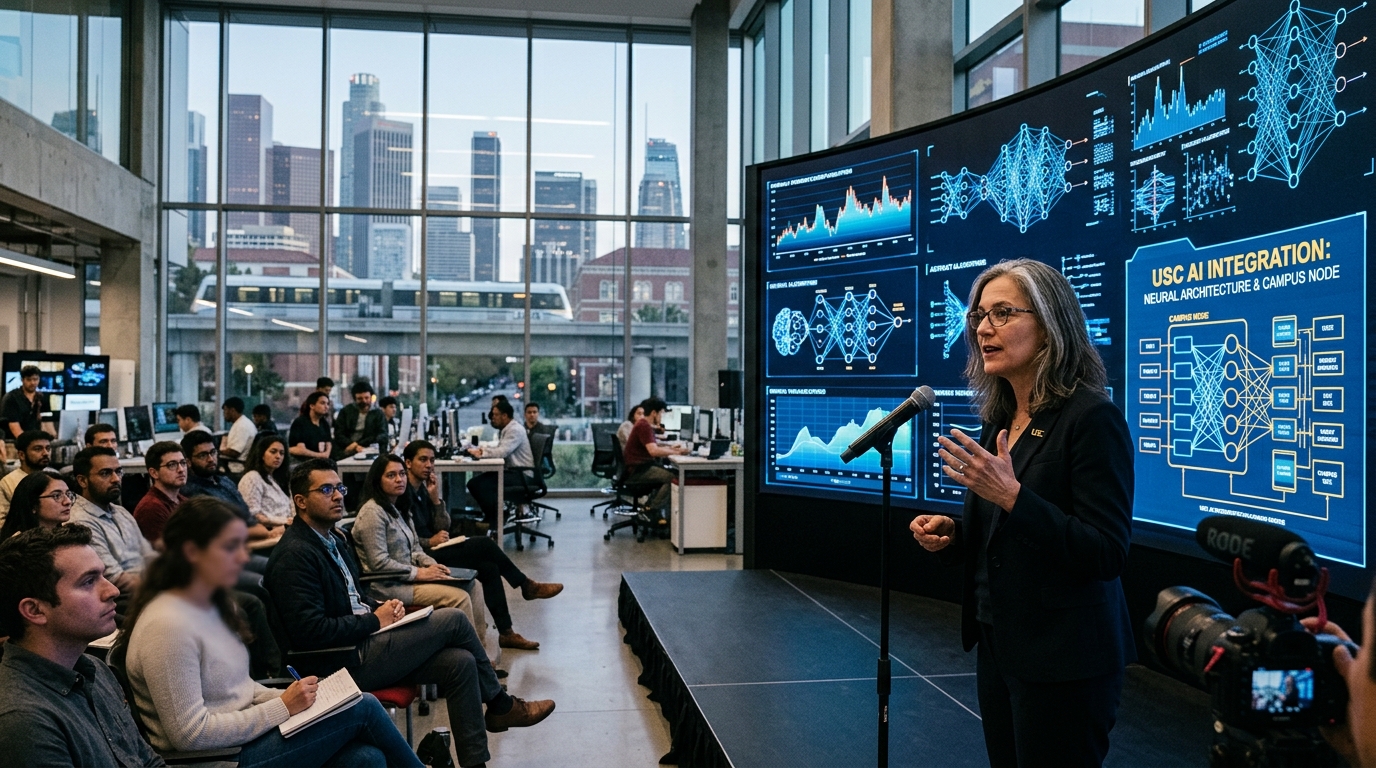
In an era where Artificial Intelligence (AI) is transitioning from an isolated technical field to the connective tissue of modern knowledge, the University of Southern California (USC) is making a move that reshapes the academic landscape. With a massive $200 million donation, the institution is embarking on an ambitious journey to infuse AI into every facet of its operations, from the humanities and arts to medicine and business administration.
This investment serves as the cornerstone of the "Frontiers of Computing" initiative, a program totaling over $1 billion, which aims to establish USC as a global leader in the ethical and responsible development of technology. This strategy isn't merely about purchasing supercomputers; it's about cultivating a new generation of "digitally literate" citizens capable of navigating a world where code and human creativity are inextricably linked.
The Frontiers of Computing Initiative and the New School
USC is not settling for superficial changes. The donation will fund the establishment of the School of Advanced Computing, which will serve as a central hub for interdisciplinary research. The goal is to hire at least 100 new faculty members over the coming years, many of whom will hold joint appointments: for instance, AI experts who simultaneously work within the School of Cinematic Arts or the Department of Philosophy.
This "cross-pollination" approach is critical. As USC President Carol Folt stated, AI should not be something that only happens in engineering labs. It must be a tool accessible to the history student analyzing thousands of ancient texts, the sociology student studying urban patterns, and the artist exploring new modes of expression. The $200 million gift, originating from the Lord Foundation, provides the necessary financial agility to realize this vision at a pace rarely seen in academia.
AI and Ethics: A Human-Centric Approach
One of the greatest challenges facing the integration of AI into education is the question of ethics. USC places a particular emphasis on developing "trustworthy" AI. In a world flooded with deepfakes, algorithmic bias, and privacy concerns, the university seeks to create a framework where technology is governed by human values.
- Developing algorithms that mitigate racial and social biases.
- Integrating ethics courses into all computer science curricula.
- Collaborating with the law school to shape the regulatory framework of AI.
USC's strategic location in Los Angeles—a city at the intersection of technology (Silicon Beach), entertainment (Hollywood), and biomedical research—gives it a unique advantage. Students won't just learn the theory of AI; they will participate in programs that apply these technologies to real-world industrial and societal problems.
The Competition for Talent and the Future of Work
USC's move is also a response to the fierce competition for talent between academic institutions and tech giants. With salaries in Silicon Valley reaching astronomical levels, universities often struggle to retain top researchers. The $200 million donation allows USC to offer competitive packages and, more importantly, the freedom to conduct research unburdened by the short-term profit motives of corporate shareholders.
"We are not just training programmers; we are shaping the leaders who will decide how technology serves humanity," the university administration emphasizes.
In conclusion, this investment by USC signals a shift toward an educational model where technology is ubiquitous but not an end in itself. It is the recognition that AI is now a core literacy, much like reading or writing, and that the mission of the modern university is to ensure this power is harnessed for the common good. The stakes are high, but with $200 million as a springboard, USC is charting the course for the 21st-century university.