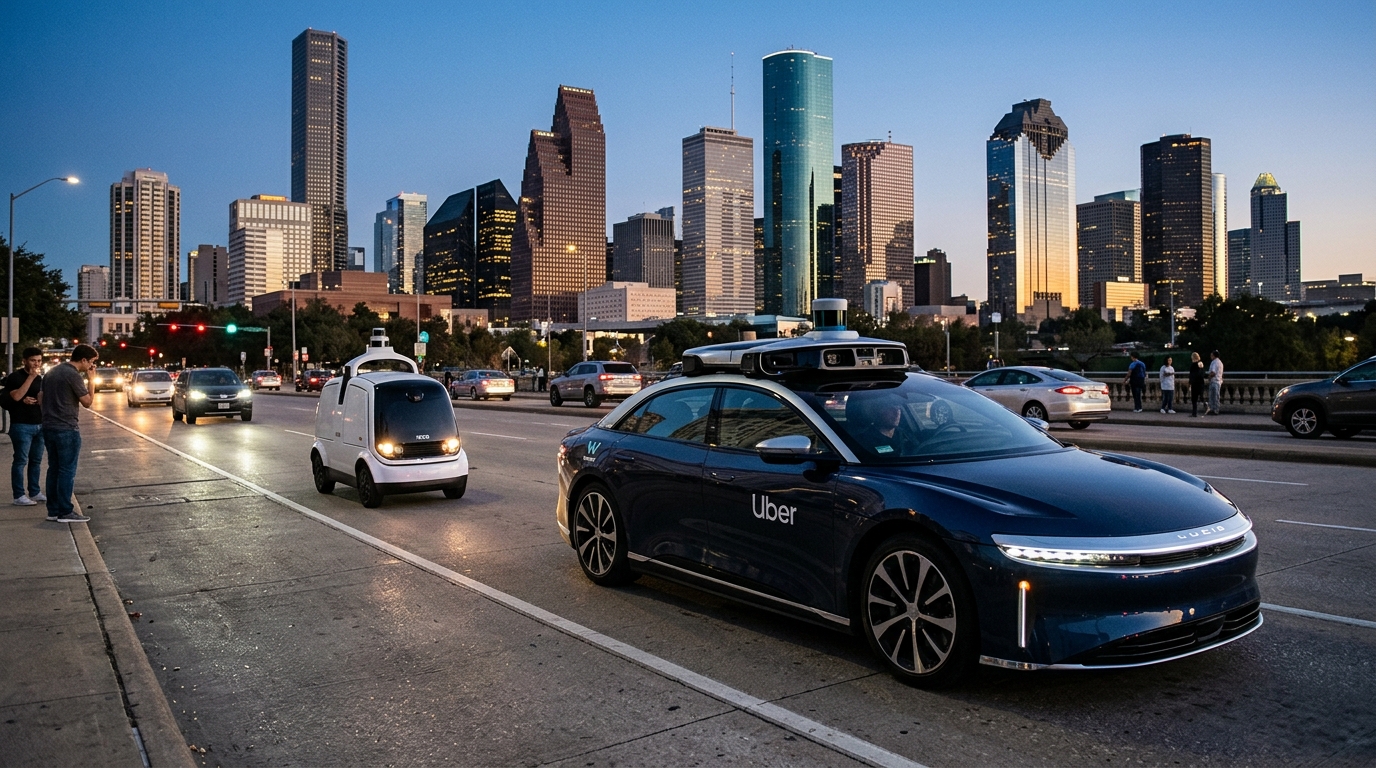
In a move that reshapes the map of autonomous mobility in the United States, Uber Technologies Inc. announced today a landmark strategic partnership with Lucid Group Inc. and Nuro Inc. The alliance aims to deploy and commercialize robotaxi services in Houston, Texas, the nation’s fourth-largest city. This development marks Uber’s most aggressive return to the autonomous driving sector since the company sold its own research and development arm (ATG) in 2020.
The Asset-Light Strategy and Uber’s Return
Uber is no longer attempting to build its own autonomous car from scratch. Instead, it is adopting an "asset-light" model, functioning as the central platform that connects vehicle manufacturers, autonomy software developers, and its vast network of customers. The choice of Houston is strategic. Texas offers one of the most liberal regulatory environments for autonomous vehicles (AVs), while the city's traffic complexity and climate conditions provide an ideal testing ground for scaling the technology.
The partnership involves utilizing Lucid’s luxury electric vehicles, renowned for their range and energy efficiency, equipped with Nuro’s autonomous driving technology. While Nuro was previously known for small goods-delivery vehicles, its expansion into passenger transport in collaboration with a giant like Uber represents a pivotal turning point for the company.
Lucid and Nuro: A Synergy of Luxury and Tech
For Lucid Group, this deal is a significant vote of confidence. The company, which is heavily backed by Saudi Arabia’s Public Investment Fund, has been seeking ways to increase sales volume and prove that its vehicles can withstand the rigorous demands of a robotaxi fleet. The Lucid Air vehicles used in Houston will feature specific modifications to house the LiDAR sensors, radars, and cameras required for driverless navigation.
On the other hand, Nuro brings its software stack to the table, which has been tested across millions of miles of urban routes. Nuro has developed a highly advanced technology stack focusing on safety and pedestrian behavior prediction. According to company sources, the integration of their software into Lucid’s vehicles was completed in record time, thanks to the flexible architecture of Lucid’s electric systems.
“This partnership isn’t just about getting from point A to point B. It’s about redefining the urban experience by combining world-class electric performance with ultimate autonomy,” said Uber CEO Dara Khosrowshahi.
Challenging Waymo and the Future of Competition
This move places Uber in direct competition with Waymo, the Alphabet subsidiary that has hitherto been considered the undisputed leader of robotaxis in the US. Waymo has already established a presence in Phoenix, San Francisco, and Los Angeles. However, Uber possesses an advantage that Waymo struggles to match: its user base. With millions of people already using the Uber app daily, integrating robotaxis into the existing platform is a seamless process.
Competition in Houston is expected to be fierce. Waymo has also announced expansion plans for the city, but Uber’s multi-partner approach allows it to scale faster without the massive capital expenditure required to own and maintain a proprietary fleet. Furthermore, using Lucid vehicles offers a "premium" experience that may attract a different demographic than traditional ride-hailing users.
Social and Economic Implications
The entry of robotaxis into Houston brings the debate over the future of work back to the forefront. While Uber argues that autonomous vehicles will complement the existing driver network rather than replace it, labor unions are expressing serious concerns. The gradual automation of labor in a city where thousands of people earn a living through ride-sharing presents a political and social challenge that local authorities will have to manage.
At the same time, the environmental dimension is positive. Using exclusively electric vehicles (Lucid) for the robotaxi fleet aligns with Uber’s goals for zero emissions by 2040. The success of the Houston project will serve as a blueprint for expanding the service to other major global metropolises, potentially including European cities in the future, although the regulatory framework in the EU remains significantly more stringent.