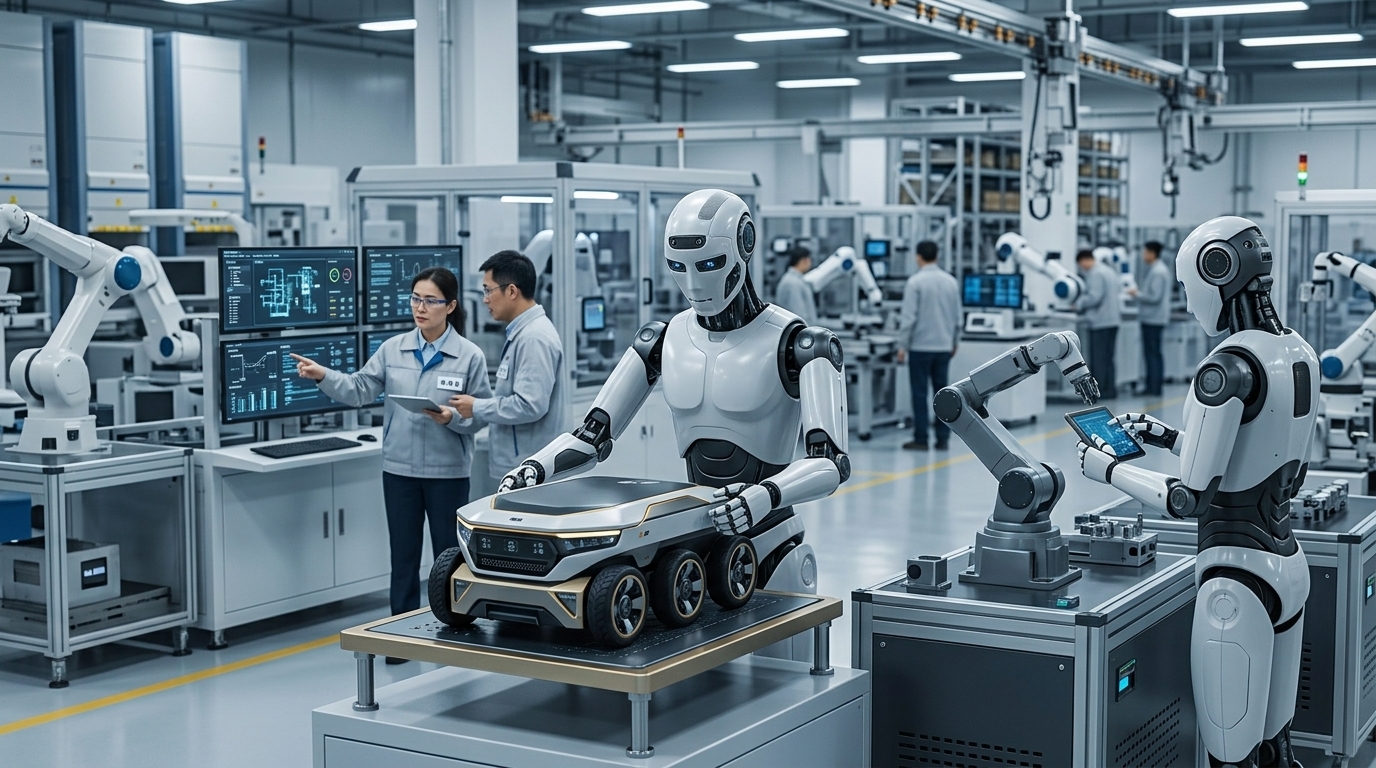
In the streets of Hangzhou and the laboratories of Shenzhen, a silent revolution is taking shape—not in flesh and blood, but in metal and silicone. China, the traditional 'world's warehouse' of manufacturing, is now on the threshold of a new era. It is no longer about assembling other companies' smartphones; it is about building the very entities that will assemble them in the future. The recent momentum surrounding Unitree Robotics and the preparation of dozens of Chinese robotics firms for Initial Public Offerings (IPOs) marks the official commencement of the 'Decade of Robots.'
Unitree and the Rapid Growth Syndrome
Unitree Robotics is not just another tech company; it is the symbol of an aggressive strategy that combines Silicon Valley speed with Chinese production scale. The announcement of its IPO intent comes at a time when its humanoids, such as the H1 and the more affordable G1, have stunned the market not only with their capabilities but primarily with their price points. When a humanoid robot costs less than a mid-range car, the conversation shifts from theoretical to purely economic.
The wave of IPOs expected in 2026 is no accident. It reflects the maturation of an ecosystem ranging from lidar sensor manufacturers to specialized AI providers for motor control. Investors see robotics as the 'next big bet' after electric vehicles (EVs), and China already possesses the infrastructure to dominate. The capital markets are being primed to fuel a massive expansion of manufacturing capacity that could dwarf the current industrial robot installations.
Beijing's Grand Strategy: From Policy to Practice
Behind the commercial success lies the long-term planning of the Chinese government. The Ministry of Industry and Information Technology (MIIT) has set clear milestones: by 2025, China must establish a comprehensive innovation system for humanoid robots, and by 2027, these robots must be an integral part of economic activity.
- State Subsidies: Billions of yuan are channeled into R&D through local governments and state-backed funds.
- Special Economic Zones: Areas like the Beijing Robotics Park offer tax incentives and specialized infrastructure.
- Education: Chinese universities are now producing more robotics engineers than any other nation, ensuring a steady pipeline of talent.
This state-led development creates an environment where failure is part of the learning process, allowing companies like Agibot and Fourier Intelligence to experiment at paces that Western counterparts struggle to match due to shareholder pressure for immediate profitability.
Competition with the West and the 'Cost Paradox'
While Tesla with Optimus and Figure AI in the US focus on high technology and absolute precision, China is following the strategy of 'cost democratization.' Unitree has proven it can mass-produce quadruped robots used for everything from factory surveillance to personal entertainment. The challenge for the West is now existential: if China manages to standardize humanoid components (actuators, harmonic drives), it will control the global robotics supply chain, much as it did with solar panels and lithium batteries.
"We are no longer in the research phase. We are in the scaling phase. Whoever manages to build the first million low-cost robots will set the standards for the next century," say market analysts in Shanghai.
Social Implications and the Future of Work
The 'Decade of Robots' is not just about stock markets. China faces an acute demographic crisis, with its working-age population shrinking rapidly. For Beijing, robotics is not a luxury but a necessity for the survival of its industrial base. However, the mass introduction of humanoids into factories raises questions for the global labor market. If the cost of a robot is lower than the annual salary of a worker in Vietnam or Mexico, the geography of production will shift radically, bringing manufacturing back to developed economies but without the jobs traditionally associated with it.
In conclusion, the preparation of Unitree and others for IPOs is the starting gun. The race for humanoid dominance will be decided not only in labs but in the ability of companies to convince the public and regulators that a world full of robots is a safe and prosperous one. As the capital flows in, the silicon workforce is punching in for its first shift.