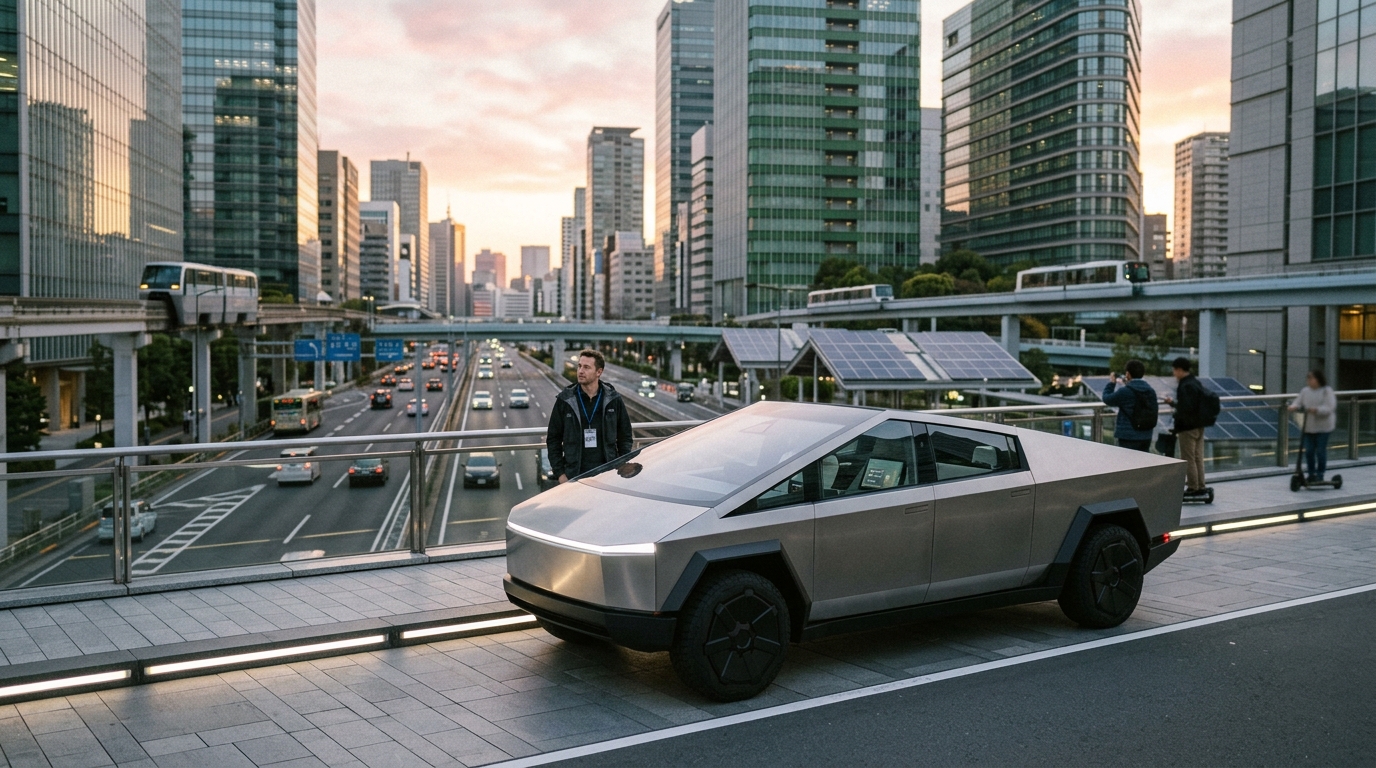
In an era where Artificial Intelligence (AI) is often confined to the digital realm of chatbots and large language models, Cathie Wood, the influential and often polarizing head of Ark Investment Management, is looking toward the physical world. According to Wood, the single largest revenue-generating opportunity from AI lies not in a server farm, but on our streets. The concept of "embodied AI" finds its ultimate expression in robotaxis, and Tesla, in her view, is on the cusp of a historic liftoff.
The Robotaxi Economy: A Multi-Trillion Dollar Frontier
Wood’s analysis is not merely based on optimistic forecasting but on a rigorous economic model that views transportation as a service (Mobility-as-a-Service - MaaS). Ark Invest estimates that the autonomous taxi ecosystem could generate between $8 trillion and $10 trillion in global revenue over the next decade. For Tesla, this represents a radical transformation from a hardware manufacturer into a software platform with profit margins reminiscent of high-growth SaaS companies.
The core of Wood’s thesis lies in Tesla’s data advantage. With the largest fleet of vehicles globally collecting real-time data, Tesla possesses a "neural network" fed by billions of miles of real-world driving. While competitors like Alphabet’s Waymo or Amazon’s Zoox rely on expensive LiDAR sensors and operate within strictly geofenced urban areas, Tesla’s vision-only approach aims for a generalized solution capable of navigating any environment without pre-mapped constraints.
Embodied AI and the 2026 Inflection Point
As we navigate through May 2026, Tesla’s Full Self-Driving (FSD) technology has reached a critical tipping point. Version 13, recently deployed, has shown a dramatic decrease in driver interventions, nearing the safety threshold required for unsupervised autonomy. Wood argues that the market consistently underestimates the speed at which AI learns from physical-world interactions. "It is no longer a question of if, but when," she told Bloomberg, emphasizing that regulatory hurdles are beginning to soften in the face of statistical evidence showing autonomous vehicles are significantly safer than human drivers.
However, the transition is not without its friction. In Europe, the regulatory landscape remains cautious, with the AI Act setting high bars for "high-risk" systems like autonomous transport. Tesla must prove not only that its system works, but that it is transparent, explainable, and resilient to cybersecurity threats. Wood believes that economic pressure and the urgent need for sustainable, efficient cities will eventually compel governments to accelerate their approval processes.
Competition and the Geopolitical Chessboard
While Wood remains laser-focused on Tesla, the global robotaxi map includes formidable players from China. Companies like Baidu (Apollo Go) and Pony.ai have already scaled commercial operations in major hubs like Beijing and Shanghai. The collision between American and Chinese AI strategies will define the future of the global automotive industry. Wood posits that Tesla’s advantage lies in its manufacturing scale and its ability to drive down the cost of vehicle production, potentially making the robotaxi an affordable mass-market solution rather than a niche luxury service.
"The convergence of three technologies—robotics, energy storage, and artificial intelligence—will change the world in a way we haven't seen since Ford's Model T rolled off the assembly line," Wood asserts.
In conclusion, Wood’s 2026 projection for Tesla is a bet on the future of human mobility. If robotaxis truly "take off," we will witness a total restructuring of urban life: reduced need for parking, lower emissions, and an entirely new economy built around the value of the passenger's liberated time. Tesla is no longer being judged as a car company, but as the primary architect of the robotics revolution.