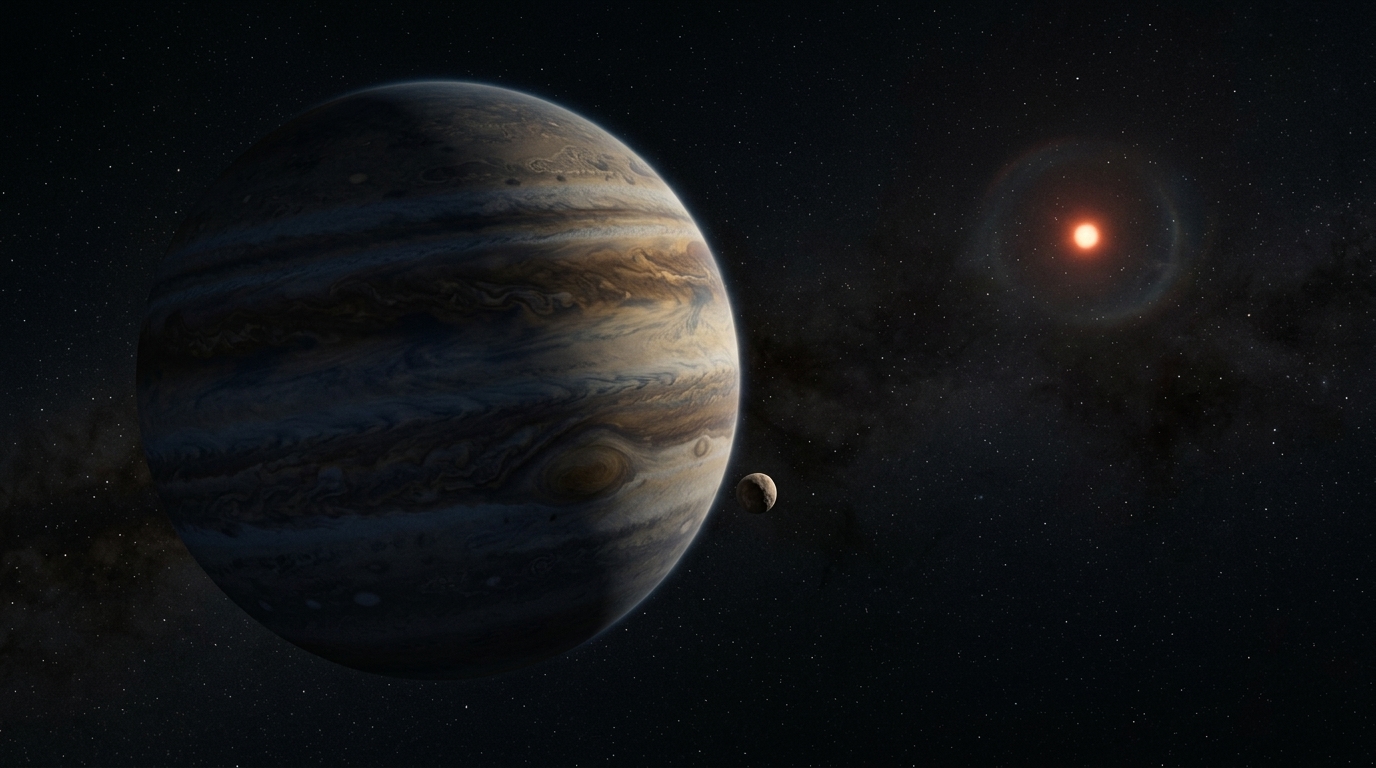
In the vast cosmic graveyard of our galaxy, astronomers have discovered something that theoretically should not exist: a living planet orbiting the corpse of a star. The discovery of a Jupiter-sized planet that survived the violent transformation of its parent star into a red giant and its subsequent collapse into a white dwarf challenges our current understanding of the fate of planetary systems.
The Anatomy of a Stellar Death
To understand the significance of this discovery, we must first examine what happens when a star like our Sun reaches the end of its life. As it exhausts the hydrogen fuel in its core, the star swells into a "red giant." During this phase, its diameter increases hundreds of times, often engulfing the inner planets of the system. For our own solar system, this means Mercury, Venus, and likely Earth will be vaporized within the scorching atmosphere of the bloated Sun.
However, the planet identified by the research team, using data from the James Webb Space Telescope and ground-based observatories, seems to have found a way to escape. The white dwarf, the dense remnant of the star left behind after it shed its outer layers, is now the size of Earth but possesses the mass of a star. The giant planet is in an orbit that suggests it either managed to move outward during the expansion or survived a process scientists call "common envelope evolution."
Theories of Survival: The Centrifuge of Mass
One of the most prevalent theories for this planet's survival is the star's mass loss. As the red giant sheds its outer layers into space, its gravitational pull weakens. This allows planets located at a safe distance to "migrate" to wider orbits, avoiding engulfment.
- Mass loss can reduce a star's gravity by up to 50%.
- Orbital migration is a dynamic process depending on the rate of material loss.
- Tidal forces play a crucial role in maintaining the planet's structural integrity.
But is this enough? This specific planet is now very close to the white dwarf, suggesting that after the critical phase, there was a second period of migration, this time inward. This "cosmic tango" shows that planetary systems are far more resilient and dynamic than previously thought.
"The existence of this planet forces us to re-evaluate the boundary of the 'death zone' around dying stars," the researchers noted in their study.
A Window into Our Solar System's Future
This discovery is not merely an astronomical curiosity; it is a simulation of our own future. In about 5 billion years, the Sun will follow this exact same path. While Earth is considered doomed, Jupiter and Saturn have a high probability of survival. The discovered planet is a "twin" of Jupiter, and its survival gives us hope that the outer parts of our system will remain intact, even when its center has faded.
Furthermore, studying such systems opens new avenues for the search for life. Although this specific planet is a gas giant, the existence of rocky moons around it cannot be ruled out. If these moons retained their atmospheres, they could theoretically host life, drawing energy from the remaining heat of the white dwarf. The resilience of matter against stellar destruction proves to be greater than anyone imagined.
Conclusion: The Persistence of Existence
As our technology allows us to look deeper into the past and future of the universe, we realize that the death of a star does not necessarily mean the end of its planetary system. The "Survivor Planet" stands as a monument to cosmic endurance. It teaches us that even in the most extreme conditions, gravity and motion find ways to maintain order within chaos. The next step for astronomers is to search for more such survivors, mapping the post-apocalyptic geography of our galaxy.