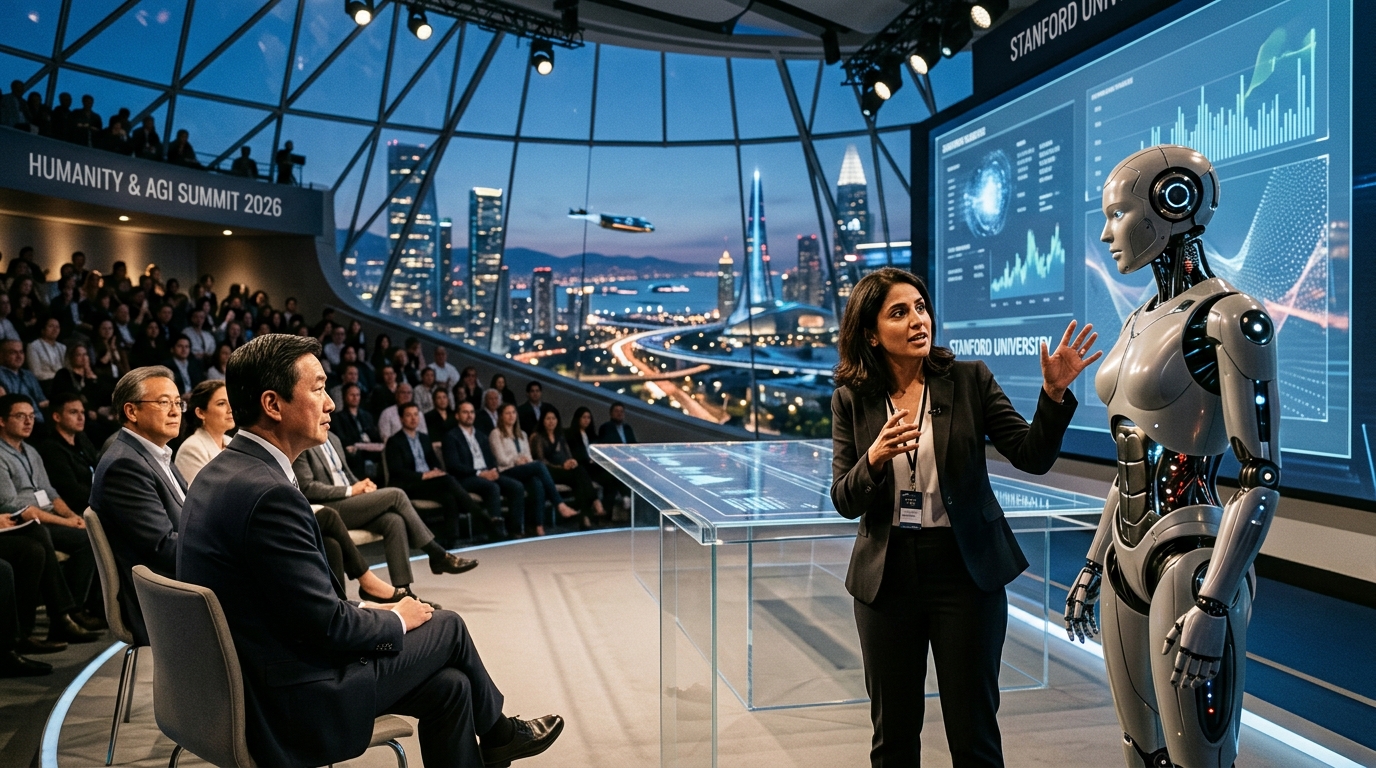
In the heart of Silicon Valley, where ideas are forged into global realities, the "Humanity & AGI Summit 2026" at Stanford University marks a historic turning point. This is no longer a conversation about clever chatbots or generative art. The central theme this year is "Embodied AI" — the moment Artificial Intelligence steps out of the servers and into our physical world through advanced robotics and autonomous systems.
This year's summit coincides with a period of intense anxiety and anticipation. With computing power doubling every few months, the milestone of Artificial General Intelligence (AGI) — an intelligence that can perform any intellectual task as well as or better than a human — is no longer viewed as science fiction, but as an imminent technological certainty. The Summit brings together political leaders from the G7, CEOs of giants like OpenAI, Google DeepMind, and Tesla, as well as philosophers tasked with answering the fundamental question: What does it mean to be human in a world shared with superior intelligences?
From Code to Steel: The Rise of Robotic AGI
The most significant development discussed in the opening sessions of the Summit is the integration of Large World Models into humanoid robots. While 2024 and 2025 saw the explosion of generative AI in software, 2026 is the year of physical action. Companies like Figure and Boston Dynamics showcased models that don't just follow programmed commands but "understand" the laws of physics through visual observation and reinforcement learning.
This transition into the physical realm is fundamentally altering the global economic landscape. The ability of machines to perform manual labor with the same dexterity and judgment as a human promises to solve labor shortages in aging societies, but simultaneously threatens to displace millions of workers. Speakers at Stanford emphasized that "Physical AI" requires a new safety framework. If software makes a mistake, the result is misinformation; if an AGI-powered robot makes a mistake, the consequences can be fatal for the physical safety of humans around it.
The Geopolitics of Intelligence and the Regulatory Gap
Another critical dimension of the Summit is the competition for AGI supremacy. The Summit serves as an informal diplomatic battlefield where the European Union, the US, and China attempt to align ethical standards. The EU Commissioner for the Digital Age warned that the concentration of AGI power in a handful of private companies poses a risk to democracy. "AGI is not just a product; it is a new form of infrastructure for our civilization," she stated.
- The necessity for hardware-level "kill-switches," not just software overrides.
- Taxing robotic systems to fund Universal Basic Income (UBI).
- Creating international standards for the "alignment" of AI goals with human values.
- The environmental impact of the massive energy grids required to sustain AGI physical nodes.
Tech leaders, on the other hand, argue that excessive regulation could delay life-saving breakthroughs in medicine and climate change mitigation. The tension between rapid innovation and cautious governance remains the primary friction point in the Summit's negotiations.
The Challenge of Human Identity
Beyond economics and politics, the Humanity & AGI Summit delves into the psychological and social impact of coexisting with AGI. With the advent of robots possessing emotional intelligence and the ability to simulate human empathy, the lines between tool and companion are blurring. Leading psychologists at Stanford presented studies on "digital loneliness," where individuals are beginning to prefer interaction with perfectly tuned artificial entities over other humans.
"The wager of 2026 is not whether we will build AGI, but whether we will manage to remain human after we have built it," noted one of the keynote speakers.
The Summit is expected to conclude with the "Stanford Declaration on Digital Humanity," a set of principles seeking to place humans at the center of AGI development. However, as machines begin to walk among us, theory gives way to practice, and humanity is called to adapt to the most radical shift in its history.