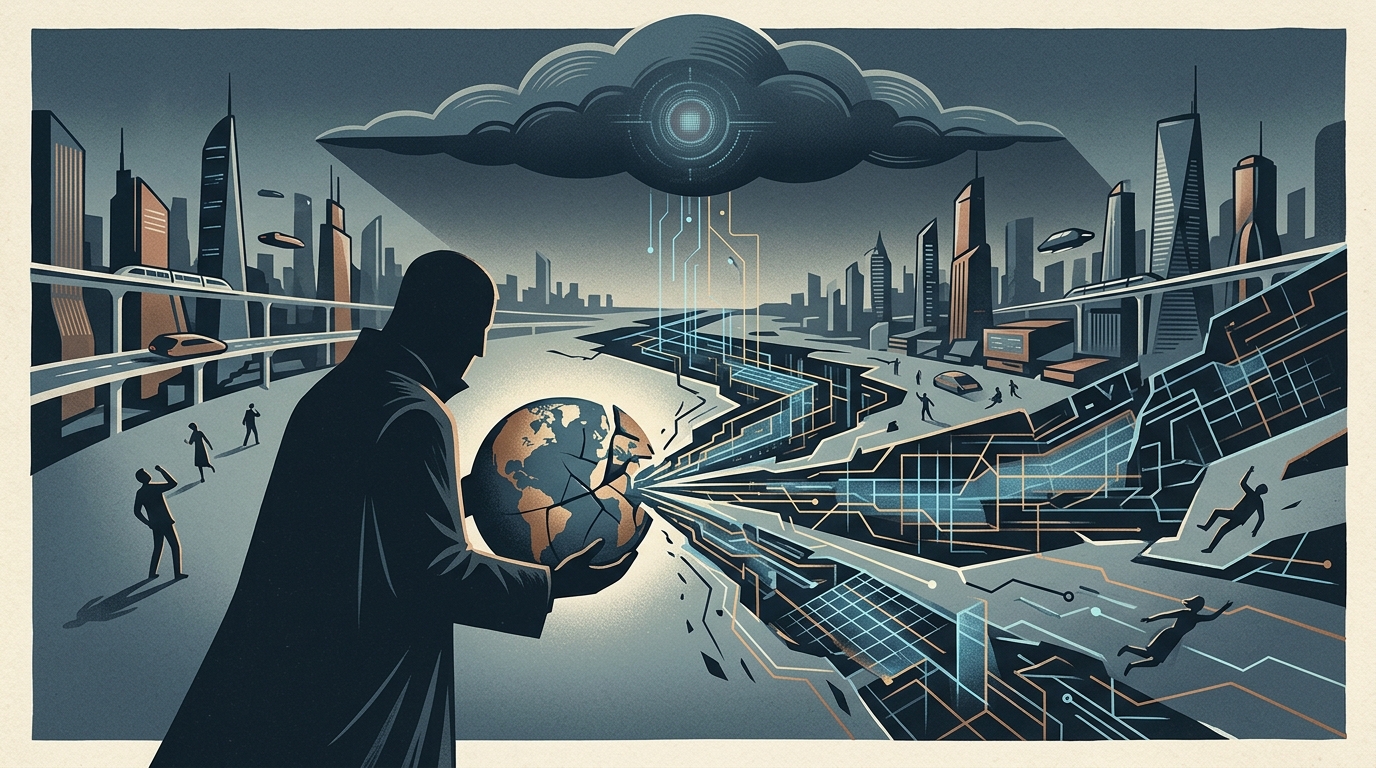
In an era where Artificial Intelligence (AI) is no longer a science fiction scenario but a daily reality shaping markets, communications, and politics, warnings from the highest echelons of the U.S. government carry a new, urgent weight. Senator Marco Rubio, in a recent and widely discussed interview with PBS, delivered a grim prediction: rapid advancements in AI have the potential to "destabilize societies all over the world." This position is not merely political rhetoric; it reflects a deep and growing fear in the corridors of power in Washington regarding the loss of control over information and social cohesion.
The Erosion of Shared Truth
Rubio’s central argument focuses on AI’s ability to manufacture realities. As generative AI models become increasingly sophisticated, the distinction between truth and fabricated falsehood is becoming nearly impossible for the average citizen to discern. The Senator emphasized that we are no longer just talking about simple "fake news," but a total assault on the concept of objective reality. When citizens can no longer believe their own eyes or ears—due to hyper-realistic deepfakes—the cornerstone of democratic deliberation crumbles.
This "epistemological crisis," as many analysts call it, is the first stage of destabilization. Without a common baseline of facts, societies polarize to a degree where mutual understanding becomes impossible. Rubio pointed out that hostile states and non-state actors can use these tools to foment internal conflicts, influence elections, and shake trust in institutions. The speed at which misinformation spreads via AI algorithms far exceeds the ability of human fact-checkers to respond effectively.
Economic Fragility and Social Unrest
Beyond the information sphere, the economic dimension of AI is an equally critical factor in destabilization. Although Rubio often focuses on national security, the link between economic insecurity and social explosion is inextricable. Automation, which now touches not only manual but also cognitive jobs, threatens to displace millions of workers in a short period. History has shown that periods of rapid technological displacement, if not accompanied by strong safety nets, inevitably lead to populist movements and political instability.
"We are not just facing a new technology, but a new form of power that can rearrange the global order without a single shot being fired," the Senator noted.
Rubio’s concern extends to the global supply chain and economic sovereignty. If AI allows authoritarian regimes to achieve technological supremacy, democratic societies will find themselves at a disadvantage, not just militarily but also in terms of living standards. The possibility of a "digital iron curtain," where different blocs of nations use incompatible and competing AI technologies, reinforces the scenario of a fragmented and unstable global community.
The Geopolitical Chessboard and the Role of China
It is impossible to analyze Rubio’s statements without considering the U.S.-China competition. For the Senator, AI is the new battlefield of a 21st-century Cold War. China, through its doctrine of "military-civil fusion," is investing billions to dominate AI, aiming to export its model of digital surveillance to other countries. Rubio warns that if the U.S. and its allies do not set the standards for the ethical and safe use of AI, the vacuum will be filled by powers that do not share democratic values.
Destabilization, therefore, is not just internal but external. The use of AI in autonomous weapons systems and in cyberattacks driven by algorithms can lead to escalations that spiral out of human control. The speed of decision-making by AI in critical military situations reduces the time leaders have for diplomacy, increasing the risk of an accidental global conflict.
Conclusion: The Regulatory Challenge
In conclusion, Marco Rubio’s intervention highlights the great dilemma of our time: How can we protect freedom and stability without stifling innovation? The legislative process in Washington moves at a snail's pace compared to the exponential growth of technology. The Senator calls for a bipartisan effort to create a regulatory framework that sets boundaries for AI, particularly in areas concerning national security and social integrity.
Destabilization is not an inevitability, but a real danger that requires vigilance. Society must develop "digital immunity," and political leaders must understand that AI is not just an economic tool, but an existential challenge to the very way we organize our lives on the planet. Rubio’s warning on PBS may serve as the catalyst for a more serious and in-depth discussion that has been dangerously delayed.