In the vast silence of the solar system, precision is the ultimate currency. As NASA’s Psyche spacecraft continues its ambitious journey toward the Main Asteroid Belt, a scheduled encounter with Mars has provided more than just a necessary gravitational boost; it offered a unique opportunity for the mission’s scientific team to sharpen the eyes of the probe. The images sent back to Earth are not merely aesthetic triumphs; they are a confirmation that humanity now possesses the tools to map worlds once thought unreachable.
The Art of the Gravitational Slingshot
Traveling to asteroid 16 Psyche—a world believed to be composed primarily of metal—requires immense energy. Rather than relying solely on its onboard fuel, the spacecraft utilized Mars as a gravitational slingshot. By passing within a specific distance of the Red Planet, Psyche stole a minute fraction of Mars’ orbital momentum, increasing its own velocity and refining its trajectory toward the outer solar system. This process, known as a gravity assist, is a complex dance of celestial mechanics that allows missions to reach distant targets with unprecedented efficiency.
However, this flyby was about more than just speed. For the engineers at NASA’s Jet Propulsion Laboratory (JPL), Mars served as the perfect calibration target. As the spacecraft zipped past, it activated its Multispectral Imager, a pair of high-resolution cameras designed to distinguish between metal and silicate rock on the surface of the target asteroid.
A Fresh Perspective on the Red Planet
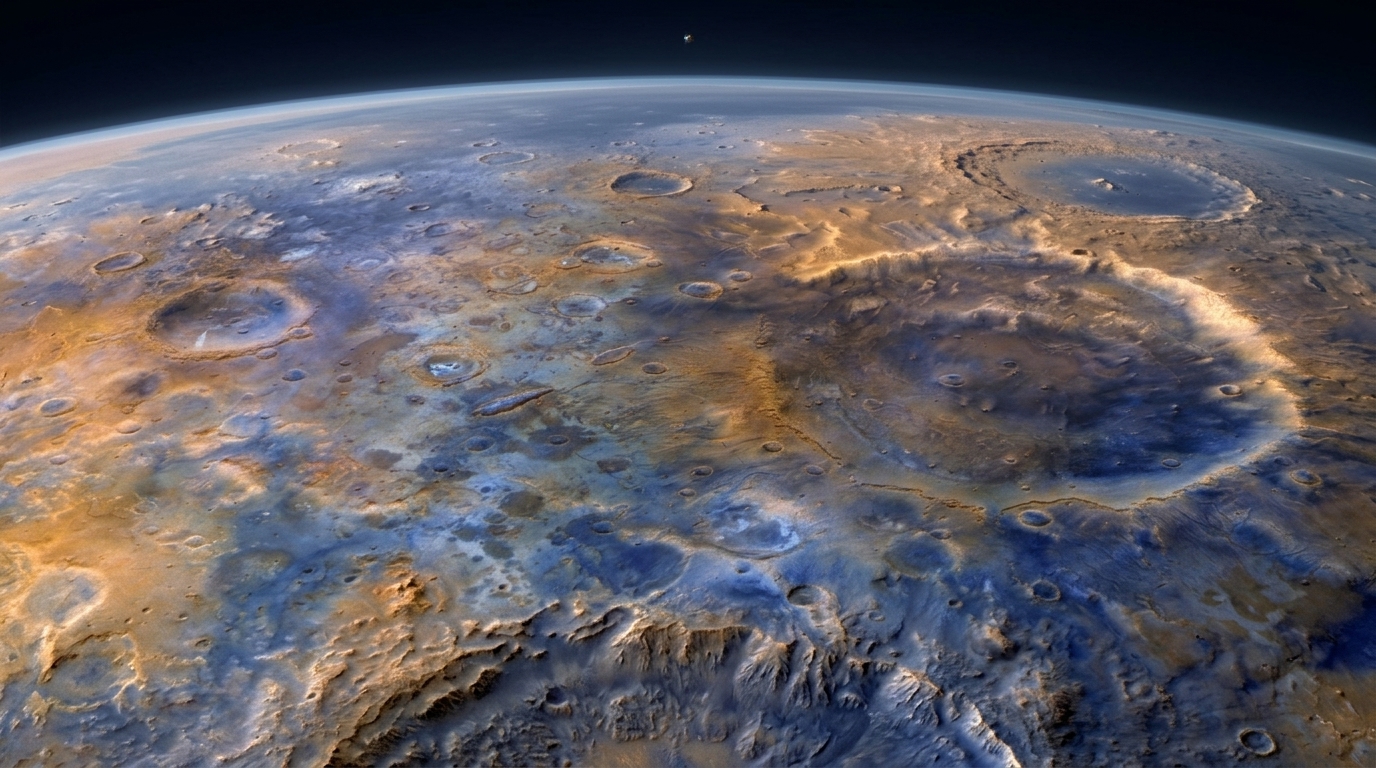
The images captured by Psyche during the flyby offer a different vantage point than the one we are accustomed to from dedicated Mars orbiters. By employing various filters, ranging from visible light to near-infrared, scientists were able to test the sensitivity of the instruments across different wavelengths. This is critical because asteroid 16 Psyche does not emit its own light; it reflects sunlight in ways that depend heavily on its chemical composition.
In these new photographs, the Martian atmosphere appears with a delicate, ethereal glow, while surface features—vast plains and volcanic fields—were captured with crystalline clarity. The success of this test means that when the spacecraft arrives at its destination in 2029, the cameras will already be finely tuned to reveal the secrets of the metallic core hidden within the asteroid.
The Laser Revolution: DSOC
Alongside its imaging capabilities, the Psyche mission carries a technology that promises to revolutionize deep-space communication: the Deep Space Optical Communications (DSOC) system. During the Mars approach, DSOC was tested once again, transmitting data via laser beams instead of traditional radio waves. The transmission speeds are exponentially higher, allowing for the transfer of high-definition video and massive scientific datasets in near real-time.
The use of lasers represents the "broadband" of future space exploration. If humanity intends to send astronauts to Mars or beyond, the ability to transmit vast amounts of information is indispensable. Psyche acts as the pioneer of this technology, proving that distance is no longer an insurmountable barrier to the flow of information.
Why 16 Psyche is the Holy Grail of Planetary Science
The spacecraft’s final destination is no ordinary asteroid. Most asteroids are composed of ice or rock. 16 Psyche, however, appears to be the exposed core of a protoplanet that lost its outer layers due to violent collisions during the early stages of the solar system. By studying it, we are effectively looking into the heart of a planet like Earth—something impossible to do on our own world due to extreme pressure and heat.
This mission is a quest for origins. It seeks to answer the fundamental question: How did rocky planets like Earth, Mars, and Venus form? If 16 Psyche is indeed a metallic core, it holds the genetic blueprint of our solar system. The images from Mars were merely the appetizer; the main course is expected to be one of the most profound discoveries in the history of astronomy.