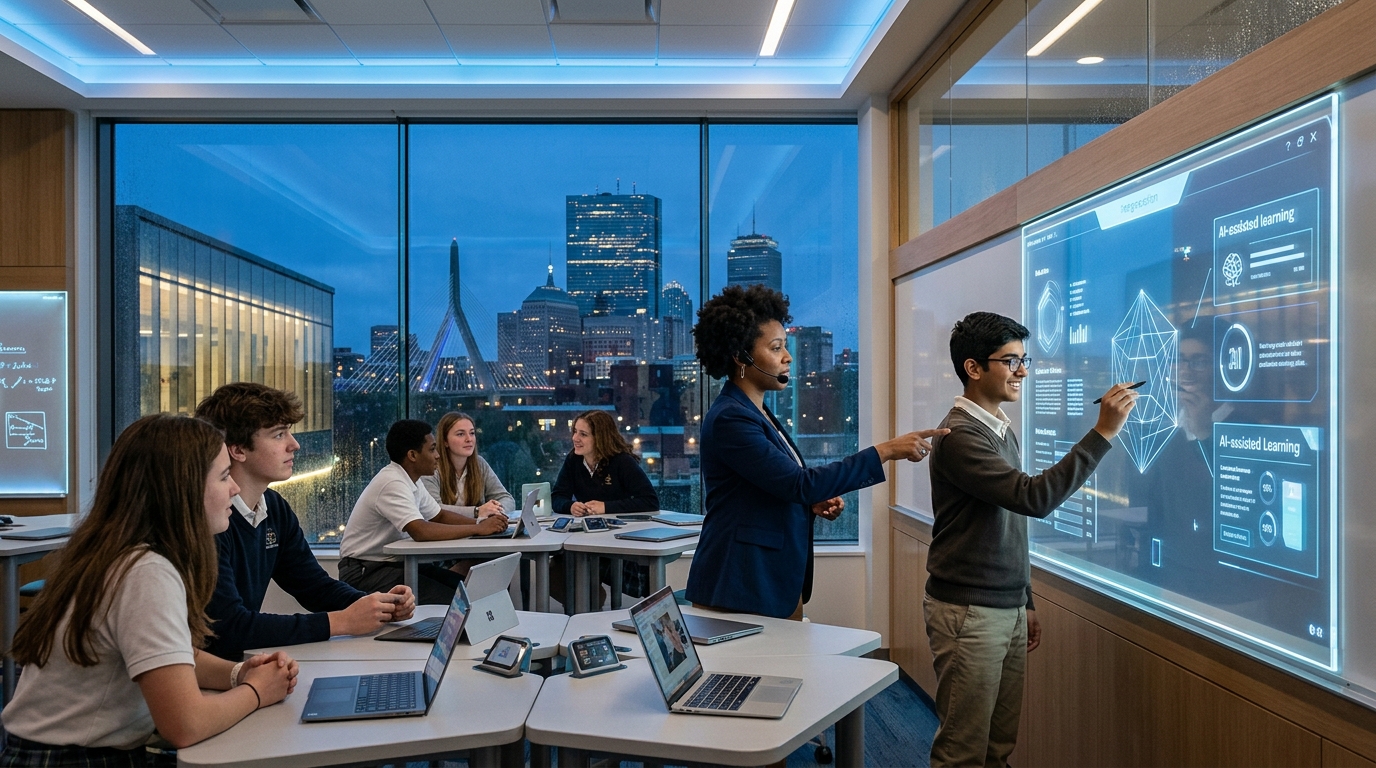
Boston, a city long revered as the intellectual cradle of the United States, is standing at the precipice of an educational revolution. A new proposal to establish a private school centered entirely on Artificial Intelligence (AI) has ignited a profound debate among educators, parents, and technologists. This venture is not merely about bringing tablets into the classroom; it represents a fundamental restructuring of pedagogy, prioritizing algorithmic personalized learning over traditional instruction.
The Philosophy of Hyper-Personalization
At the core of the proposal lies the conviction that the traditional "one-size-fits-all" model of education is an artifact of the industrial age. The proposed school aims to deploy sophisticated AI systems that function as 1-on-1 tutors for every student. These systems analyze a child’s strengths, weaknesses, and learning velocity in real-time, tailoring the curriculum accordingly. For instance, if a student struggles with algebraic concepts but excels in molecular biology, the AI will pivot, offering diverse explanatory methods for math while providing advanced, college-level material for science.
Proponents argue that AI can provide the level of bespoke attention once reserved for the elite who could afford private tutors in centuries past. Today, technology promises to democratize this luxury, though its implementation within an expensive private institution raises immediate questions about equity and access.
The Teacher’s Role in the Algorithmic Age
Perhaps the most contentious aspect of this proposal is the shifting role of the human educator. In the Boston model, teachers are not being replaced, but their functions are being radically redefined. Moving away from the traditional role of a lecturer, the teacher becomes a "mentor" and "facilitator." While the AI handles the transmission of factual knowledge and technical skill assessments, the human teacher focuses on the essential development of critical thinking, emotional intelligence, and ethical reasoning.
- Adaptive Learning: Students progress at their own speed, eliminating the frustration of being left behind or the boredom of waiting for others.
- Data-Driven Insights: Mentors receive instant analytics on student performance, allowing for early intervention in learning gaps.
- Self-Directed Growth: The model encourages students to take ownership of their educational journey, fostering independence.
However, critics warn that this shift carries significant risks. There is a fear that an over-reliance on technology could erode the social fabric of the classroom—a space where children learn not just facts, but how to navigate social dynamics and collective problem-solving.
Ethical Dilemmas and the Digital Divide
The introduction of an AI-centric school in Boston highlights a growing concern regarding social stratification. While AI has the potential to elevate every student, its deployment in a private setting may exacerbate the gap between the privileged and the underserved. If students at elite private schools are utilizing advanced algorithms to accelerate their intellectual growth, what happens to the public school system, which is often struggling with basic infrastructure and staffing?
"Education is not just the accumulation of data; it is the formation of character. We must ask ourselves if an algorithm can truly teach empathy, civic duty, or the nuance of human history," notes a local education policy analyst.
Furthermore, data privacy remains a paramount concern. The continuous monitoring of a child’s cognitive processes and learning behaviors generates an unprecedented amount of sensitive data. Who owns this data? How can we ensure it isn't used for future corporate profiling or predictive social ranking?
Conclusion: A Global Litmus Test
The proposal for this AI-powered school in Boston is more than a local news story; it is a global experiment. If successful, it could provide the blueprint for 21st-century education worldwide. If it fails, it will serve as a cautionary tale regarding the limits of technological intervention in human development. As the boundaries between human and artificial instruction blur, the world watches to see if Boston will once again lead an intellectual revolution or if this is a step toward an overly mechanized future.