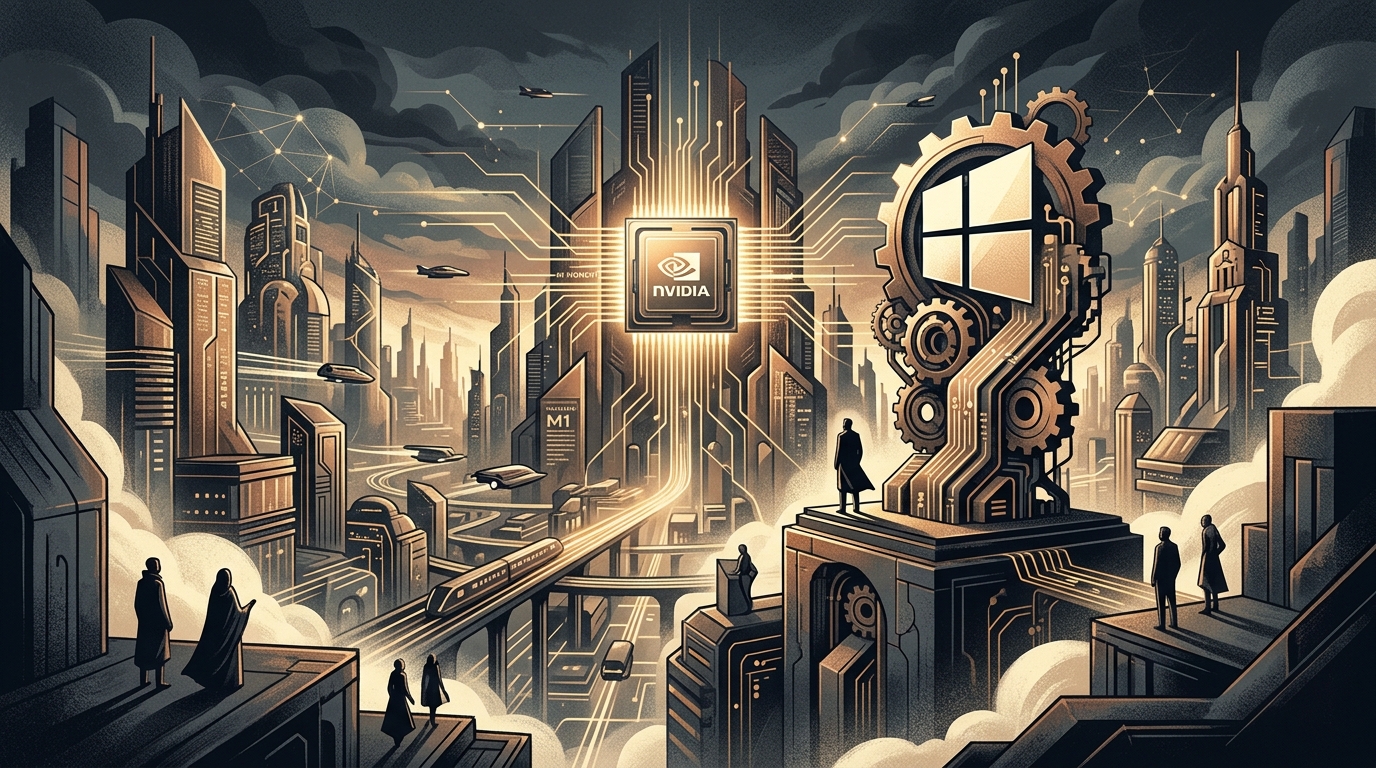
For nearly four years, Windows users have watched MacBook owners with a touch of envy. Since 2020, when Apple unveiled the M1 processor, the personal computing landscape has shifted radically. The promise was simple yet revolutionary: top-tier performance without the need for noisy fans and a battery that lasts for days, not hours. While Qualcomm attempted to respond with the Snapdragon X Elite series, the true "M1 moment" for the Windows ecosystem seems to be arriving from a player that already dominates the world of Artificial Intelligence: Nvidia.
The Emergence of RTX Spark
Recent revelations about "RTX Spark," Nvidia's first fully integrated System-on-a-Chip (SoC) for consumer laptops, are more than just news for hardware enthusiasts. This represents a geopolitical and economic shift in the tech industry. Nvidia, having conquered data centers globally, is now turning its sights toward the desktop and laptop markets, utilizing the Arm architecture. The difference here is integration. Unlike traditional solutions where the CPU and GPU are separate components that consume energy just to communicate, RTX Spark promises a unified memory architecture similar to Apple's.
This means that the massive power of Nvidia's Blackwell cores will sit directly alongside high-performance Arm CPU cores. The result? A laptop that can render 3D graphics or run local Large Language Models (LLMs) with the speed of a workstation, while remaining thin and portable. However, this technological superiority comes with an asterisk that many refuse to acknowledge: the cost.
The Price of Innovation
Apple managed to control the cost of its M-series chips because it controls the entire supply chain and the software. Nvidia, on the other hand, is a supplier that must sell to manufacturers like Dell, HP, and Lenovo. Integrated RAM—essential for the speeds Nvidia promises—means laptop manufacturers lose the profit margins from memory upgrades, while the cost of the chip itself is expected to be astronomical. Market analysts estimate that an RTX Spark-equipped laptop could start at $2,500 or even $3,000, placing it in an "ultra-premium" category that few can afford.
Furthermore, there is the issue of Windows on Arm. Despite Microsoft's massive improvements with Prism (the emulation layer for x86 applications), the experience remains occasionally problematic for specialized software. Nvidia is betting that its brand power and the urgent need for "AI PCs" will force developers to optimize their applications faster than ever before.
The Battle for Chip Supremacy
Nvidia’s move is a direct threat to Intel and AMD. For decades, the x86 architecture was the undisputed king of Windows. However, the energy efficiency of Arm is now impossible to ignore. If Nvidia can deliver a chip that doesn’t burn the user's lap while processing 8K video, Intel will find itself in an extremely difficult position. Intel is already trying to respond with its Lunar Lake series, also focusing on integrated memory and efficiency, but it lacks the "AI halo" currently surrounding Nvidia.
- Unified Memory: The key to performance, but also the reason for high prices.
- Blackwell Architecture: Bringing supercomputer technology to laptops.
- AI Ecosystem: Nvidia isn't just selling hardware; it's selling CUDA, the industry standard.
- Thermal Management: The promise of silent Windows laptops that don't sacrifice power.
In conclusion, RTX Spark may indeed be the salvation Windows power users have been waiting for. It is the first time a chip manufacturer has the prestige and technological infrastructure to look Apple in the eye. However, the democratization of this technology is still a long way off. For 2026, the Windows "M1 moment" will be a privilege for the few—a status symbol combining absolute power with an absolute price tag.