In the vibrant streets of Lagos, where creativity flourishes out of necessity and improvisation, Nollywood—the world's second-largest film industry by volume—is undergoing a silent yet catalytic revolution. As we move through May 2026, the integration of Artificial Intelligence (AI) is no longer a distant sci-fi scenario but a daily reality in production studios. The central question facing creators, critics, and audiences is whether this technological explosion will act as an accelerator for the African voice or as a "digital Trojan horse" that homogenizes the continent's unique narratives.
The Democratization of Visual Effects and Production Costs
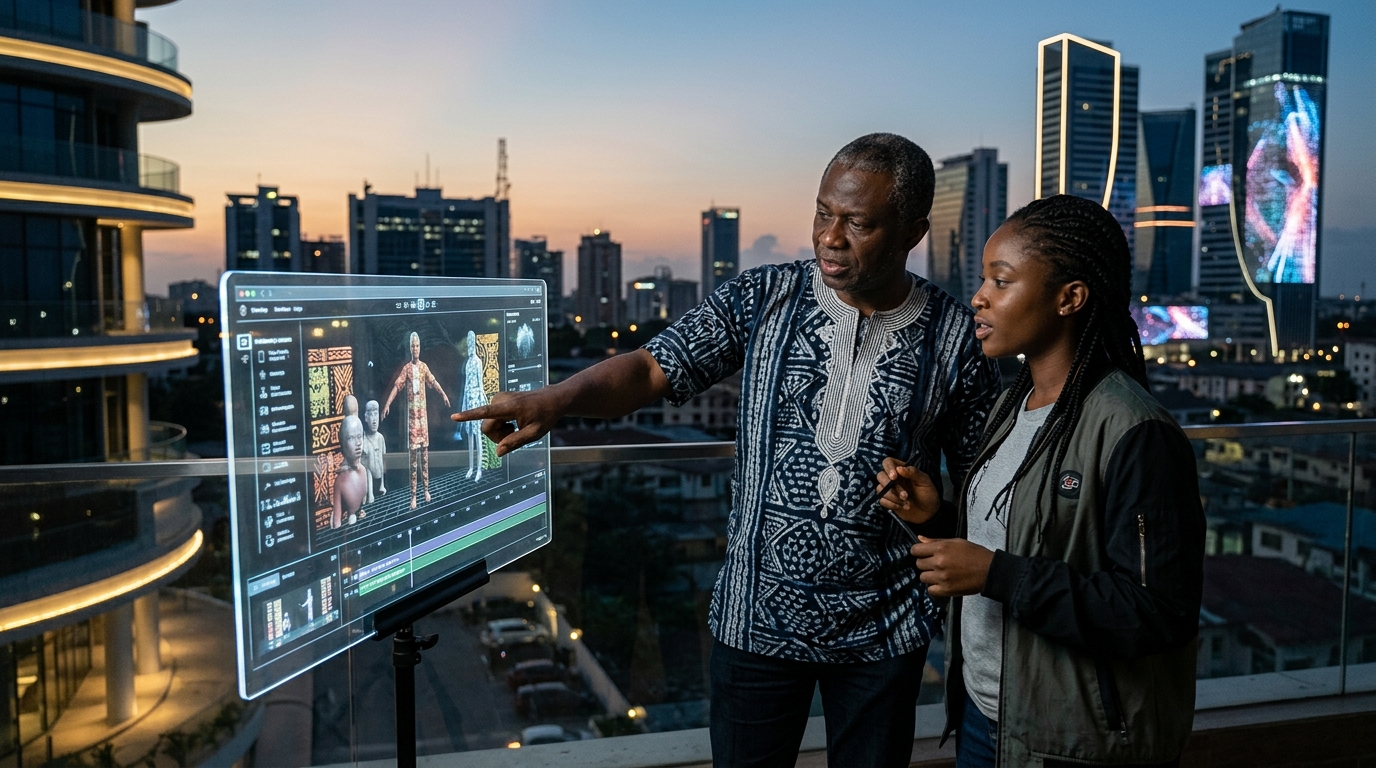
For decades, Nollywood was synonymous with low budgets and lightning-fast shoots. The ability of Nigerian directors to produce feature films in a matter of weeks with minimal resources is legendary. However, the quality of visual effects (VFX) often remained the industry's Achilles' heel, limiting its penetration into international markets and global streaming platforms like Netflix and Amazon Prime. Generative AI is drastically changing this landscape. Tools that allow for the creation of complex sets, lighting correction, and the addition of realistic effects at a fraction of traditional costs are giving African creators the "weapons" to compete with Hollywood on a technical level.
- Reduction of post-production costs by up to 60%.
- Ability to create epic historical dramas without the need for thousands of extras.
- Restoration of old Nollywood classics for the new digital era.
This technological upgrade allows young filmmakers from Kano to Enugu to envision stories that were previously considered "impossible" to film due to financial constraints. AI is no longer a luxury but a tool for survival and growth.
The Storytelling Dilemma: Algorithms vs. Tradition
However, the use of AI in screenwriting and character development raises serious concerns. Large Language Models (LLMs) are primarily trained on Western data, which often leads to a "cultural bias." There is a risk that algorithms will suggest narrative structures that follow Western standards, sidelining the specifics of Africa's oral traditions, the use of local dialects, and the unique way Nollywood handles melodrama and spirituality.
"The soul of Nollywood lies in its raw energy. If we let AI 'smooth out' our edges to become more palatable to a global audience, we will cease to be ourselves," says a veteran director from Lagos.
The challenge lies in training AI models on local data—on Yoruba, Igbo, Hausa, and Swahili stories. Only then will the technology be able to understand the context of a proverb or the significance of a social hierarchy in a village without turning them into clichés.
Linguistic Unification and the Pan-African Market
One of the most promising applications of AI in Nollywood is high-precision automated dubbing and subtitling. Africa has over 2,000 languages, and the language barrier has always been an obstacle to intra-continental distribution. With AI dubbing technology, a film from Nigeria can be released simultaneously in Francophone Senegal, Arabic-speaking Egypt, and Swahili-speaking East Africa, while preserving the emotional tone of the original actors. This creates a massive unified market, boosting the economic independence of producers and reducing reliance on Western distribution platforms.
Conclusion: A Relationship of Collaboration, Not Replacement
The future of Nollywood in the AI era is not set in stone. If the industry adopts technology as a means to enhance its authenticity rather than replace it, then the "Eye on Africa" will witness a new golden age. Artificial intelligence can take over the labor of production, leaving African creators the space to focus on what they do better than anyone else: telling stories that vibrate at the heart of the continent.