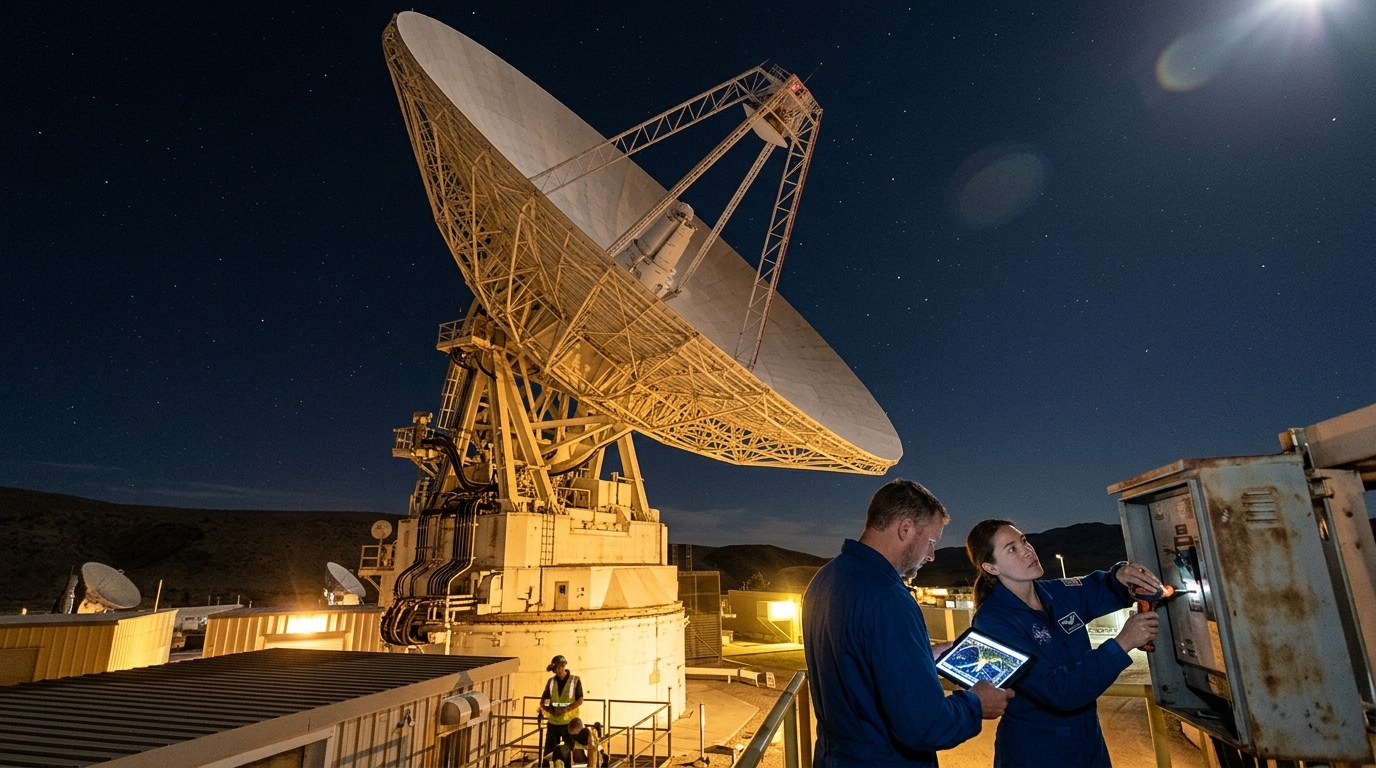
The success of the Artemis II mission marks a new chapter for humanity as astronauts returned to the lunar vicinity. Yet, behind the breathtaking imagery and global celebrations, a quiet battle was being waged in the realm of telecommunications. NASA’s Deep Space Network (DSN)—the invisible backbone connecting Earth to our robotic and human ambassadors in the cosmos—managed to withstand the immense pressure of the mission, despite having been on the verge of operational collapse just months prior.
Infrastructure Crisis and Mission Salvation
The DSN consists of three primary antenna complexes located in California, Spain, and Australia, strategically positioned to ensure continuous contact with spacecraft as the Earth rotates. In recent years, the network has faced an unprecedented capacity crisis. With the launch of the James Webb Space Telescope and a surge in commercial and international lunar missions, the DSN’s antennas were stretched to a breaking point.
According to recent statements from NASA officials, the network "worked well" during Artemis II. This was far from a guaranteed outcome. The mission required massive bandwidth for real-time high-definition video feeds, crew biometrics, and critical telemetry. To achieve this, NASA had to grant absolute priority to Artemis II, forcing other scientific missions—such as those studying distant galaxies or Martian weather—to temporarily go silent or drastically reduce their data transmission.
The "Paperwork vs. Reality" Dilemma
One of the most striking revelations from the mission's post-analysis is the discrepancy between planned and actual workloads. As NASA officials noted, "some missions are using more than what their paperwork would say." This phenomenon of "data creep" creates a scheduling nightmare for mission controllers.
Modern missions, equipped with cutting-edge sensors, produce volumes of information that often exceed the original engineering estimates. When a vessel like the Orion capsule is in flight, the need for a continuous data stream is a matter of crew safety. This means the DSN is not just executing a pre-set schedule; it is managing a dynamic and often unpredictable demand that threatens to crowd out all other scientific activity in deep space.
- Priority for Artemis II impacted over 40 other active science missions.
- The Ka-band network was utilized to its theoretical limits.
- 34-meter antennas were frequently "arrayed" (combined) to boost signal strength for the crewed capsule.
Looking Ahead: Lasers and New Investments
The success of Artemis II should not be a cause for complacency. With Artemis III aiming to land humans on the lunar South Pole, the demands will increase exponentially. NASA acknowledges that traditional radio frequencies are reaching their physical limits. The solution appears to lie in Optical (Laser) Communications, which promise transmission speeds up to 100 times faster than current radio systems.
"The DSN is a national treasure that was neglected for too long. Artemis II showed us we can manage with careful planning, but the future requires a radical upgrade of our infrastructure," said a senior NASA communications analyst.
In conclusion, the resilience of the Deep Space Network during Artemis II was a triumph of engineering and strategic prioritization. However, the communication bottleneck remains the single greatest hurdle for a permanent human presence on the Moon and, eventually, Mars. Without sustained investment in new antennas and laser technology, the dream of exploration risks being "disconnected."