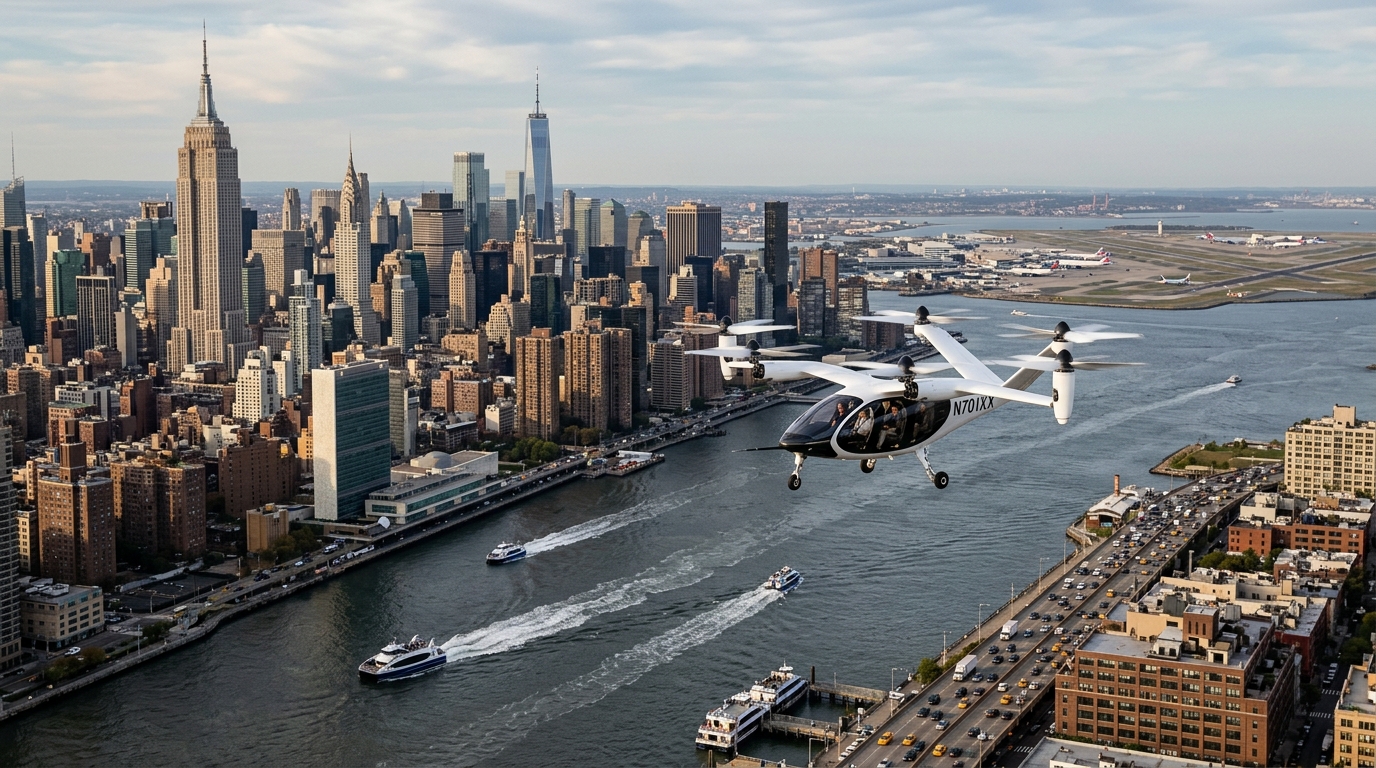
The vision of sleek vehicles gliding between skyscrapers, once a staple of science fiction, is becoming a tangible reality above the New York City skyline. This week, Joby Aviation, a leader in the electric vertical take-off and landing (eVTOL) sector, commenced a series of pivotal test flights connecting John F. Kennedy International Airport (JFK) to downtown Manhattan. This move is not merely a display of technological prowess but a strategic leap toward the commercial launch of a service that promises to slash a grueling one-hour commute to a mere seven minutes.
The Silent Electric Revolution
The primary obstacle to urban aerial mobility has always been noise. Conventional helicopters, while effective, are a constant source of friction for New Yorkers due to the deafening roar of their engines and rotor blades. Joby’s aircraft, however, is built on a radically different philosophy. Utilizing six electric motors, the craft is nearly silent during cruise flight, producing a sound signature more akin to a light breeze than a mechanical engine.
During the JFK demonstrations, observers noted that the aircraft becomes virtually inaudible once it reaches an altitude of a few hundred feet. This characteristic is vital for public and regulatory acceptance. Joby aims to prove that urban air traffic can coexist harmoniously with daily life in a dense metropolis without exacerbating the city's already significant noise pollution levels. By removing the acoustic barrier, Joby is clearing the path for a mass-market adoption that helicopters could never achieve.
Infrastructure and Strategic Partnerships
Bringing this vision to life requires an entire ecosystem, not just an aircraft. Joby Aviation has forged strategic alliances with industry giants like Delta Air Lines and Uber. Delta plans to offer the air taxi service as a premium add-on for its passengers, allowing them to book their flight to the airport directly through the airline's app. This integration mirrors how Uber transformed ground transportation, now extending that same convenience to the skies.
Furthermore, the issue of "vertiports" is central to the project's success. New York City already possesses existing infrastructure at the Downtown Manhattan Heliport, which is currently being upgraded to support high-speed electric charging and the specific operational needs of eVTOLs. The ongoing challenge lies in scaling this infrastructure to handle hundreds of daily flights while maintaining the rigorous safety standards mandated by the Federal Aviation Administration (FAA). The goal is a seamless transition from the sidewalk to the sky.
Challenges and the Future of Urban Transit
Despite the palpable optimism, the road to full commercialization is fraught with hurdles. The FAA certification process is notoriously stringent, as this represents an entirely new category of aircraft. Joby is currently in the advanced stages, having completed several certification milestones, but final approval for passenger-carrying flights is anticipated in late 2025 or early 2026. Additionally, the cost of the service remains a point of debate. While Joby promises that prices will eventually be competitive with an Uber Black ride, the initial service is expected to cater to a more affluent demographic.
In a broader context, the success of the Manhattan trials will serve as a blueprint for other global megacities. From London to Tokyo, municipal authorities are closely monitoring the New York experiment. If Joby can demonstrate that eVTOLs are safe, quiet, and economically viable, we are on the threshold of a new era for humanity. We are finally beginning to utilize the three-dimensional space of our cities to solve the gridlock issues that have plagued urban centers for over a century.
- Travel time from JFK to Manhattan reduced from 60+ minutes to just 7 minutes.
- Zero operational emissions due to fully electric propulsion systems.
- Noise levels significantly lower than traditional helicopters, facilitating urban integration.
- Strategic partnership with Delta Air Lines for integrated booking and logistics.
In conclusion, Joby’s flight over Manhattan is more than just a test; it is a statement of intent. The technology has arrived, the capital investment is massive, and the demand for sustainable urban transit is more urgent than ever. The question is no longer whether we will see flying taxis, but how quickly they will become a standard part of our urban fabric.