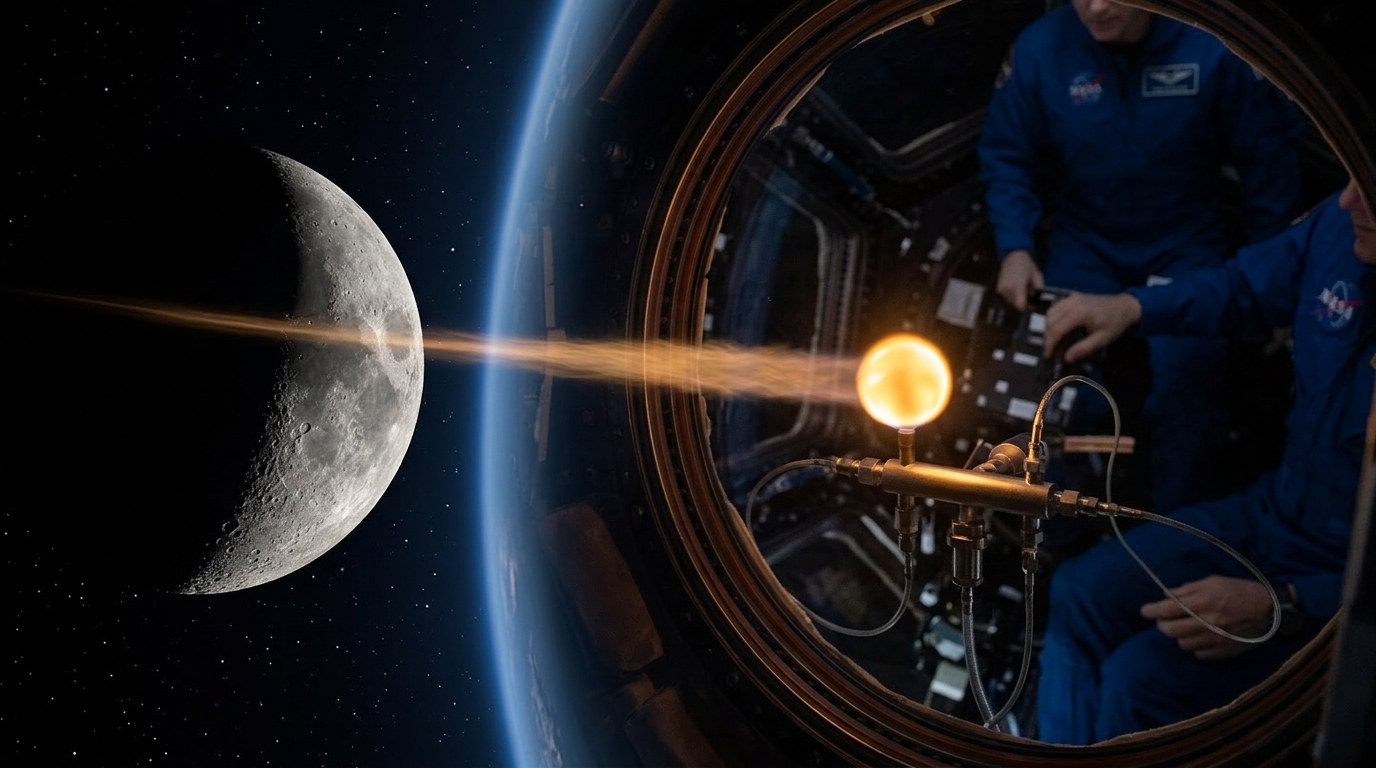
The conquest of the Moon under the Artemis program is not merely a display of technological prowess; it is an exercise in survival within an environment where the most fundamental laws of physics, as we know them on Earth, are upended. One of the greatest risks facing astronauts in a confined lunar habitat is not asteroids or radiation, but fire. Recognizing a significant knowledge gap regarding how combustion behaves in partial gravity (1/6th of Earth's), NASA is preparing a series of groundbreaking experiments to be conducted directly on the lunar surface.
The Trap of Partial Gravity
On Earth, fire behaves in a predictable manner due to buoyancy. Hot air rises, allowing fresh oxygen to feed the flame from below, creating the characteristic teardrop shape. In space, specifically on the Moon, this process is either absent or dramatically altered. In microgravity environments, such as the International Space Station (ISS), flames tend to become spherical. However, the Moon presents a unique challenge: it has enough gravity to influence airflow, but not enough to make it identical to Earth's.
NASA scientists are concerned that materials considered "fire-resistant" or safe for use in terrestrial laboratories might prove extremely flammable in the lunar environment. Without Earth's strong buoyancy, combustion products do not dissipate quickly. This can lead to slow, "invisible" smoldering fires that last longer and release toxic gases into confined living spaces before smoke detectors even register their presence.
The FLARE Experiment and the Legacy of Apollo 1
NASA's history is permanently scarred by the Apollo 1 tragedy in 1967, where three astronauts lost their lives during a ground test due to a cabin fire. This lesson remains vital. The new suite of experiments, titled FLARE (Fire Limits and Extinction), aims to redefine safety standards for materials used in lunar outposts. These experiments will be conducted in specially designed combustion chambers delivered to the Moon via Commercial Lunar Payload Services (CLPS).
- Textile Testing: Astronaut suits and coverings will be exposed to controlled ignition sources to observe flame spread.
- Polymer Materials: Plastics used in 3D printing on the Moon will be tested for their thermal stability.
- Smoke Detection: Development of new sensors that function without relying on thermal air currents.
The core challenge is that on the Moon, heat does not dissipate efficiently. A small ignition source can lead to localized heat buildup, causing sudden flashovers of nearby materials—something that on Earth is often mitigated by the cooling effect of natural air circulation.
Strategy for Permanent Habitation
Establishing the Artemis Base Camp requires the use of In-Situ Resource Utilization (ISRU), meaning many structural components will be manufactured on-site using lunar regolith and polymers. "We cannot rely solely on data from the ISS or Earth," NASA officials state. Understanding combustion at 1/6 gravity is essential for designing ventilation systems and emergency protocols. If a fire breaks out in a lunar base, extinguishing it will be far more complex, as traditional fire suppressants might disperse toxic particles unpredictably in a low-pressure environment.
"Fire on the Moon is not just a hazard; it is a physical phenomenon we must map from scratch if we are to become an interplanetary species."
In conclusion, these experiments represent the cornerstone of 21st-century space safety. NASA is not just looking for ways to put out fires; it is attempting to decode the chemistry of combustion in a world without the protective embrace of Earth's atmosphere and gravity. The results will dictate not only how lunar bases are built but also how future crewed missions to Mars are engineered for safety.