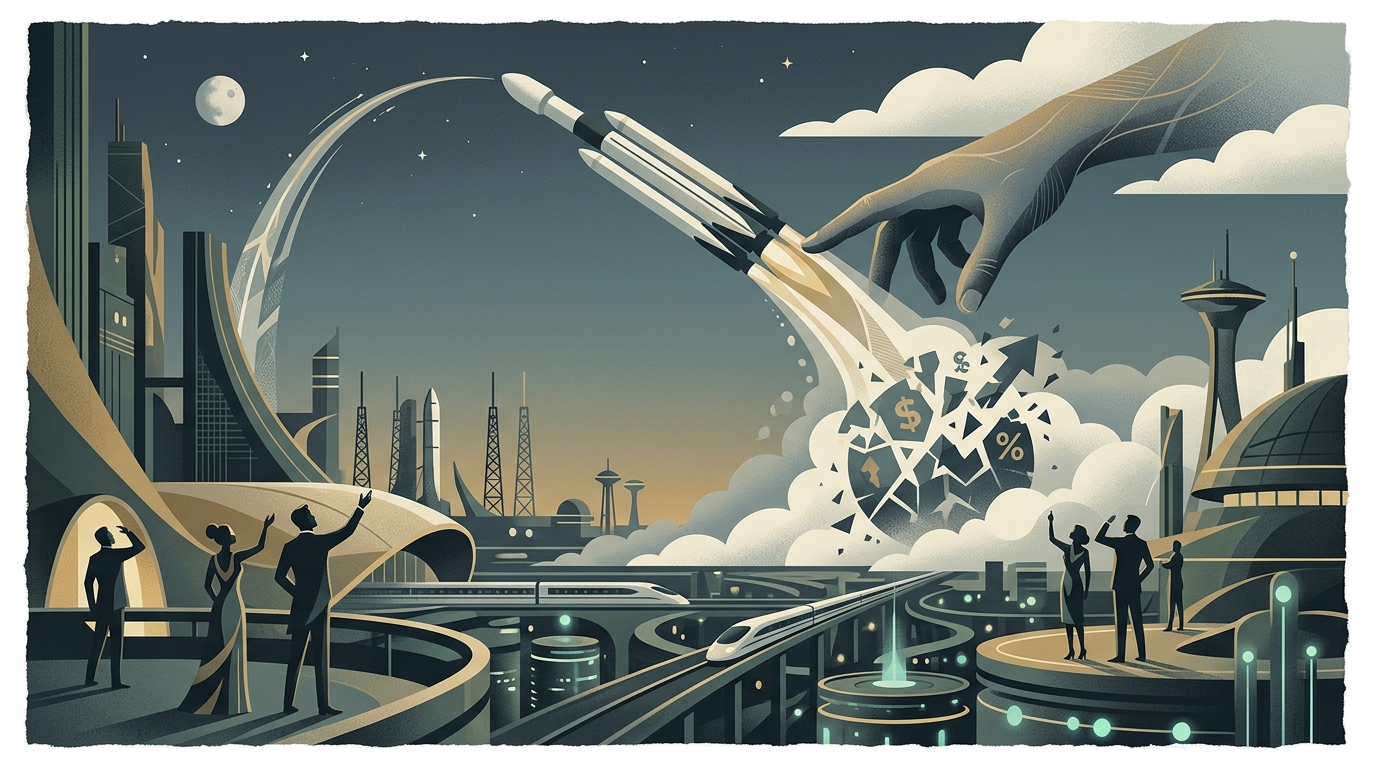
In the world of high-stakes investing, few names carry the gravitas of Jeremy Grantham. The co-founder of GMO, renowned for accurately predicting the three major bubbles of the last few decades—Japan in 1989, the dot-com burst in 2000, and the housing crisis in 2008—has returned with a warning that is sending shockwaves through the financial community. This time, his target is not an entire market, but the ultimate symbol of modern technological ambition: SpaceX.
Speaking on Morningstar's 'The Long View' podcast, Grantham did not mince words. He characterized a potential SpaceX initial public offering (IPO) as the 'craziest in human history.' For Grantham, the company's current valuation, which hovers around $210 billion in secondary markets, is not merely excessive; it is evidence of a collective hallucination that ignores the laws of physics, biology, and, most importantly, economics.
The Anatomy of a 'Super-Bubble'
Grantham argues that SpaceX embodies what he calls a 'super-bubble.' This is a condition where investor optimism completely detaches from fundamental realities. In the case of SpaceX, the narrative of colonizing Mars acts as a powerful capital magnet that lacks any realistic foundation. 'In 50 years, they will tell stories about SpaceX, they will read excerpts from the company's prospectus and they will laugh,' he stated emphatically.
Grantham's critique focuses on the fact that SpaceX is not valued as an aerospace or telecommunications company (via Starlink), but as a quasi-religious promise for the salvation of the human species. This 'futurism premium' allows the company to raise capital at valuations that no other industrial enterprise could dream of. However, Grantham reminds us that history is merciless toward those who promise the impossible: from the South Sea Bubble to the dot-com firms that argued profits didn't matter in the 'new economy.'
Mars: A Business Plan Without Oxygen
The most controversial point of Grantham's analysis concerns Elon Musk's central vision: the colonization of the Red Planet. Grantham considers the idea of turning Mars into a viable economic entity to be 'pure fantasy.' He cites the immense technical challenges, from cosmic radiation to the lack of a breathable atmosphere, and argues that the cost of maintaining a human presence there would be so astronomical that no market could ever sustain it.
'It is an attempt to sell a dream at a time when Earth faces existential crises,' he notes. Grantham sees in SpaceX a dangerous diversion of resources. Instead of capital being directed toward addressing climate change or improving productivity on our own planet, it is being invested in an 'escape plan' that, in his view, will never materialize under the terms Musk describes. For Grantham, SpaceX is the ultimate symbol of the 'late stage' of an economic cycle, where excess liquidity seeks refuge in the most extreme and improbable ideas.
Starlink and the Reality of the Numbers
Despite his harsh criticism, Grantham acknowledges the success of Starlink as a technological feat, but questions whether it is enough to justify the company's scale. Starlink, which provides satellite internet globally, is the only part of SpaceX generating significant revenue. However, Grantham points out that competition in the satellite communications sector is increasing and that profit margins may soon be squeezed as giants like Amazon enter the fray.
The question Grantham poses is simple: If we remove the 'Musk halo' and the Martian promise, what remains? What's left is a rocket launch company with high operating expenses and an internet service in a maturing market. The gap between this reality and a $200+ billion valuation is, according to him, the measure of the 'insanity' that will lead to the final correction. His warning is clear: investors buying into SpaceX today are not purchasing shares; they are buying a ticket to a show that is nearing its final act.