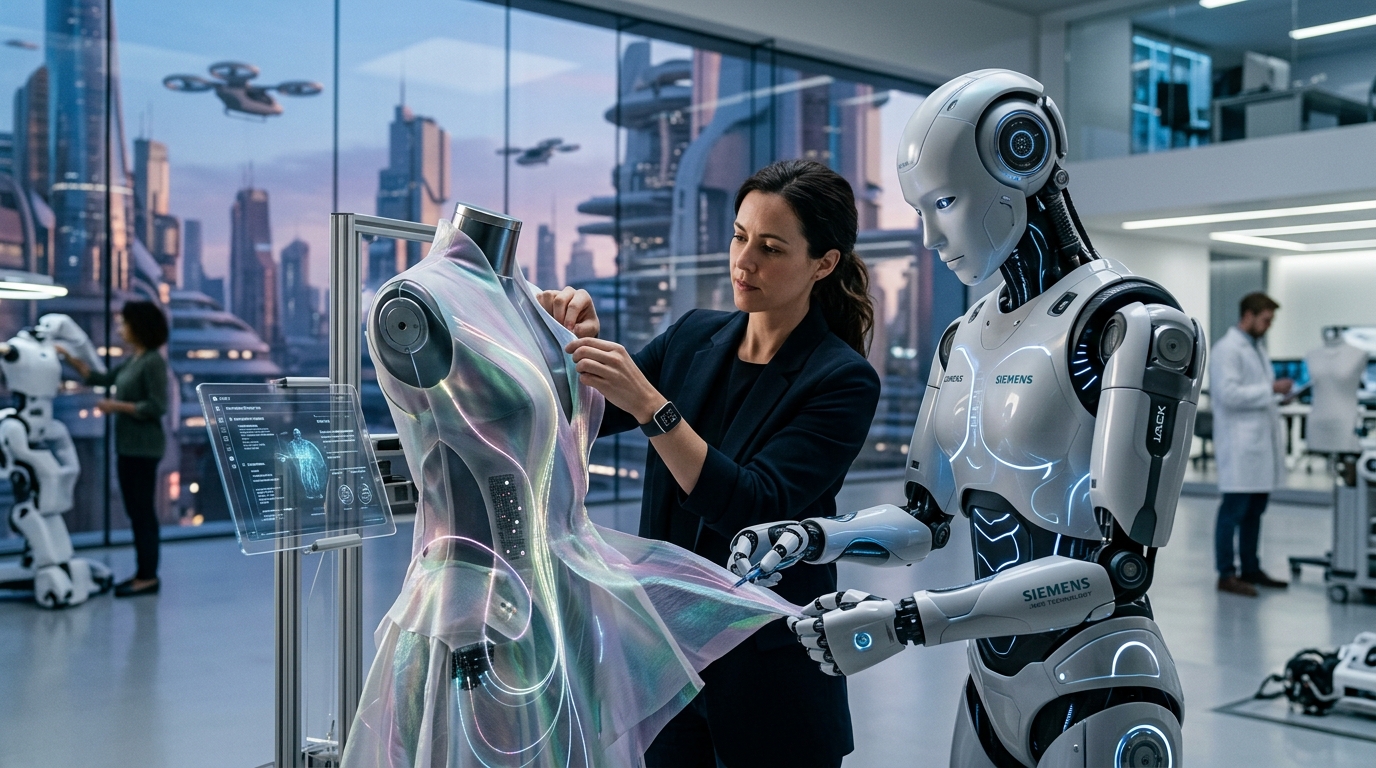
For over a century, the garment industry has remained one of the last bastions of labor-intensive manual work. While automobiles are assembled by robotic arms and electronics are produced in sterile, fully automated cleanrooms, your humble t-shirt likely passed through the hands of dozens of workers in a developing nation. The reason? Fabric is "limp" and unpredictable, making its manipulation by traditional robots a technological nightmare. However, the announcement of a strategic partnership between Jack Technology and industrial titan Siemens promises to overturn this status quo, introducing Artificial Intelligence and humanoid robots to the sewing floor.
The Challenge of Flexible Materials and the AI Solution
The primary difficulty in automating sewing lies in the very nature of fabric. Unlike metal or plastic, fabric stretches, folds, and slides in ways that require constant sensory feedback and fine motor skills—skills humans take for granted but robots have struggled to replicate. Jack Technology, a leader in industrial sewing machinery, is joining forces with Siemens to integrate advanced machine learning algorithms and computer vision systems into the manufacturing process.
Siemens contributes its "Digital Twin" software and Industrial Edge platform, allowing robots to "predict" fabric behavior in real-time. This means the robot is not simply following a pre-programmed path; it adjusts its pressure and movement based on the texture, weight, and elasticity of the material it holds. This represents a fundamental shift from rigid automation to "intelligent" adaptability.
Why Humanoid Robots?
The choice of humanoid robots is neither accidental nor merely for show. Most garment factories worldwide are designed for humans: the workbenches, the aisles, and the sewing machines themselves have ergonomics tailored to the human form. Introducing specialized, bulky robotic systems would require a complete factory overhaul—an investment prohibitively expensive for many manufacturers.
Humanoid robots, equipped with highly sophisticated end-effectors (hands) that mimic human touch, can step into existing infrastructure and work alongside humans or take over shifts in hazardous or repetitive tasks. The use of AI allows these robots to learn by observing human tailors via video—a process known as "Imitation Learning"—dramatically reducing the programming time required for new clothing designs.
Geopolitical and Economic Implications
The move by Jack Technology and Siemens has profound geopolitical consequences. For decades, the fashion industry has relied on the "offshoring" model—moving production to countries with low labor costs. Full automation could lead to "reshoring," bringing production back to Europe and North America. If the cost of robotic labor becomes lower than the cost of manual labor in Asia, companies will prefer to produce closer to their consumers to reduce lead times and the environmental footprint of long-distance shipping.
"We aren't just improving a machine; we are reimagining the logic of global production," executives involved in the partnership stated during the announcement.
However, this raises critical questions about the future of millions of workers in countries like Bangladesh, Vietnam, and Cambodia, where the textile industry forms the backbone of the economy. While Siemens argues that its technology will create new high-skilled jobs in maintenance and programming, the transition is expected to be painful and unevenly distributed.
The Vision of the "Dark Factory" in Apparel
The ultimate goal is the so-called "Dark Factory"—a production facility that operates without lights, heating, or air conditioning because there are no humans inside. With AI monitoring quality at every stitch through high-resolution cameras, error rates could drop to near zero. Furthermore, the capacity for "on-demand" production—sewing a garment only after it has been ordered online—could end the overproduction and waste that plagues the Fast Fashion industry.
In conclusion, the Jack Technology and Siemens partnership is not just a technical upgrade. It is the first serious step toward the digitization of an industry that has remained "analog" for generations. The success of this venture will determine whether the future of fashion remains human-centric or if your next favorite shirt will be the result of a perfect, cold, algorithmic execution.