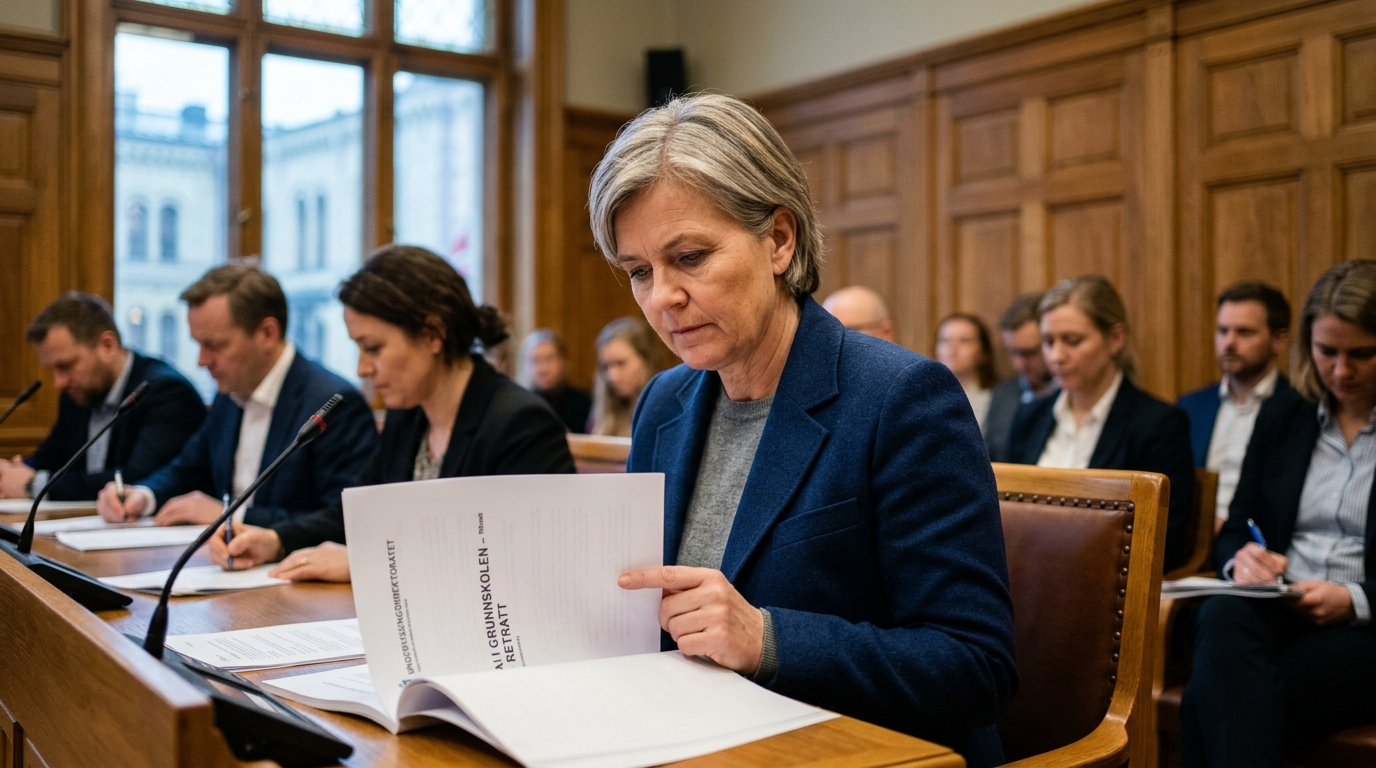
Norway, a nation that for decades stood as the vanguard of digital transformation in education, is orchestrating a historic reversal. In a decision echoing across Europe, the Norwegian government and the Directorate for Education and Training (Udir) have announced a near-total ban on the use of Artificial Intelligence tools for students aged 6 to 13. This move is not merely a technophobic reaction but the result of profound concern regarding the erosion of core cognitive skills in a world increasingly dominated by algorithms.
Norway's Minister of Education, Kari Nessa Nordtun, has been explicit: the "digital naivety" of previous years must yield to a more cautious, evidence-based approach. After years where tablets and laptops replaced paper and pencils, international assessment results (such as PISA) revealed a troubling decline in reading comprehension and focus among students. The proliferation of Generative AI was viewed as the final straw, threatening to turn the educational process into an automated information exchange devoid of critical thought.
A Return to the Roots of Learning
Norway's new policy centers on restoring "deep learning." Educators are now directed to limit the use of chatbots and text-generation tools, shifting focus back to handwriting, reading physical books, and face-to-face classroom interaction. The scientific community in the country strongly argues that for primary school children, the learning process is inextricably linked to motor skills and the neuroplasticity developed through traditional writing.
Under the new guidelines, AI use is permitted only in exceptional circumstances and under strict teacher supervision, primarily to familiarize students with technology as a concept rather than a tool for task completion. "We do not want a generation that knows how to give orders to a machine, but a generation that can think for itself before even touching a machine," a Udir official stated.
The Nordic Model in Crisis?
Norway's move is not an isolated incident. It follows the example of Sweden, which in 2023 began withdrawing digital media from preschools and primary schools, investing millions of euros in re-purchasing physical textbooks. This "Nordic counter-offensive" against hyper-digitalization signals the end of an era where technology was seen as a panacea for every educational challenge.
Critics of the decision argue that the ban will create a skills gap, leaving children unprepared for the future labor market. However, the Norwegian government counters that the foundation for any technological skill is robust linguistic and mathematical literacy, which is undermined when AI provides ready-made solutions. The focus is shifting from what technology can do to how the human brain develops.
Social and Psychological Implications
Beyond the academic sphere, the ban aims to address the mental health crisis and declining attention spans. Constant screen exposure and the convenience offered by AI have been linked to reduced patience and difficulty managing complex problems. In Norway, the debate has moved toward a child's right to an "analog space" for growth, free from the surveillance and direction of algorithms.
In an era where Silicon Valley promotes an AI-first approach to education, Norway is choosing a Human-first path. This experiment will be closely watched worldwide, as it offers an alternative route: one of controlled and conscious technology use, rather than uncritical integration during the most sensitive stages of human development.