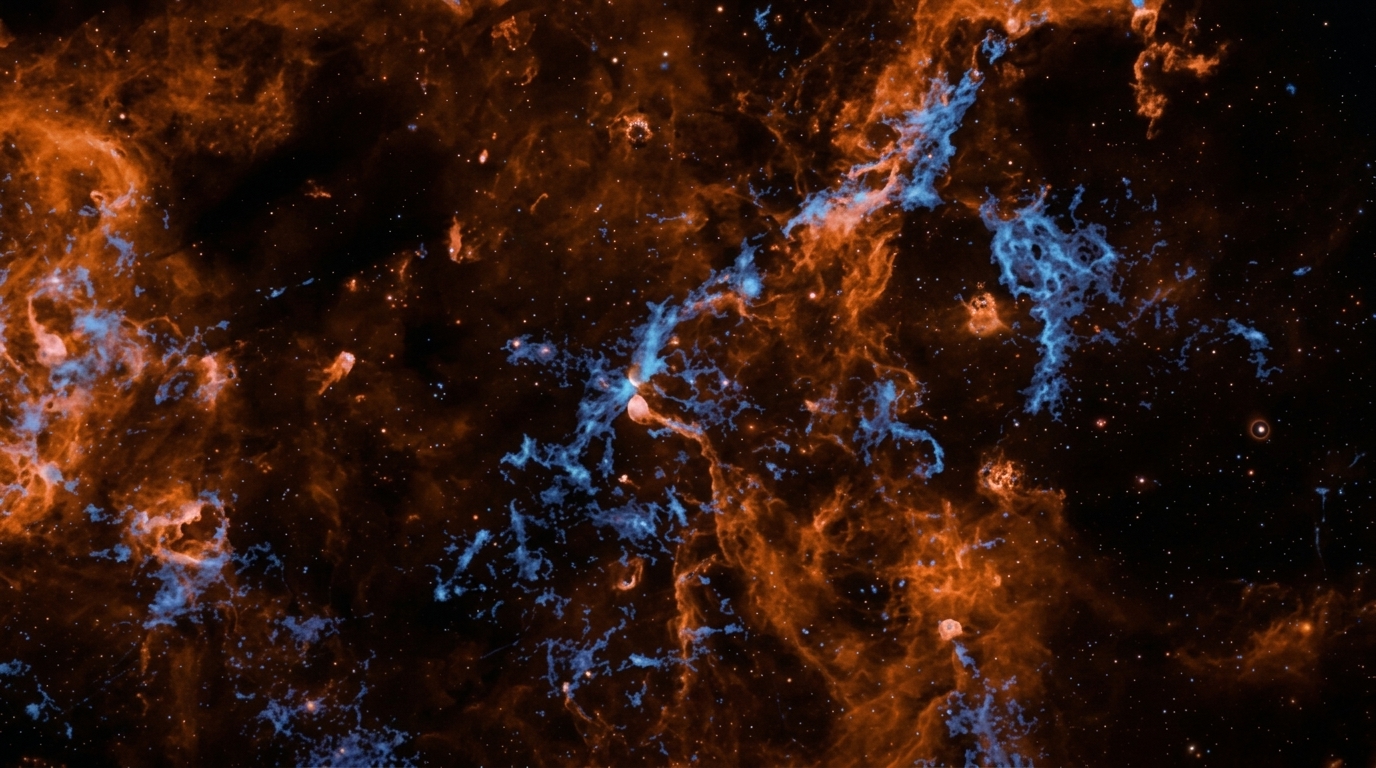
The quest to uncover the origins of water, the most vital element for life as we know it, has taken a monumental leap forward. NASA’s SPHEREx (Spectro-Photometer for the History of the Universe, Epoch of Reionization and Ices Explorer) space telescope has provided scientists with an unprecedented view of "interstellar glaciers" hidden within the dark, chaotic molecular clouds of our Milky Way. These glaciers are unlike anything found on Earth; they are vast concentrations of frozen molecules coating dust grains, waiting to be incorporated into future planets and, perhaps, future oceans.
The Technology Behind the Revelation
SPHEREx is no ordinary telescope. Designed to map the entire sky in near-infrared light, it utilizes a technique called spectroscopy to analyze starlight as it passes through interstellar clouds of gas and dust. When light encounters ice, specific wavelengths are absorbed, leaving a "chemical fingerprint" that scientists can identify. This method has allowed for the identification of not just water ice, but also frozen carbon dioxide, carbon monoxide, and methanol.
These interstellar glaciers are located in regions of intense star formation, such as the Rho Ophiuchi cloud complex. In these areas, gravity causes dense clouds of gas to collapse, leading to the birth of new stars. Around these young stars, protoplanetary disks form, which are rich in these frozen materials. This discovery confirms that water is not a rare "gift" that appears randomly, but a fundamental ingredient that predates the birth of planetary systems themselves.
The Water Cycle on a Galactic Scale
Understanding how water travels from interstellar space to the surface of a planet is crucial for astrobiology. Scientists believe that the ice detected by SPHEREx clings to microscopic grains of silicate dust. As these grains collide and stick together, they form larger bodies, such as asteroids and comets. During the early stages of a solar system's formation, these "frozen messengers" bombard newly formed planets, delivering the water and organic molecules necessary for life.
The sheer volume of ice detected is staggering. In some regions, the mass of the ice far exceeds the total mass of water in all of Earth's oceans combined. This suggests that the Milky Way is a much wetter and more "life-friendly" environment than previously thought. Furthermore, the presence of methanol in the ice is particularly significant, as it serves as a key building block for the synthesis of more complex organic compounds, such as amino acids.
Astrobiological Implications: Are We Alone?
The discovery of interstellar glaciers bolsters the theory of "cosmic seeding." If the basic ingredients of life—water and organic molecules—are ubiquitous in star-forming regions, then the probability of habitable planets existing throughout the Galaxy increases dramatically. It is no longer a question of whether water exists elsewhere, but how that water evolves in environments that can support biological processes.
- Water exists in the form of ice on dust grains even before planets are formed.
- The chemical complexity of these glaciers suggests that organic chemistry begins in deep space.
- The SPHEREx telescope will continue to map these regions, creating a "treasure map" for future life-seeking missions.
In conclusion, NASA reminds us that Earth's story did not begin 4.5 billion years ago in our own solar system, but much earlier, within the frozen darkness of the Galaxy. Every drop of water we drink today may have begun its journey as an ice crystal in an interstellar glacier, billions of kilometers away and billions of years ago.