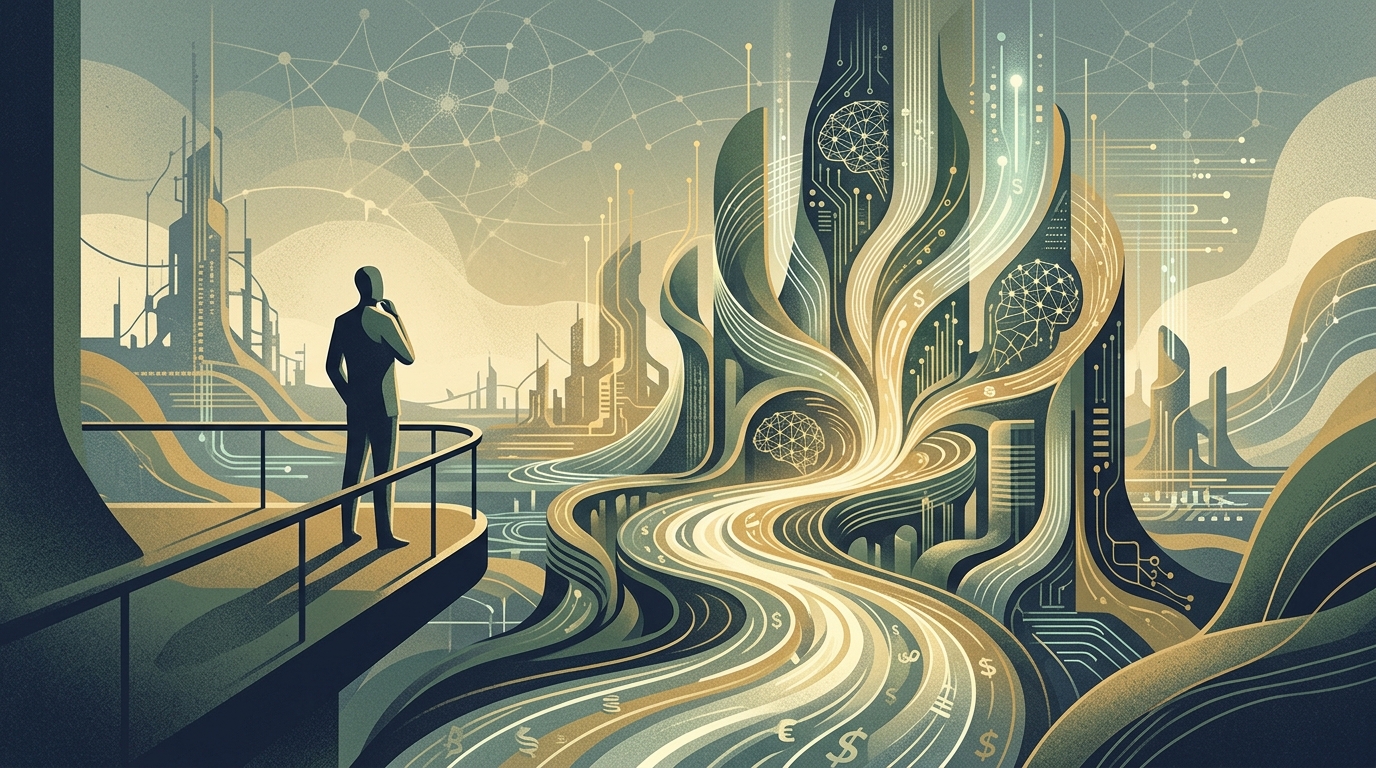
June 2026. If we could visualize the flow of data coursing through the fiber-optic cables beneath the world's oceans, we would witness a staggering shift: human digital footprints have become the minority. For the first time in history, the internet—a global network built for human communication—now belongs, in terms of volume and activity, to Artificial Intelligence. This is not merely a statistical fluctuation; it is a structural upheaval that redefines information, economics, and our very social existence.
The Great Migration of Agents
The rise of autonomous AI agents in 2025 and 2026 has transformed the internet from a library browsed by humans into a battlefield for algorithms. These agents don't just "surf." They scrape billions of pages per second to train new models, execute complex purchases on behalf of their users, compare prices, book flights, and interact with other AI systems without any human intervention.
According to recent analyses, "non-human" internet traffic has surpassed 60%. While in the past bots were considered "parasites" or malicious tools (spam bots), today's AI agents are the legitimate residents of the web. The result is a web operating at speeds and scales that the human brain cannot comprehend. Information is no longer produced primarily to be read by human eyes, but to be consumed by algorithmic APIs.
The Death of the Click and the Collapse of Ad-Tech
The most immediate and painful impact of this shift is felt in the internet's economy. For three decades, the Web was funded by advertising. The model was simple: a human views a page, clicks an ad, and the publisher gets paid. But what happens when the visitor isn't human? An AI agent isn't going to impulsively buy a pair of shoes because it saw a banner. It isn't influenced by marketing, it has no emotions, and it doesn't have "dwell time" in the traditional sense.
- The collapse of traditional display ad revenue.
- The rise of AIO (AI Optimization) replacing traditional SEO.
- The need for new subscription models and "tolls" for AI bots to access quality content.
Major news platforms and content creators are in despair. If users receive their answers directly from ChatGPT or Gemini without ever visiting the source, the economic ecosystem of the free internet is threatened with extinction. Already, in 2026, we are seeing the establishment of "Proof of Personhood"—technologies that require users to prove their biological existence before being granted access to specific communities.
Is the 'Dead Internet Theory' Becoming Reality?
A few years ago, the "Dead Internet Theory" was considered a fringe conspiracy theory. It claimed that the internet had already been taken over by bots and that human interaction was an illusion. Today, that theory looks like a prophecy. With AI-generated content flooding social networks, humans often argue, comment on, or interact with machine-made content that was pushed by algorithms to other machines.
"We are not just in a new era of the internet. We are in its post-human phase, where the World Wide Web functions as the nervous system of a collective artificial intelligence, with humans relegated to the role of mere training data providers."
The challenge for the future is the preservation of the "human oasis." As the internet becomes increasingly hostile to humans—filled with AI noise, endless data loops, and algorithmic coldness—we may see a return to closed, private communities and physical interactions. AI's dominance of the internet is not the end of technology, but it may be the end of the internet as we loved it: as an open, chaotic, and deeply human space.