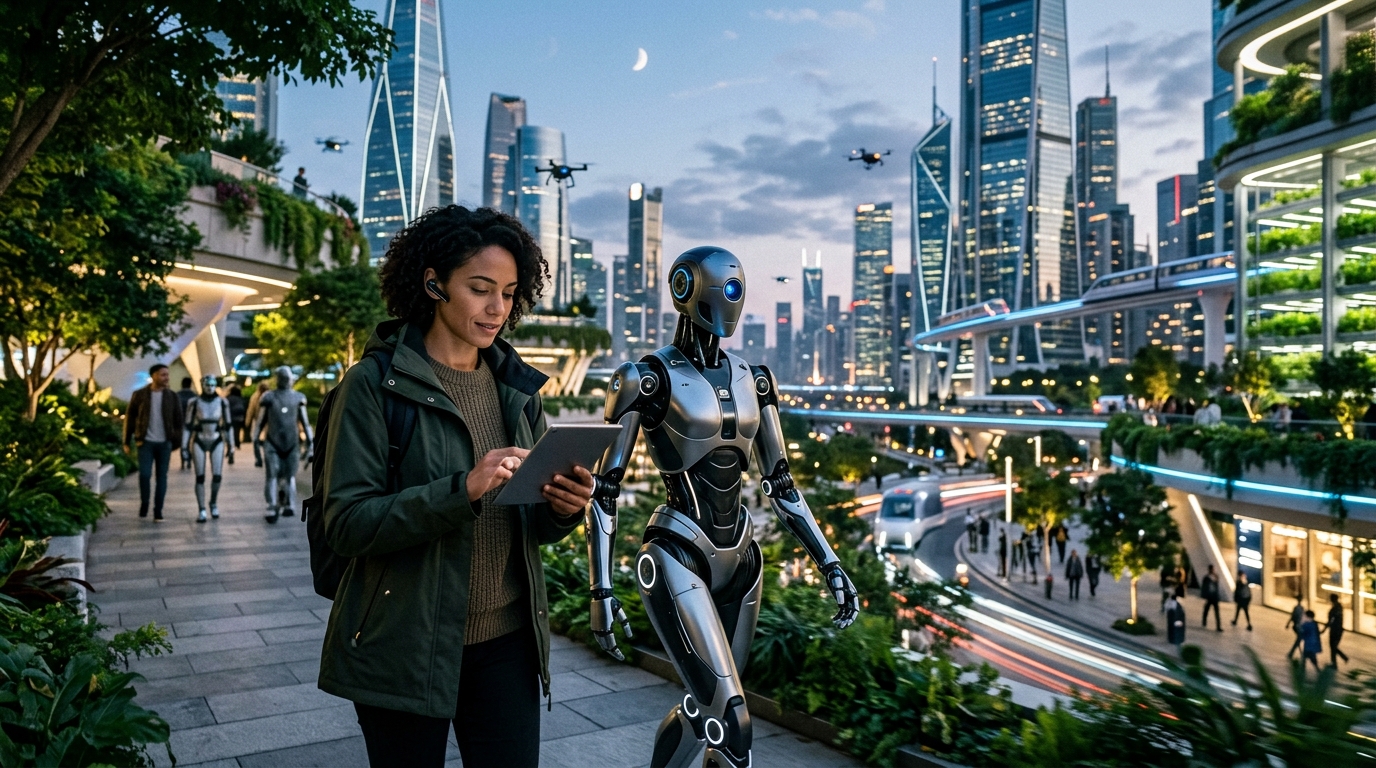
The image of a robot delivering packages, an autonomous shuttle gliding silently through narrow streets, and a central operating system managing energy and waste flows in real-time is no longer a scene from a Ridley Scott film. Today, in April 2026, we stand at the threshold of an urban revolution. The concept of the 'smart city' is evolving into something much deeper: the 'living lab' city, where the coexistence of humans and machines is tested in real-world conditions, redefining what it means to live in a society.
The Architecture of Coexistence: The Woven City Model
In Japan, Toyota’s Woven City, at the base of Mount Fuji, serves as the most prominent example of this new reality. This is not merely a district with fast Wi-Fi; it is a fully integrated digital organism. The city is designed with three types of streets: one for fast autonomous vehicles, one for micro-mobility (bicycles, scooters), and one exclusively for pedestrians, resembling a linear park. Beneath the surface, an invisible network of robotic tunnels handles logistics and goods delivery, freeing the streets from congestion and noise.
The heart of this city is the 'Digital Twin.' Every movement, every unit of energy consumed, and every interaction is recorded and simulated on a digital map. This allows AI to predict residents' needs before they even express them. For instance, if an elderly resident exhibits unusual movement patterns, sensors built into the floors and walls immediately alert the medical center, while a robotic transport vehicle is dispatched to their door.
Ethics and Privacy in the 'Living Laboratory'
However, this utopian vision comes with serious questions regarding privacy. In a city where robots are omnipresent, the notion of 'private space' becomes fluid. The residents of these cities, often employees of the corporations building them, act as volunteers in a perpetual experiment. Data collection is the 'rent' they pay for the convenience provided to them.
- Who owns the data of our daily movements?
- How can we ensure that an algorithm doesn't impose social exclusion on 'unproductive' citizens?
- What happens in the event of a cyberattack that could paralyze the entire city?
Critics argue that these cities risk becoming 'gilded cages,' where human spontaneity is sacrificed on the altar of algorithmic efficiency. The challenge for urban planners in 2026 is to integrate technology without stripping away the 'soul' of the city—the chaos, the serendipity, and the unpredictable nature of human encounters.
The Geopolitics of Urban Artificial Intelligence
The race for dominance in future cities is not just technological; it is geopolitical. While Japan focuses on harmony and an aging population, Saudi Arabia, with its NEOM project and 'The Line,' seeks to create a global innovation hub from scratch, challenging traditional norms of horizontal urban sprawl. In China, cities like Hangzhou utilize Alibaba’s 'City Brain' to control everything from traffic lights to policing, sparking reactions in the West regarding the 'digital surveillance' model.
"The city of the future is not a place where we live alongside machines, but a place where the city itself is the machine," state architects involved in these projects.
This approach is also transforming the labor market. In these cities, traditional jobs in sanitation, maintenance, and transport have been replaced by 'robot supervisors' and data analysts. The challenge of socially integrating those who do not possess these high-tech skills remains the primary obstacle on the governmental agenda.
Conclusion: Towards a New Social Contract
As we move deeper into 2026, the coexistence of humans and robots in urban environments will necessitate a new social contract. Technological excellence is not enough; a legal framework is required to protect humans from the potential arbitrariness of code. The futuristic city must remain human-centric, even if its streets are swept by machines and its decisions are made by neural networks. The success of these ventures will not be judged by the speed of their 6G networks, but by whether their inhabitants still feel like citizens rather than mere users.