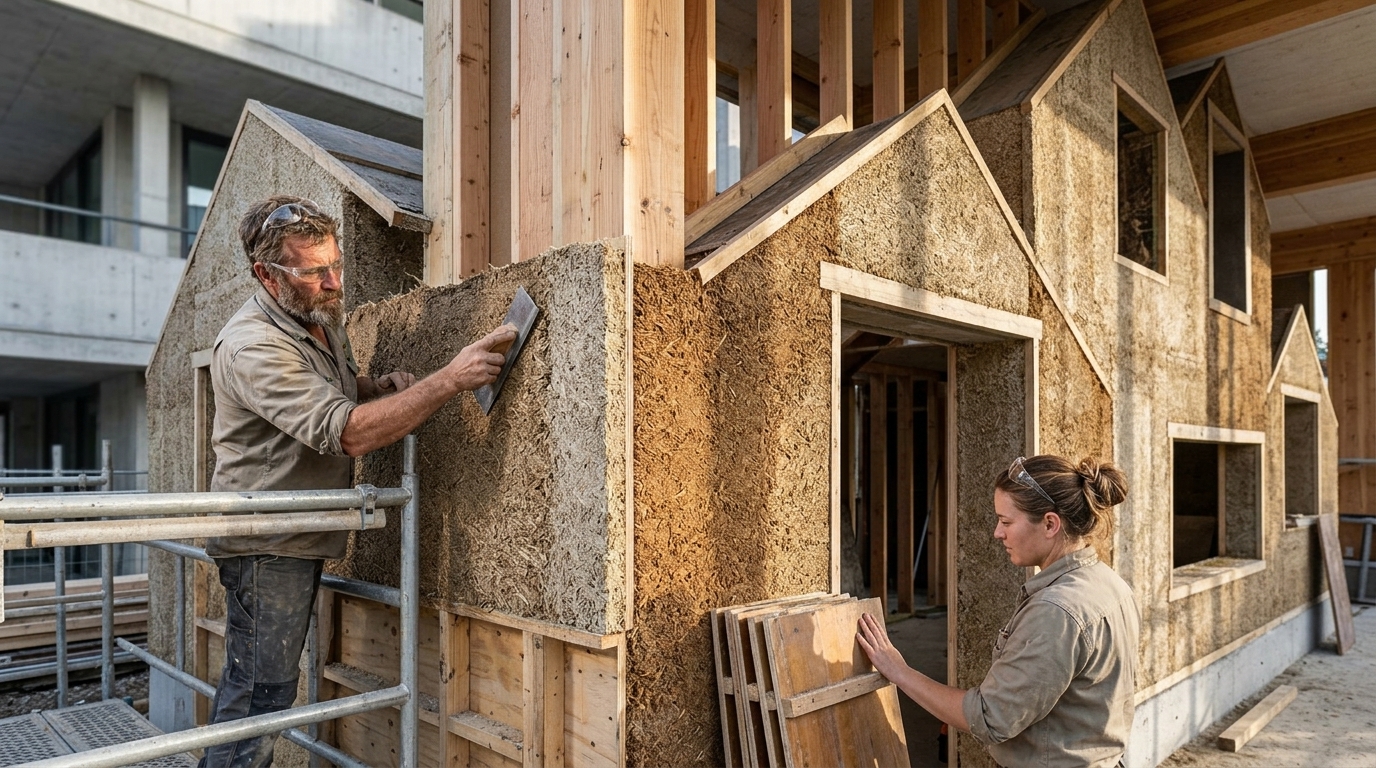
The story of industrial hemp in construction is not new, but its renaissance feels like a revolution at the dawn of the 21st century. After nearly a century of bans and misunderstandings, "hempcrete"—a bio-composite material made from the woody core of the hemp plant, lime, and water—is emerging as the ultimate ally of green building. As the construction industry accounts for nearly 40% of global carbon emissions, the need for materials that do not burden the planet has turned a once "illegal" plant into a valuable industrial resource.
The Science Behind Hempcrete
Hempcrete is not just an alternative brick. It is a material that offers properties traditional concrete simply cannot match. The combination of hemp with lime creates a chemical reaction called carbonation, where the material absorbs carbon dioxide from the atmosphere and petrifies over time. This means a hemp wall continues to clean the air throughout its lifespan.
Furthermore, the material's structure is highly porous, giving it unique thermal and hygrometric properties. Unlike synthetic insulators, hempcrete "breathes," naturally regulating humidity inside the building and preventing mold growth. This "thermal mass" allows homes to stay cool in summer and warm in winter, drastically reducing heating and cooling costs.
From Prohibition to Policy
The return of hemp to the US and Europe has been a complex journey. For decades, industrial hemp was conflated with marijuana, despite its negligible THC content. The legalization of cultivation via the 2018 Farm Bill in the US paved the way, but integrating the material into official building codes was the next major hurdle. In 2022, hempcrete was finally approved for use in residential construction in the International Residential Code (IRC), a development that empowers architects and contractors to use it without bureaucratic friction.
- Carbon Negative: Hemp sequesters more carbon during its growth than is emitted during its production and transport.
- Fire Resistance: Despite its plant-based origin, the lime coating makes the material highly fire-resistant.
- Durability: It does not rot and is naturally resistant to pests and rodents.
Challenges and the Global Market
Despite its advantages, the widespread adoption of hempcrete faces significant obstacles. The primary challenge is the lack of a robust supply chain. Processing hemp requires specialized decortication plants to separate the fibers from the hurd (the woody core). Currently, these facilities are scarce, making the material harder to source than traditional timber or concrete.
Cost also remains a factor, often hovering slightly higher than conventional methods due to the need for specialized labor. However, when factoring in long-term energy savings and the building's longevity, hempcrete proves to be an economically sound investment. Industrial hemp is no longer just a niche material for eco-warriors; it is a sophisticated solution for a world desperate to decarbonize its urban landscape.
A Sustainable Legacy
As we look toward 2030 and beyond, the integration of bio-based materials will be mandatory rather than optional. Hempcrete represents a bridge between ancient agricultural wisdom and modern engineering. It challenges the "fast-building" culture of the last century, proposing instead a legacy of structures that are healthy for both their inhabitants and the planet. The movement is gaining momentum, from luxury eco-resorts in Europe to affordable housing projects in the US, proving that the humblest of plants can hold the key to our architectural future.