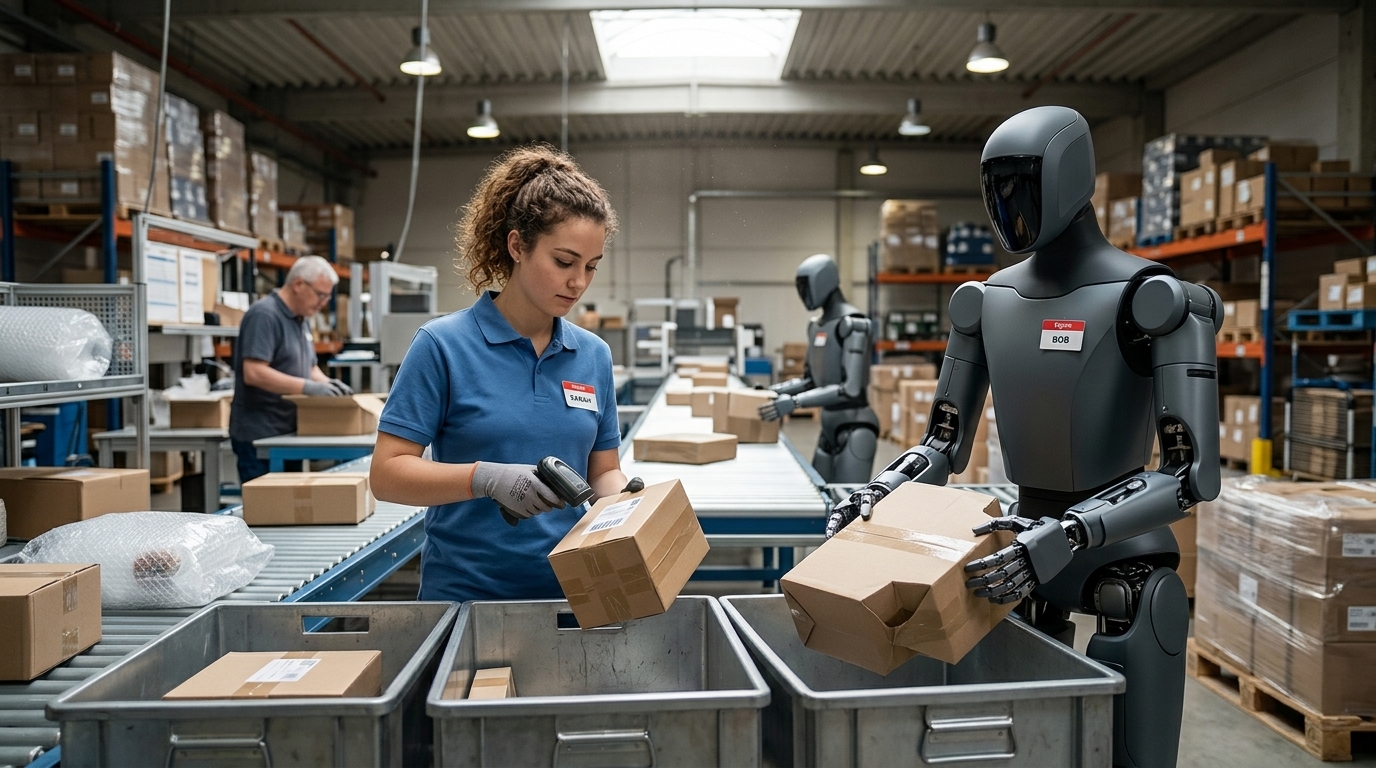
In the heart of Silicon Valley, where the future is drafted in lines of code and titanium joints, a confrontation took place that echoed the biblical battle of David and Goliath. On one side, Figure 01, one of the world's most sophisticated humanoid robots, a product of Figure AI—a company backed by giants like Nvidia, Microsoft, and Jeff Bezos. On the other, a young intern, armed only with human physiology and focus. The battlefield? A ten-hour "marathon" of sorting objects.
The result of the trial was not just a victory for the human species, but a resounding reality check for our expectations surrounding the full automation of labor. Despite the billions of dollars being poured into AI and robotics development, the human ability to manage the unpredictable and maintain a steady pace in complex physical tasks remains, for now, unsurpassed.
The Anatomy of a 10-Hour Showdown
The test was designed to simulate a typical shift in a logistics warehouse. The task was deceptively simple: identifying, picking up, and placing items into specific bins. However, the ten-hour duration introduced variables that robots still struggle to manage. While Figure 01 demonstrated impressive precision in the early hours, its performance began to fluctuate due to technical constraints, such as battery life and the need for sensor recalibration.
The intern, on the other hand, although facing physical fatigue, exhibited what engineers call "dynamic adaptability." When an object slipped or when the arrangement of packages changed unexpectedly, the human could correct their movement in fractions of a second. For the robot, a slight deviation from the programmed environment often meant a "freeze moment" or the need to restart the work cycle.
- Human speed remained consistently higher in high-variability environments.
- The robot required regular breaks for power source swaps and system cooling.
- The fine motor skills of human fingers proved superior in handling fragile or irregular objects.
The Gap Between Laboratory and Reality
Figure AI, led by visionary Brett Adcock, isn't just trying to build a robot; they are trying to solve the global labor shortage. Their strategy relies on creating a "general-purpose" humanoid that can learn through observation (Large Behavior Models). However, the showdown with the intern highlighted the so-called "Moravec's Paradox": high-level reasoning requires very little computation, but low-level sensorimotor skills require enormous resources.
"It is comparatively easy to make computers exhibit adult-level performance on intelligence tests or playing checkers, and difficult or impossible to give them the skills of a one-year-old when it comes to perception and mobility," robotics researchers often note.
In Figure AI's case, the Figure 01 robot is an engineering marvel, capable of conversing with users thanks to OpenAI technology and performing tasks autonomously. But real warehouse work is not a controlled demonstration. It is a chaotic dance of objects, dust, and constant changes. The intern "won" because the human brain is the most sophisticated real-time data processing system we know, capable of self-correction without needing a software update.
The Economic Dimension and the Future of Work
Although the human won this battle, the automation war is still in its infancy. Investors are not deterred by such results; instead, they use them as data to improve the next generation of machines. The cost of a humanoid robot remains prohibitive for most businesses today, reaching hundreds of thousands of dollars, while an intern costs very little. However, the technology's cost curve is declining, while human labor is becoming increasingly expensive and scarce in certain sectors.
The real challenge for Figure AI and its competitors, such as Tesla with Optimus or Boston Dynamics with the new electric Atlas, is reliability. A human can work 8-10 hours with a few food breaks. A robot must be able to work 24/7 with minimal human supervision to justify its cost. Figure 01's "defeat" by an intern shows that the distance to be traveled is still great, but it also highlights how quickly this gap is closing.
Conclusion: Collaboration, Not Replacement
The message from Figure AI headquarters is not one of failure, but a promise of evolution. The intern's victory reminds us of the value of human presence in labor: intuition, adaptability, and resilience. In the future, the most likely scenario is not the complete replacement of humans, but a hybrid form of labor where robots take on the most dangerous and repetitive tasks, leaving humans the role of supervisor and crisis manager. The intern may have won today, but the robot never gets tired of learning.