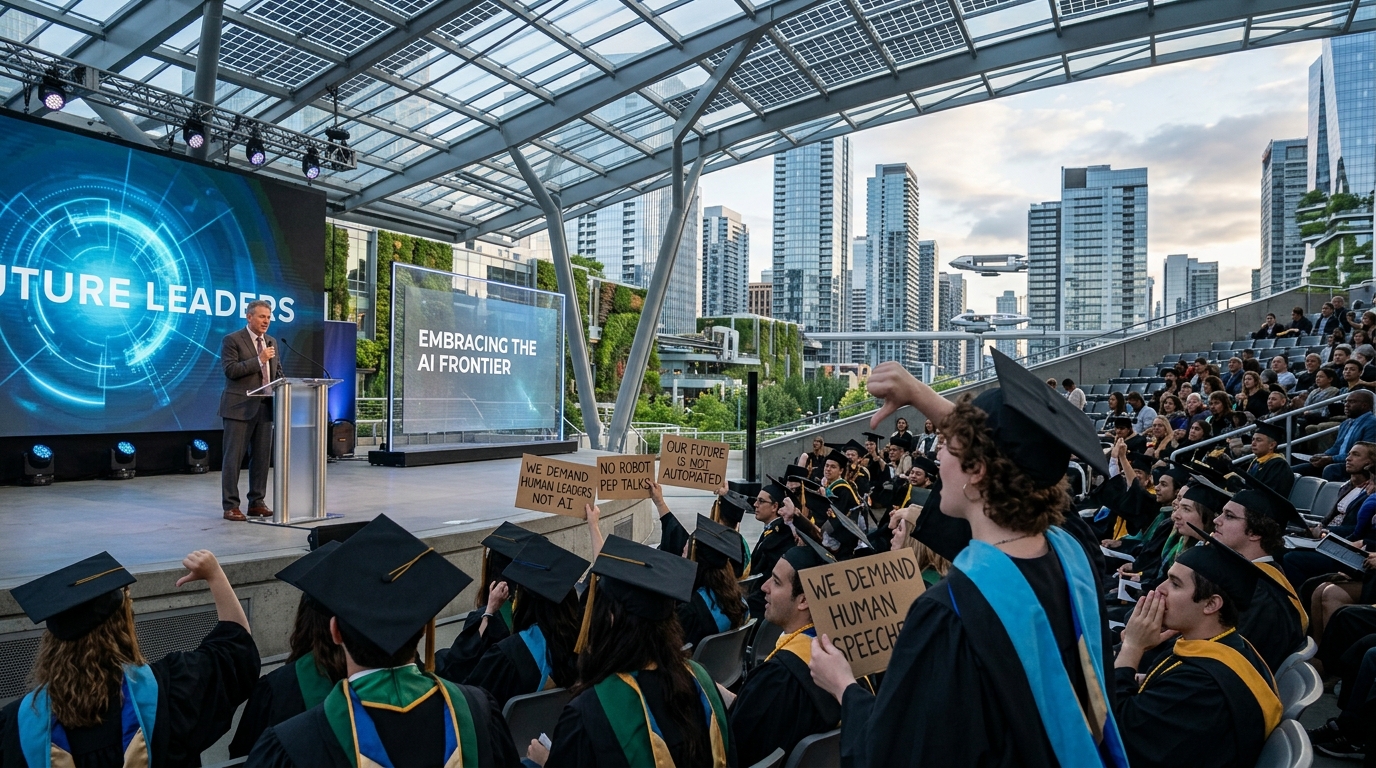
Commencement ceremonies have always served as a sacred bridge between academic preparation and professional adulthood. It is the moment when years of labor are transmuted into hope for the future. However, in 2026, the atmosphere on major university campuses across the United States and Europe has shifted dramatically. Traditional 'pep talks' focusing on the Artificial Intelligence revolution are no longer met with applause, but with boos and a chilling silence that portends social unrest.
The Optimism Gap
The phenomenon recently recorded at universities like Duke and Stanford, where graduates booed speakers presenting AI as the 'ultimate tool of the future,' is not a simple manifestation of youthful contrarianism. It is a profound existential crisis. For the deans and CEOs often invited to the podium, AI is a productivity metric and a promise of technological supremacy. For the graduate who has invested thousands of dollars and countless hours of study, AI looks more like the gallows that will eliminate entry-level jobs.
Students feel that speakers are detached from reality. When a Silicon Valley billionaire tells a humanities or graphic design graduate that 'AI will liberate your creativity,' the graduate hears that 'your skill now has zero marginal cost.' This discrepancy in perception creates an explosive mixture of anger and frustration.
The Threat to Entry-Level Positions
The core cause of the anger is economic. Historically, graduates gained experience through junior positions that involved repetitive but necessary tasks. Today, these very roles—in coding, legal research, translation, and data analysis—are being absorbed by Large Language Models. The Class of 2026 faces an 'experience gap': companies are looking for senior professionals who can manage AI, but they no longer offer the ladder to reach that level.
- Automation of junior roles reduces opportunities for vital mentoring.
- Competition for remaining jobs has skyrocketed, leading to wage compression.
- A pervasive sense that the degree is devalued before the ink on the diploma even dries.
According to recent surveys, over 60% of graduates worry that the skills they acquired are already obsolete due to the speed of algorithmic evolution. Thus, when a speaker urges them to 'embrace change,' the exhortation rings as cynical irony.
The Lost Humanity of the Ceremony
Beyond the economic aspect, there is a moral dimension. Graduation is a celebration of human effort. Students want to hear about values, social contribution, and overcoming adversity. Instead, they are often served a 'techno-gospel' that reduces humans to machine operators. The booing is a cry for a return to anthropocentrism.
"We didn't study for four years to become the 'editors' of an algorithm's mistakes," said one graduate in North Carolina. "We want to build, not just oversee our automated decline."
This stance by graduates is forcing universities to reconsider not only whom they invite as speakers but also how they integrate technology into their narrative. AI cannot be the central theme of a ceremony concerning human development unless the discussion includes job security and the ethical protection of young workers.
Conclusion: Toward a New Social Contract
The boos at commencement ceremonies are the 'canary in the coal mine.' They warn of a generation that feels betrayed by the education system and the labor market. To bridge the gap, industry leaders and academics must stop treating AI as an inevitable deity and start discussing it as a tool that must be placed at the service of human dignity rather than corporate profitability. The Class of 2026 is not rejecting technology; it is rejecting the indifference toward its future.