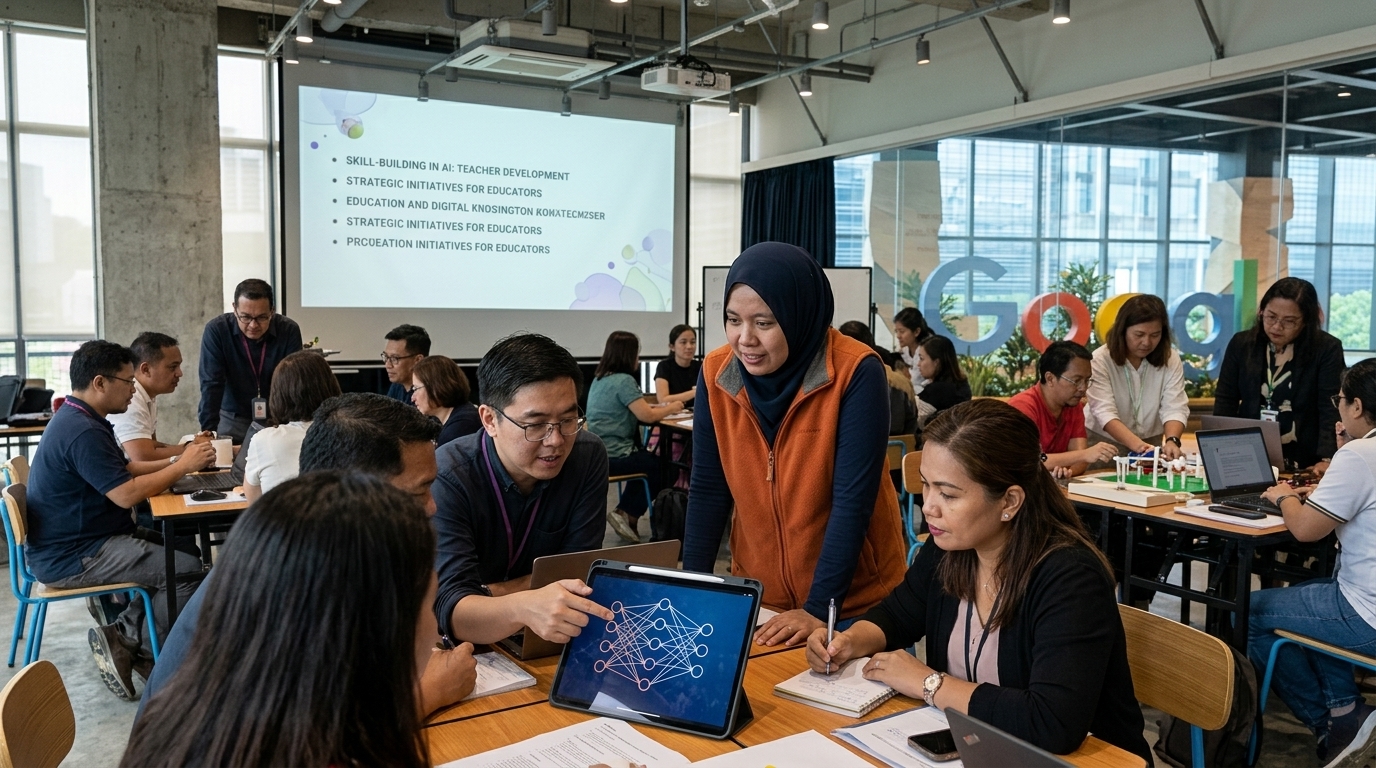
As we navigate the first half of 2026, the global conversation surrounding Artificial Intelligence (AI) has fundamentally shifted. We are no longer asking what the technology can do; we are asking how we can integrate it meaningfully into the human experience. In this context, Google’s announcement to inject an additional $10 million into its AI Opportunity Fund is more than a philanthropic gesture—it is a strategic pivot that places the educator at the heart of the technological revolution.
The Philosophy of Teacher Empowerment
For decades, the introduction of technology in classrooms followed a flawed "top-down" model. Tablets and software were handed to students with the naive hope that learning outcomes would spontaneously improve. Recognizing these historical pitfalls, Google is now championing a different path. The new initiative focuses on upskilling educators, students, and workers, providing them with the conceptual and practical tools to master AI.
The logic is as sound as it is impactful: a single teacher fluent in AI can influence thousands of students over a career. Instead of attempting to reach every student individually, the company is investing in "knowledge multipliers." This is particularly vital in the Asia-Pacific region, where the digital economy is expanding at breakneck speed, yet a persistent skills gap threatens to leave millions behind.
Breaking Down the Investment: Where the Money Goes
The $10 million fund will be distributed through non-profits and educational institutions. The goal is to craft curricula that go beyond mere tool usage—like prompt engineering for Gemini—to address deeper issues.
- Professional development for teachers in rural or underserved areas.
- Scholarship programs for students from marginalized backgrounds.
- Reskilling workshops for workers whose roles are most vulnerable to automation.
This move comes at a time when "AI Literacy" has become a non-negotiable requirement in the global job market. By stepping into this space, Google is acting as a de facto global ministry of education, shaping the framework within which the next generation of the workforce will be trained.
Challenges and the Ethical Stakes
Despite the optimistic rhetoric, the deep integration of Big Tech into public education is not without its critics. There is a valid concern regarding "vendor lock-in," where students and institutions become inextricably tied to a specific corporate ecosystem. Furthermore, the presence of generative AI in classrooms complicates the very nature of academic integrity. How does an educator distinguish between genuine student effort and machine-generated output?
Google’s response suggests that AI should be viewed as a "thought partner" rather than an "answer engine." However, implementing this distinction requires a high level of pedagogical sophistication that many systems currently lack.
"Technology will never replace the teacher, but the teacher who uses technology will eventually replace the one who does not," is a common refrain in Silicon Valley circles.
In regions like Europe, where educational systems are more centralized and regulated, such initiatives must navigate strict GDPR compliance and national curricula. Google appears to be mitigating these tensions by partnering with local NGOs, ensuring that the training is culturally relevant and legally sound.
Conclusion: The Classroom of 2026
The classroom of the future, as envisioned by this initiative, is not a place where children are merely staring at screens. It is a space where the educator, liberated from administrative drudgery by AI automation, has more time for personalized instruction and emotional mentorship. Google’s investment is a high-stakes bet: if successful, AI will become the bridge to a more equitable education. If it fails, it risks becoming another footnote in the history of overhyped educational technology.