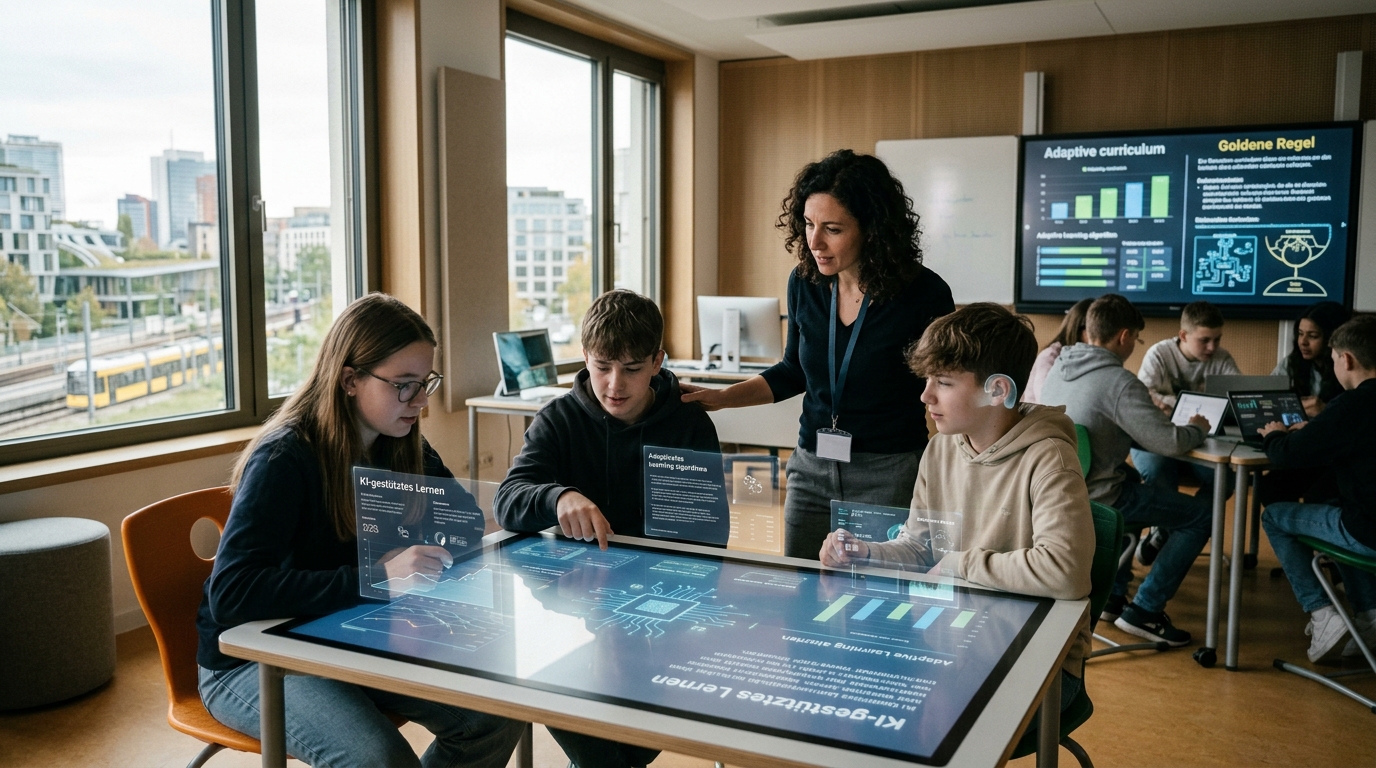
In Germany, a country traditionally known for its meticulousness and adherence to institutional processes, education is undergoing one of the most radical shifts in recent decades. Artificial Intelligence (AI) is no longer an experimental tool in computer labs but a 'learning accelerator' integrated into the core of the teaching process. From Berlin to Munich, the question is no longer whether AI has a place in schools, but how it will be used to enhance critical thinking without replacing human judgment.
The Learning Accelerator: Personalization at Scale
The primary promise of AI in German education centers on personalized learning. In a typical classroom of 25 or 30 students, it is impossible for a teacher to cater to the individual learning paces of every child. This is where Intelligent Tutoring Systems (ITS) step in. These tools analyze student performance in real-time, identify knowledge gaps, and adapt the educational material accordingly.
For instance, if a student struggles with quadratic equations, the system doesn't just provide the answer; it offers supplementary explanatory videos, warm-up exercises, and feedback focusing on the specific point of misunderstanding. This process allows students to progress at their own pace, reducing failure anxiety and increasing self-confidence. In Germany, this approach is labeled an 'accelerator' because it allows for faster curriculum coverage, leaving more time for classroom discussion and deeper exploration.
The 'Golden Rule': Pedagogy Over Technology
Despite the enthusiasm, the German educational community has established a 'golden rule': technology must serve pedagogy, not the other way around. This rule dictates that AI cannot be the 'teacher' but rather the 'assistant.' Final assessment and the emotional support of the student remains the exclusive domain of the human educator.
"Artificial Intelligence can grade an exam or explain a law of physics, but it cannot inspire a student, nor can it understand the social dynamics of a classroom," state experts from the Ministry of Education.
This golden rule translates into practice by using AI to reduce the administrative burden on teachers. Automated grading of standardized tests and lesson plan organization free up valuable time, which educators can then dedicate to personal interactions with students. Furthermore, teaching 'AI literacy' is becoming mandatory, ensuring students understand how these systems work, what their biases are, and why they should not blindly trust every answer provided by a chatbot.
Social Equity and the Digital Divide
One of the greatest challenges Germany faces is ensuring that AI does not widen social inequalities. There is a risk that schools in wealthy states or affluent areas will have access to top-tier AI tools, while others lag behind. To combat this, the federal government is investing billions through the 'Digitalpakt Schule' (Digital Pact for Schools), aiming to provide equal access to hardware and software.
Moreover, AI is being used as an inclusion tool for students with migrant backgrounds. Specialized real-time translation and language learning apps help children who do not have German as their mother tongue follow lessons on equal footing with their peers, accelerating their social integration.
The Data Privacy Challenge
In Germany, data protection (GDPR) is sacred. Using AI in schools requires managing vast amounts of student data, which raises significant concerns. The preferred solution is the development of 'closed' educational ecosystems, where data is neither sold to third parties nor used to train commercial AI models. Many federal states are developing their own platforms, ensuring that the digital sovereignty of education remains in public hands.
In conclusion, Germany is demonstrating a path of synthesis: adopting cutting-edge technology while maintaining the humanistic values of education. AI has not come to replace the school, but to make it more efficient, fairer, and better adapted to the needs of the 21st century.