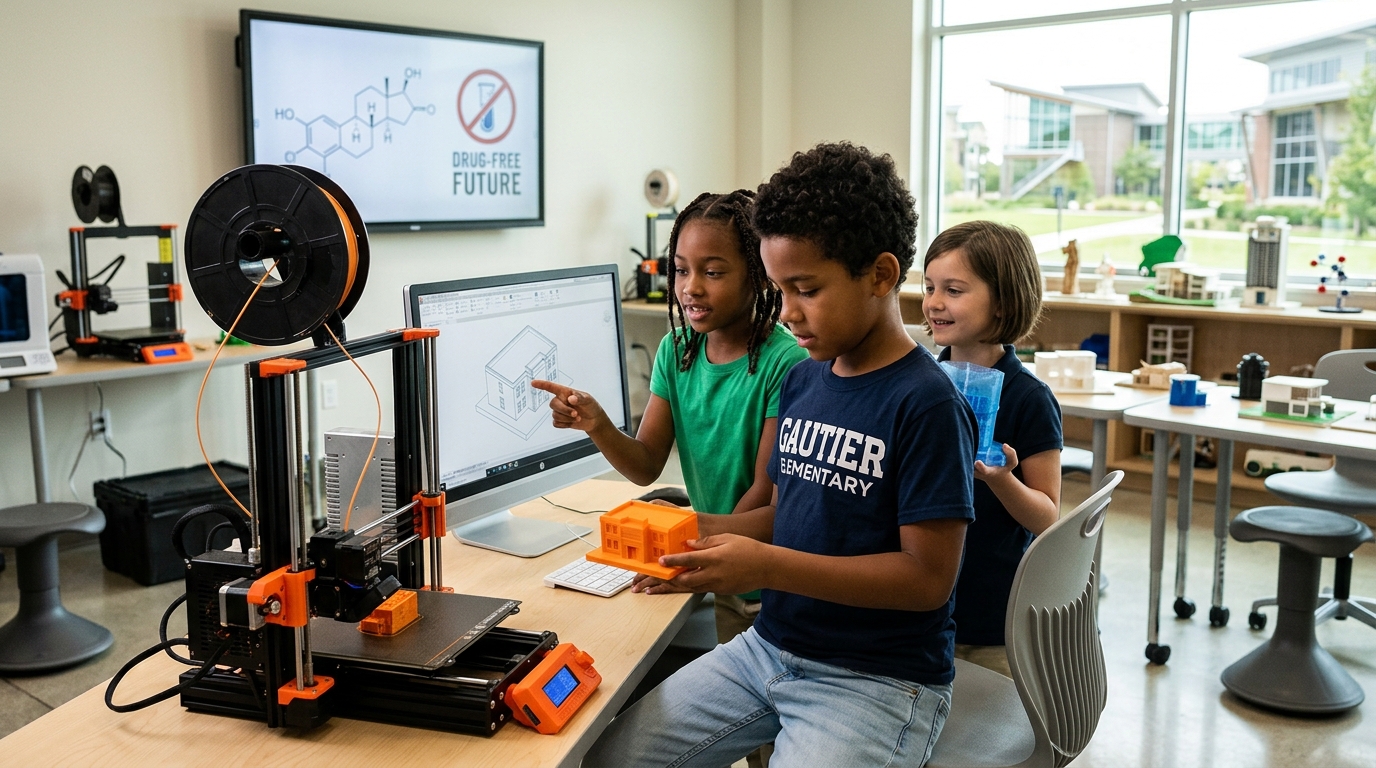
In a classroom in Gautier, Mississippi, the traditional image of students coloring with crayons is being replaced by something far more sophisticated and visionary. Fifth graders at Gautier Elementary aren't just learning about the dangers of substance abuse through handouts; they are using the power of Artificial Intelligence (AI) and 3D printing to design a "Drug-Free City" from scratch. This initiative, launched as part of Red Ribbon Week, serves as a vivid example of how technology can be integrated into social awareness, turning abstract concepts into tangible, three-dimensional results.
The Intersection of STEM and Social Responsibility
The project in Gautier is not a simple computer science exercise. It is a multi-layered educational approach that blends STEM (Science, Technology, Engineering, Mathematics) with civic education. Students were asked to contemplate: What does a city that promotes health and well-being look like? What infrastructure is necessary to keep youth away from addiction? Using AI image generators, the children transformed their ideas into visual blueprints. From recreational parks and youth centers to advanced hospitals and schools, AI allowed ten-year-olds to function as urban planners.
The use of AI in primary education is often met with skepticism, primarily due to concerns about intellectual effort. However, in Gautier's case, AI acted as a creativity catalyst. Instead of being limited by their artistic skills, students focused on conceptual development. The ability to correctly formulate "prompts" for image generation is a new form of digital literacy, requiring precision of language and critical thinking. Following the creation of digital models, the baton was passed to 3D printers, which gave physical form to the children's visions, teaching them the principles of engineering and the manufacturing process.
From Passive Consumption to Active Creation
Traditional education often relies on the passive consumption of information. The "Drug-Free City" project flips this model. Students are no longer spectators of a lecture but creators of solutions. The 3D printing process requires patience, problem-solving, and an understanding of the physical world's limits. When a model fails to print correctly, the student must analyze why, return to the digital design, and fix it. This iterative process is the heart of the scientific method.
- Boosting self-confidence through the completion of complex projects.
- Developing collaboration skills as students work in teams to assemble parts of the city.
- Gaining a deeper understanding of social issues through visualization.
Furthermore, linking technology with the anti-drug message adds a new weight to Red Ribbon Week. Instead of the usual slogans, children create an environment where the choice of a drug-free life is embedded into the very fabric of their city. This creates a stronger psychological connection to the message, as the students have invested time and creative energy into building this ideal world.
Preparing the Generation of AI-Natives
As Artificial Intelligence becomes an integral part of daily life, education must adapt. The students in Gautier are not just learning to use tools; they are learning to coexist with them. The ability to use AI to solve social problems is a skill that will be invaluable in the future. However, this also raises questions about the digital divide. How many schools can afford to provide 3D printers and access to advanced AI software? The Gautier case highlights the need for equal opportunities in technological education so that the "AI generation" is not divided into the privileged and the underserved.
"Technology is not the end goal, but the means to empower our children's voices on issues concerning their future," say educators involved in the program.
In conclusion, the initiative of the fifth graders in Mississippi serves as a lighthouse for the future of education. It shows that when we provide children with the right tools and the freedom to dream, they can build—literally and metaphorically—a better, healthier, and more innovative world. Gautier's "Drug-Free City" may be a scale model, but the skills and values it cultivates in its creators are immense.