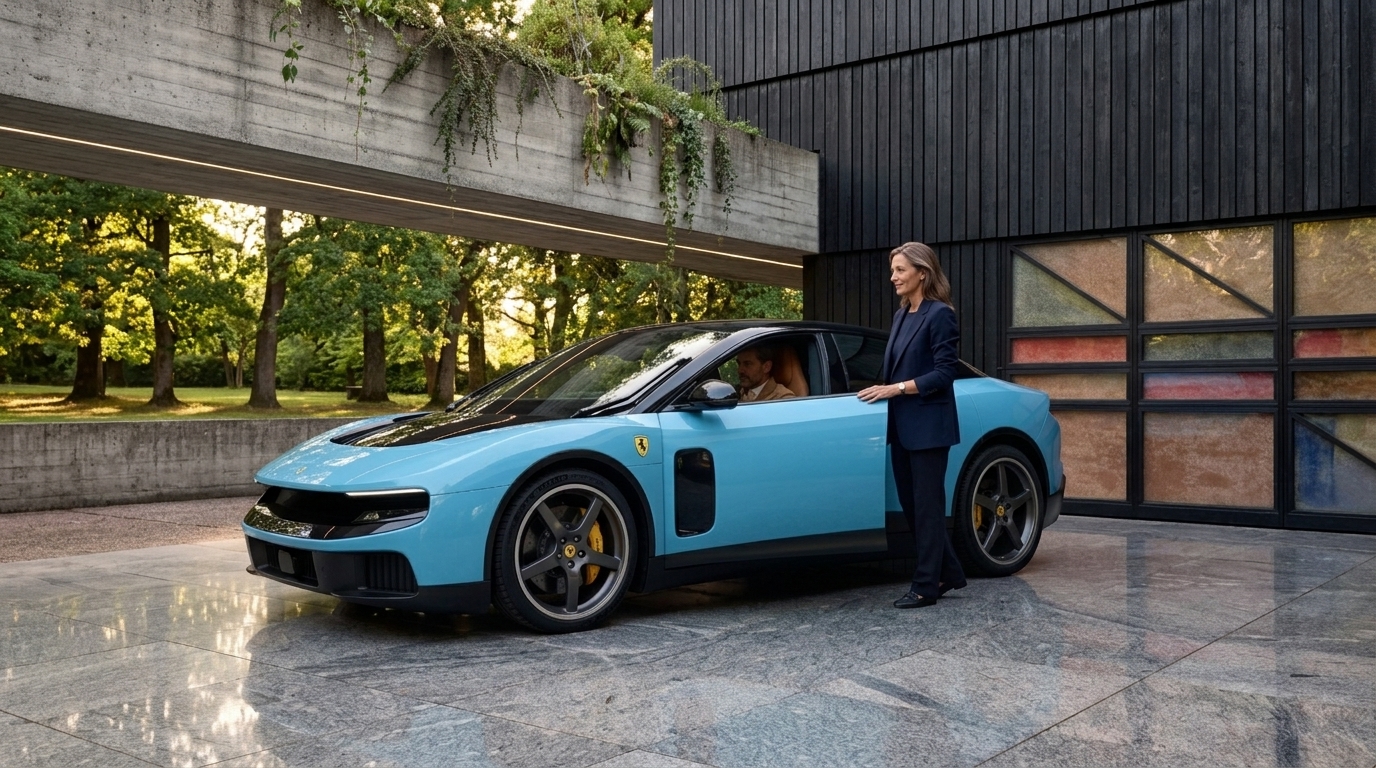
The silence at Maranello is no longer a sign of stagnation, but the prelude to a revolution. For decades, Ferrari has been synonymous with the roar of V12 engines and the scent of high-octane gasoline. Today, the unveiling of the Ferrari Luce marks the end of an era and the beginning of a new one, where the Prancing Horse gallops on electron power. Delivering 1,000 horsepower with a price tag approaching €550,000, the Luce is not just a car; it is Italy's answer to the existential challenge of climate change and stringent European regulations.
The Engineering of Emotion in the Electric Age
The biggest question faced by the engineering team under the leadership of Benedetto Vigna was not speed—electric motors provide plenty of torque—but emotion. How do you transfer Ferrari's DNA into a vehicle that lacks pistons and camshafts? The Luce utilizes a groundbreaking battery architecture integrated into the chassis, keeping the center of gravity extremely low and offering a driving experience that, according to early tests, surpasses even the SF90 Stradale in responsiveness.
The Luce is equipped with three electric motors—one on the front axle and two on the rear—allowing for full torque vectoring on each wheel individually. This means the car can "dance" through corners with a precision that was impossible with traditional differential mechanisms. Acceleration from 0-100 km/h is achieved in less than 2 seconds, placing the Luce at the very top of the hypercar pyramid.
The €550,000 Gamble and the Luxury Market
The €550,000 price point places the Luce in a category where competition is limited but fierce. Ferrari is not competing with Tesla; it is competing with Rimac and the upcoming electric offering from Lamborghini. The company's strategy remains the same: "always one car less than the market demands." Production of the Luce will be strictly limited, ensuring that resale value remains at staggering heights, as is the case with every iconic Maranello model.
However, the Luce also carries another innovation: the "sonic DNA." Ferrari developed a system that doesn't just play fake sounds through speakers but uses the natural vibrations of the electric motors and amplifies them through special resonators in the bodywork. The result is a unique, high-pitched sound reminiscent more of a futuristic fighter jet than a traditional car, providing the driver with the acoustic feedback necessary for limit-pushing driving.
The E-Building: The New Home of Innovation
To support this transition, Ferrari inaugurated the "e-building" in Maranello, a state-of-the-art production facility where batteries, electric motors, and transmission systems are manufactured in-house. This move is of strategic importance, as Ferrari refuses to become a mere "assembler" of third-party components. Maintaining control over the technology is what will allow the company to preserve its high profit margins and technological edge.
The Luce is not the end of the road, but the beginning of a new family of models. By 2030, Ferrari aims for 40% of its sales to come from fully electric models. The challenge will be to convince traditional collectors, who adore the mechanical complexity of internal combustion engines, that the future is just as exciting. With the Luce, Ferrari seems to be winning the first round, proving that luxury and performance can survive—and thrive—without a single drop of gasoline.