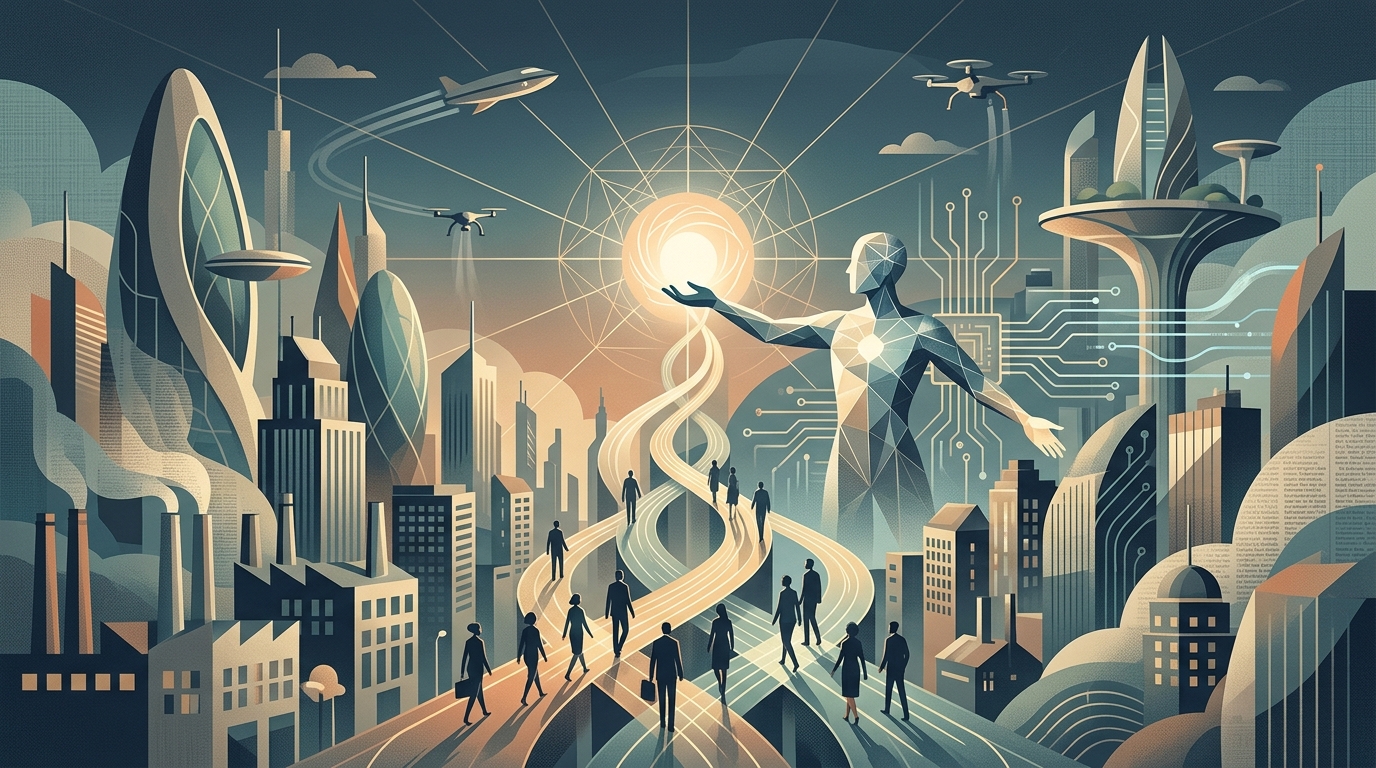
In an era where Artificial Intelligence (AI) is radically transforming the employment landscape, Elon Musk, the controversial yet consistently influential visionary behind Tesla and SpaceX, has put forward a proposal that pushes the boundaries of traditional economic thought. During recent public appearances, Musk did not limit himself to the idea of a 'Universal Basic Income' (UBI), but went a step further, introducing the term 'Universal High Income' (UHI). This proposal isn't merely about citizen survival in a jobless world; it's about ensuring a life of radical abundance.
The Transition from Survival to Abundance
For years, sociologists and economists have warned that automation would require a safety net—UBI—to prevent mass poverty. However, Musk argues that AI will not just replace labor, but will make the production of goods and services so inexpensive that the concept of 'scarcity' will effectively vanish. 'There will be no shortage of goods or services,' he stated, envisioning a world where robots, such as Tesla’s Optimus, perform every manual and repetitive task.
In this context, 'High' income is not a luxury, but the logical consequence of an economy where production costs approach zero. Musk envisions a future where the state provides citizens with checks that allow them to purchase whatever they desire, as supply will be practically unlimited. This approach upends the capitalist model based on labor as the primary mechanism for resource distribution.
The End of Labor and the Existential Void
The greatest challenge Musk identifies is not economic, but psychological. If work ceases to be necessary for survival, how will humans find meaning in their lives? For centuries, individual identity has been inextricably linked to one's profession. In Ancient Greece, 'schole' (leisure) was considered the highest state for intellectual cultivation, but in modern industrial society, idleness often leads to alienation and despair.
Musk argues that in a world with Universal High Income, work will become optional—a 'hobby' for those who wish to contribute or create. However, critics point out that this utopia hides risks of social disintegration. Without the structure provided by a work environment, society may face a crisis of purpose, where consumption becomes the only activity, leading to a form of spiritual lethargy.
Funding and Geopolitical Implications
The question that remains unanswered is 'who pays?' Musk implies that taxing the surplus value generated by AI and robotics will be the source of these funds. If a company can produce millions of products without a human workforce, its profits will be astronomical, and a significant portion of these must be redistributed via government checks.
Furthermore, this transition could create new global inequalities. Countries leading in AI development (such as the US and China) will have the capacity to implement UHI, while developing economies that rely on cheap labor may face collapse. Musk’s proposal, while sounding like science fiction, forces us to seriously reconsider the social contract of the 21st century. Artificial Intelligence is not just a productivity tool; it is a catalyst that may force us to redefine what it means to be human in a society without material needs.