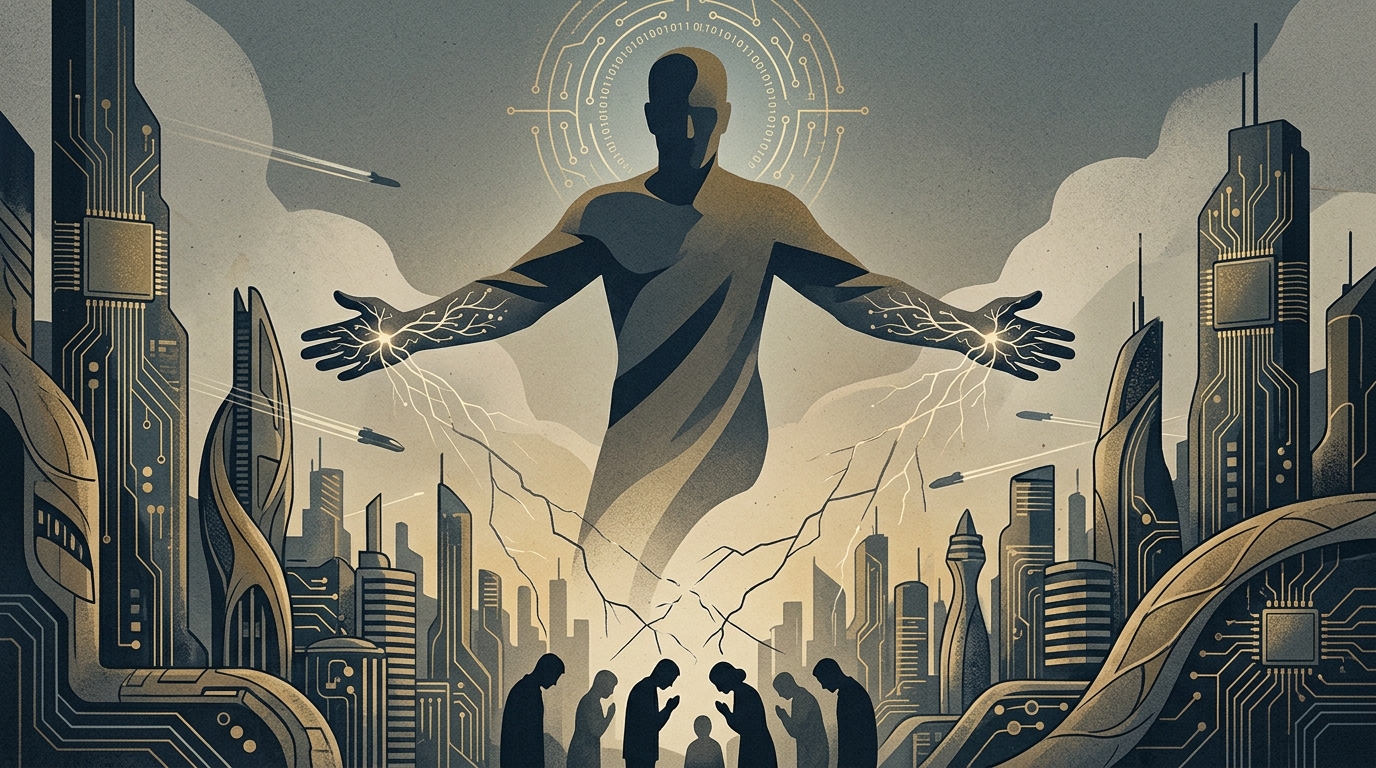
In the recent annals of technological evolution, few figures have managed to polarize public opinion as effectively as Elon Musk. However, his latest pronouncement regarding Neuralink—his brain-computer interface (BCI) venture—has transcended the boundaries of typical corporate hyperbole. By characterizing Neuralink’s technology as 'Jesus-level,' Musk was not merely referencing an innovation; he was issuing a promise to fundamentally rewrite human biological destiny.
The comparison to the miracles of Christ, such as healing the blind and restoring mobility to the paralyzed, is far from accidental. In Musk’s worldview, technology is no longer just a tool for convenience but a mechanism for 'salvation.' Neuralink aims to implant microscopic electrodes into the brain that can interpret neural signals and bypass damaged nerve pathways. While the scientific foundations of the endeavor are grounded in reality, the rhetoric surrounding it raises profound questions about ethics, scientific deontology, and the psychology of modern technological messianism.
The Promise of 'Blindsight' vs. The Scientific Reality
The centerpiece of Musk’s recent claims is the 'Blindsight' project. According to the billionaire, the device will enable individuals who have lost both eyes and their optic nerve to see again. 'Even if someone has never had vision, if they were born blind, we believe we can restore vision,' he stated. This claim sent waves of hope through millions while simultaneously triggering intense skepticism within the medical community.
Neuroscientists point out that while direct stimulation of the visual cortex has been studied for decades, the quality of vision current technology can provide is a far cry from a 'miracle.' Early stages will likely offer low-resolution imagery, akin to the graphics of early Atari video games. The gap between perceiving a few points of light (phosphenes) and full visual perception is immense. Nevertheless, Musk insists that progress will be exponential, eventually leading to vision that surpasses human capabilities, including infrared or ultraviolet perception.
Ethical Dilemmas and the Peril of False Hope
One of the most thorny issues is the management of patient expectations. When one of the world's wealthiest individuals uses religious terminology to describe a medical product, he creates a moral obligation that science may not be ready to fulfill. The use of the word 'miracle' implies a certainty that simply does not exist in clinical trials.
- Data Transparency: Neuralink has faced criticism for a lack of peer-reviewed scientific publications, opting instead for 'show-and-tell' events and announcements on X (formerly Twitter).
- Animal Welfare: Allegations regarding the treatment of research animals in previous years remain a shadow over the company’s reputation.
- Long-term Safety: Placing a foreign object in the brain carries risks of infection, tissue scarring, and electrode degradation over time.
The danger lies in turning medical research into a public relations spectacle. If Neuralink fails to deliver the 'miracle' promised, the damage to public trust in biotechnology could be catastrophic. Conversely, if it achieves even 10% of its stated goals, it will have altered the trajectory of human history.
The Technological Messianism of Silicon Valley
The comparison to Jesus is not just verbal flair; it reflects a broader culture within Silicon Valley. It is the belief that the hardships of the human condition—pain, disability, and even death—are merely 'bugs' in the biological code that can be patched with the right software and hardware.
"Technology is the new religion, and CEOs are its high priests. When Musk talks about curing blindness, he isn’t selling a device; he’s selling a new version of humanity."
This approach, often associated with transhumanism, seeks the eventual merger of man and machine. Musk has repeatedly stated that Neuralink is necessary for humans to compete with Artificial Intelligence in the future. In this context, restoring sight and mobility is just the first step toward a 'symbiotic' relationship with AI.
Conclusion: Between Hope and Hesitation
History will determine whether Elon Musk will be vindicated as a modern Prometheus or remembered as an Icarus who flew too close to the sun of his own hubris. Neuralink has already taken a significant step with the successful implantation in its first human patient, Noland Arbaugh, who demonstrated the ability to control a computer with his thoughts. This is an undeniable achievement.
However, the use of religious metaphors to market technological products requires caution. Science progresses through questioning and proof, not through faith. While we all hope for a day when paralysis and blindness are relics of the past, the road to that future must be paved with ethical integrity and scientific rigor, not just provocative tweets.