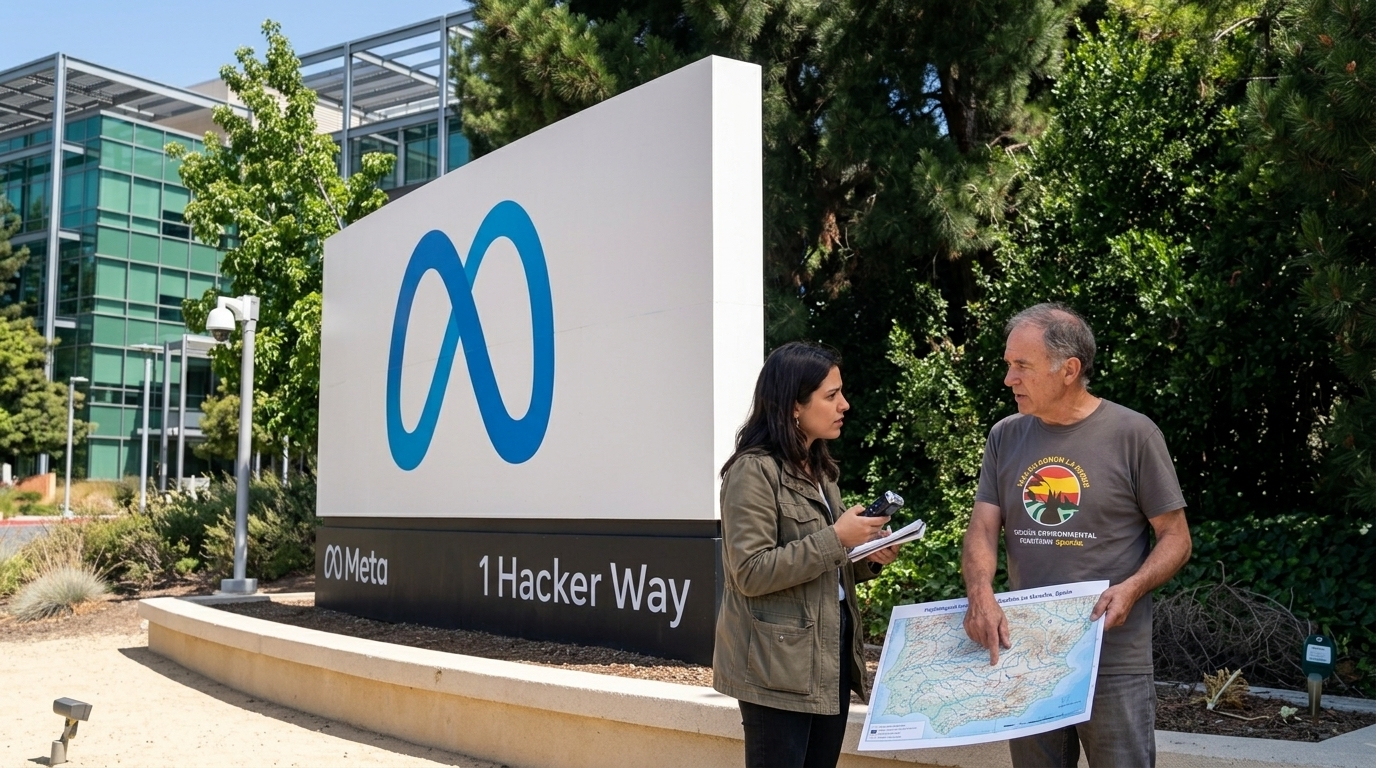
The digital economy, despite the ephemeral nature suggested by the term "cloud," rests upon a deeply physical and energy-intensive infrastructure. The recent news regarding the construction of a new, gargantuan data center by Meta (the parent company of Facebook and Instagram) in Talavera de la Reina, Spain, brings a harsh reality to the forefront: the relentless collision between technological expansion and environmental sustainability. The project, expected to cost over €1 billion, is causing alarm not just because of its scale, but primarily due to the "footprint" it will leave on the already strained water resources of the Iberian Peninsula.
The Thirst of Artificial Intelligence and the Utah Experience
To understand the magnitude of the issue, one must look at Meta’s track record. In Eagle Mountain, Utah, a similar data center was accused of "drying out" the region, consuming millions of gallons of water in a state plagued by historic droughts. Data centers require massive amounts of water for their cooling systems to prevent the overheating of thousands of servers that process data for billions of users and train new Artificial Intelligence models.
In the case of Talavera de la Reina, the estimates are shocking. According to environmental organizations and local stakeholders, the data center could consume up to 665 million liters of water annually. This represents approximately 8% of the region's available water resources. In a country like Spain, which has faced unprecedented periods of water scarcity due to the climate crisis in recent years, granting such quantities of water to a multinational corporation is viewed by many as "environmental suicide."
Economic Growth vs. Ecological Survival
The regional government of Castilla-La Mancha welcomed the investment with enthusiasm, highlighting job creation and the technological upgrade of the area. However, the criticism is fierce. Opponents of the project argue that the jobs created are disproportionately few compared to the environmental damage. Furthermore, an ethical question arises: Who takes priority in water access? Local farmers, residents for their basic needs, or the servers of a company aiming to maximize profits through the Metaverse and AI?
Meta, for its part, promises a "water positive" footprint by 2030, claiming it will return more water to the environment than it consumes through wetland restoration projects and water network improvements. However, these promises are met with skepticism, as immediate consumption remains a reality, while the benefits of compensatory projects are often long-term and uncertain.
The European Challenge and the Future of Infrastructure
The Spanish case is not isolated. Across Europe, from Ireland to the Netherlands, local communities are pushing back against the proliferation of data centers. The European Union finds itself in a difficult balancing act: on one hand, it desires digital sovereignty and the attraction of high-tech investments; on the other, it is bound by the Green Deal to protect natural resources.
The need for a stricter regulatory framework is now imperative. Energy efficiency (PUE) is no longer enough; water usage effectiveness (WUE) standards must be established, and alternative cooling methods, such as using seawater or locating data centers in northern climates, must be explored. Meta’s case in Spain serves as a critical test of whether Europe is willing to sacrifice its natural capital on the altar of digital acceleration. "Thirsty" AI is not merely a technical issue, but a profound political and ethical challenge that will determine the sustainability of our societies in the 21st century.