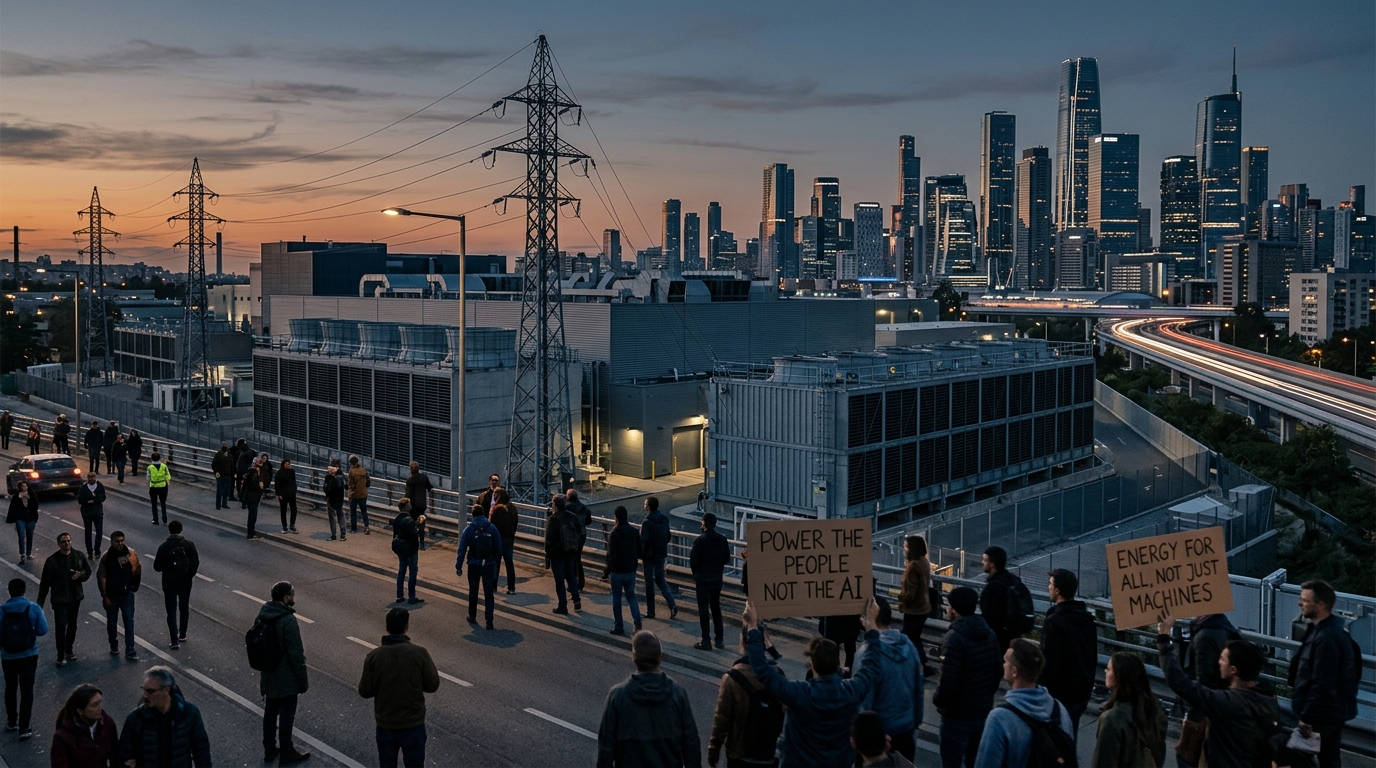
For decades, the concept of "The Cloud" was marketed as something ethereal—an intangible digital realm where our data floated safely above the messiness of the physical world. However, the generative AI boom of 2023 and 2024 has decisively shattered that illusion. Artificial Intelligence does not live in a cloud; it lives in massive, humming concrete fortresses filled with thousands of energy-hungry processors that require staggering amounts of electricity and water. Today, as tech giants race to build the infrastructure of the future, they are hitting an unexpected and growing wall of resistance: a backlash from local communities and national power grids.
The Insatiable Appetite for Power
The core of the conflict lies in energy consumption. A single ChatGPT query consumes roughly ten times as much electricity as a standard Google search. As Generative AI is integrated into every facet of our digital lives, global energy demand for data centers is projected to double or even triple by the end of the decade. In Ireland, data centers already consume 21% of the country’s total electricity—more than all urban households combined. In Northern Virginia, the world's data center capital, demand is so intense that utilities are struggling to build new transmission lines fast enough, sparking fury among residents who see their landscapes carved up by high-voltage pylons.
This surge complicates global climate commitments. While Microsoft, Google, and Amazon have pledged ambitious "net zero" goals, their actual carbon emissions are rising due to data center construction. This contradiction creates a political minefield. Governments are being forced to choose between the economic promise of the AI revolution and the environmental mandates they have promised their voters. In Amsterdam and Singapore, temporary moratoriums on new data center construction have already been enacted, sending a clear signal: space and energy are no longer infinite resources.
Local Resistance: Noise, Water, and NIMBYism
Beyond the abstract numbers of the power grid, there is a visceral human dimension. The NIMBY (Not In My Backyard) movement has found a new target. Residents living near data center hubs complain about the constant low-frequency hum of cooling fans, the visual blight of massive windowless warehouses, and, most critically, water usage. In an era of increasing droughts, using millions of gallons of water to cool servers is seen as an environmental provocation. In Uruguay, public outcry forced Google to scale back its plans, while in Chile, courts have halted projects over concerns about local aquifers.
- Acoustic Pollution: Data centers operate 24/7, creating a persistent noise floor that can affect mental health and property values.
- Resource Competition: Cooling often requires potable water, putting tech giants in direct competition with local agriculture and residents.
- Infrastructure Burden: The need for massive substations and transmission lines disrupts local landscapes without providing significant long-term employment.
Strategic Shifts: The Nuclear Option
Faced with this backlash, Big Tech is pursuing radical solutions. The most significant trend is the pivot toward nuclear energy. Microsoft recently signed a deal to help restart a reactor at Three Mile Island, while Amazon and Google are investing in Small Modular Reactors (SMRs). The logic is simple: if the public grid cannot provide the power, the companies will generate it themselves, effectively privatizing energy infrastructure to secure their AI ambitions.
"We are at a tipping point where digital progress is being constrained by the physical reality of copper, concrete, and electrons," says a leading industry analyst.
Simultaneously, technological innovation is focusing on efficiency. New liquid cooling systems and more efficient silicon are being deployed. However, the industry faces "Jevons' Paradox": as technology becomes more efficient, the cost of using it drops, which often leads to an increase in total consumption rather than a decrease. The more efficient AI becomes, the more we will use it, further straining the physical world.
Conclusion: Progress Under Pressure
The backlash against data centers is unlikely to stop the advancement of AI, but it will fundamentally reshape how it grows. The era of unchecked expansion is over. The future of AI will be decided not just in the software labs of Silicon Valley, but in town hall meetings and the control rooms of national power grids. The industry must now prove that the value generated by AI justifies the immense physical and social costs it imposes. If it fails to do so, the AI revolution may find its limit—not for a lack of intelligence, but for a lack of power.