In an era where "digital fatigue" is a clinical reality and parents face a daily battle to limit their children's screen time, an unexpected educational revolution is taking place in the neighborhoods of Chicago. The question it poses is provocative: Can we prepare the next generation for the age of Artificial Intelligence (AI) without using computers at all? The answer, according to an innovative after-school program, is a resounding "yes."
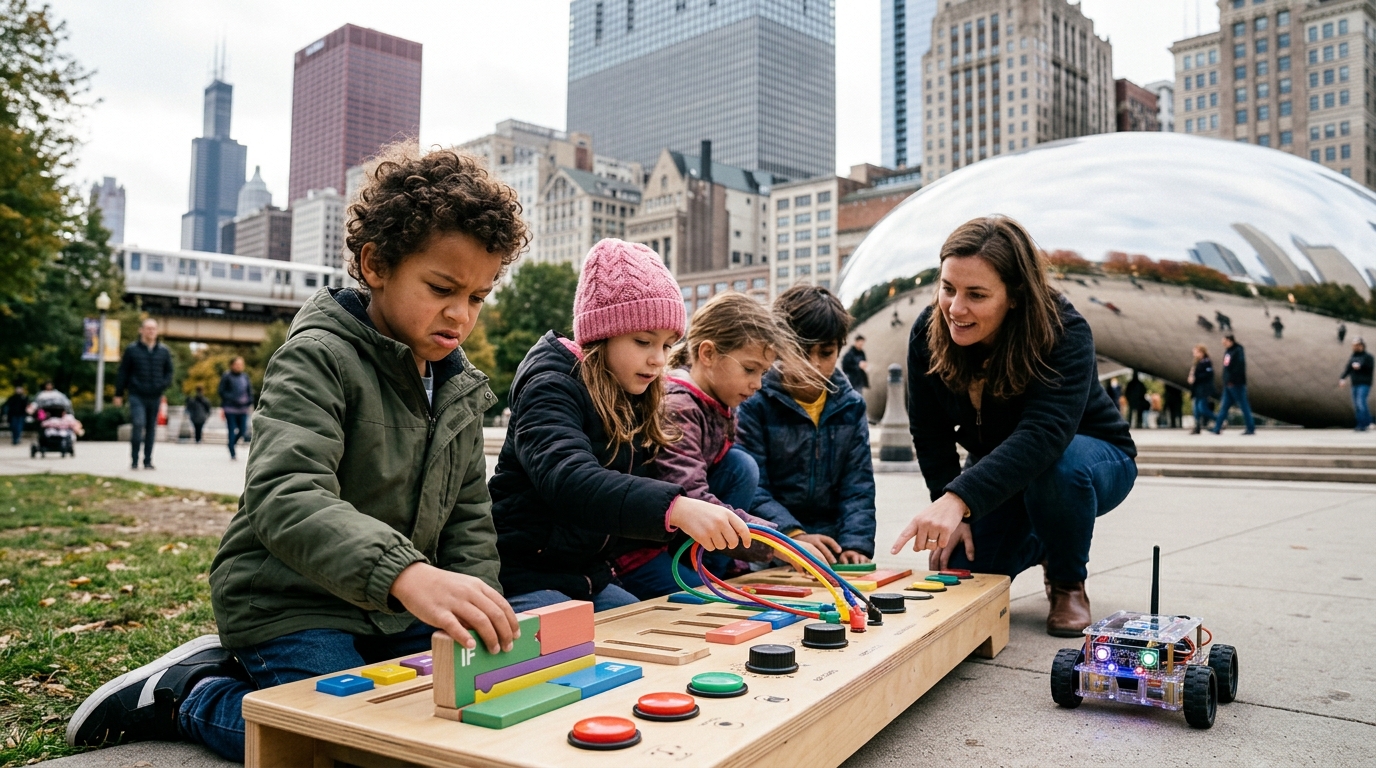
This approach, known as "unplugged AI," is not an attempt to return to Luddism, but a profound strategic choice. Instead of code and pixels, children use cards, blocks, role-playing, and physical movement to understand the abstract concepts that govern algorithms. The goal is to demystify the "magic" of technology and replace it with a solid understanding of logic and ethics.
The "Unplugged" Philosophy: From Consumption to Comprehension
The Chicago program, supported by researchers from elite institutions like Northwestern and the University of Chicago, focuses on "computational thinking." This means children learn to break down complex problems into smaller steps, recognize patterns, and design instructions — exactly what an algorithm does. For instance, one activity involves "training" a classmate acting as a robot to make a sandwich. If the instructions aren't perfectly precise, the "robot" fails, demonstrating the critical importance of data input accuracy.
This method removes the barrier of technical complexity. Often, in traditional computer science education, kids get lost in the syntax of a programming language or the technical glitches of software. Without the screen, the focus remains on the core: How does a machine make decisions? How do our own biases affect the outcome?
Bridging the Digital Divide
One of the most critical aspects of the program is its social dimension. In Chicago, as in many major cities, access to high-end technology is not a given for everyone. Many schools in underserved areas lack the latest computers or high-speed internet. Unplugged learning acts as a great equalizer. You don't need a $2,000 MacBook to learn how a neural network works if you can represent it with a net of ropes and human nodes in the schoolyard.
Furthermore, the lack of screens encourages social interaction. AI is often portrayed as a solitary pursuit, but in reality, it is a collective human creation. Through collaboration, children learn that technology is a tool in the hands of the community, rather than an impersonal force imposed from above.
Ethics and Bias: Lessons on the Playground
Perhaps the most important lesson delivered in these programs concerns the ethics of AI. Children are taught about "algorithmic bias" through simple sorting games. If a group is asked to categorize images of fruit but is only given red fruits, they soon realize their "system" will fail to recognize a green banana. This simple example translates directly to how facial recognition systems or hiring algorithms can discriminate.
Understanding these concepts at a young age is vital. It's not enough to know how to use ChatGPT; one must know why ChatGPT might be wrong and what the social implications of those errors are. The Chicago program treats children not as future tech consumers, but as future citizens who will be called upon to regulate and oversee these systems.
A Model for the Future of Education
As the Chicago experiment expands, educators worldwide are watching closely. Its success suggests that AI education should not be confined to computer labs. It can — and should — be integrated into math, literature, and even physical education. The ability to think algorithmically and critically is a life skill, independent of whether a child becomes a programmer or an artist.
In a world overwhelmed by digital information, returning to the physical, the tangible, and the hands-on might be the most effective way to understand humanity's most abstract creation. Chicago shows us that to see the future of technology clearly, sometimes we just need to turn off the screen.