As the global demand for Artificial Intelligence (AI) processing power grows at an exponential rate, the limitations of terrestrial infrastructure are becoming increasingly apparent. Energy consumption, the massive water requirements for cooling, and geopolitical tensions surrounding data centers are forcing tech giants to look upward. The question is no longer whether we will send data into space, but whether space itself can become the backbone of a global, orbital supercomputer.
The Orbital Edge Computing Revolution
The traditional approach to satellite technology relied on collecting data and beaming it down to ground stations for processing. However, the volume of data generated by modern Earth observation sensors is now so vast that uploading it creates severe latency issues and bandwidth congestion. The solution lies in installing AI processing units directly onto the satellites themselves.
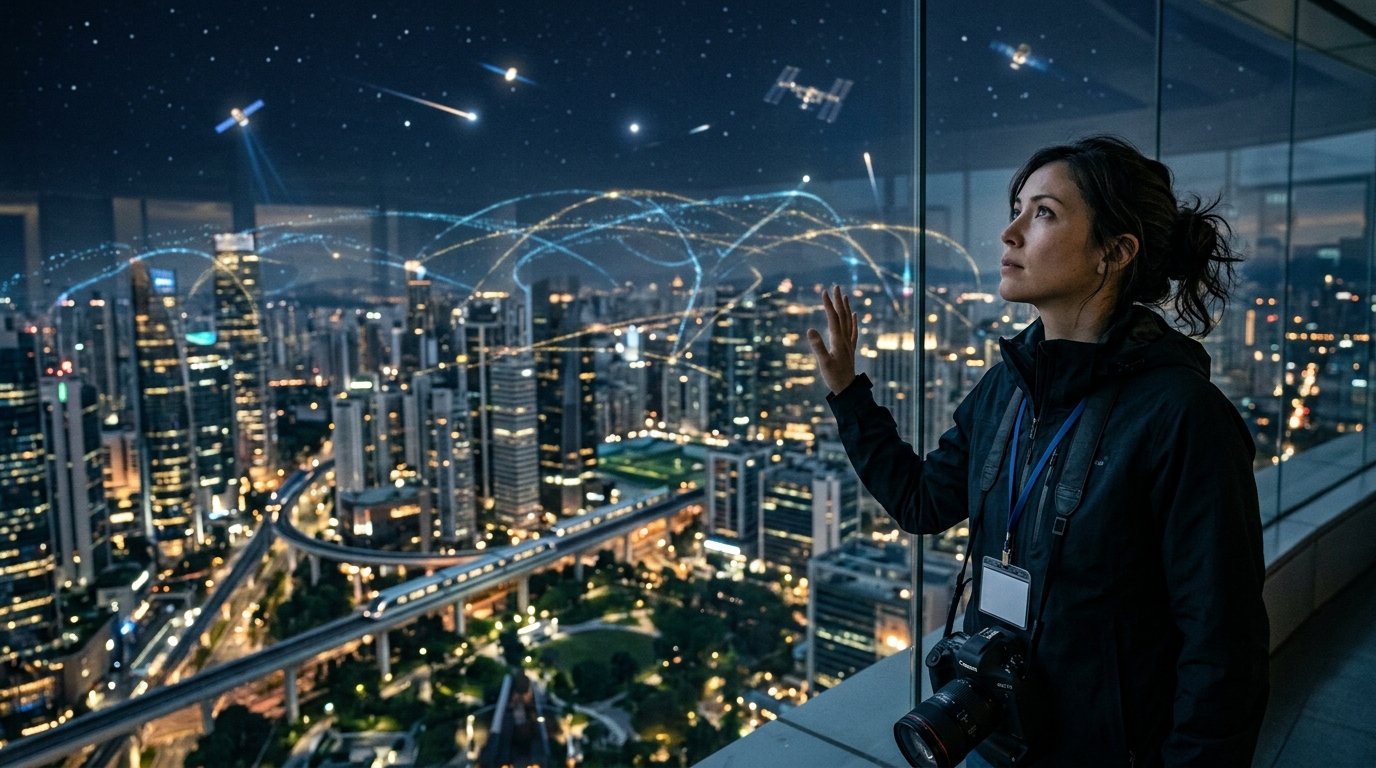
This so-called "Space-based Edge Computing" allows satellites to analyze images and data in real-time. For instance, an AI-equipped satellite can detect a forest fire or a military movement and send only the critical alert to Earth, rather than gigabytes of raw imagery. This drastically reduces response times, transforming satellites from mere information mirrors into autonomous computational hubs.
Energy Sovereignty and the Vacuum's "Cooler"
One of the biggest hurdles for AI development on Earth is the environmental footprint. Terrestrial data centers consume a significant percentage of the world's electricity. In space, the situation changes radically. Solar energy is abundant and continuous, without the interference of the atmosphere or the day-night cycle (in specific orbits).
Furthermore, the heat problem—which requires billions of liters of water to cool servers on Earth—can be addressed differently in the vacuum of space. While dissipating heat in a vacuum is technically challenging (requiring large radiation surfaces), the absence of atmospheric heating and the possibility of placing infrastructure in permanently shadowed regions (such as lunar craters) offer new perspectives for managing the thermal energy of supercomputers.
Geopolitical Sovereignty and the "Sovereign Cloud"
Moving data to space introduces a new dimension to the concept of national sovereignty. Today, a country's data is often stored on servers located on foreign soil, making it vulnerable to legal interventions or physical sabotage. A network of orbital data centers could offer "sovereign space" to nations wishing to protect their strategic data away from terrestrial jurisdictions.
"Space offers the ultimate 'High Ground' not only for military power but for informational sovereignty. Whoever controls the computational nodes in orbit will control the flow of global intelligence," industry analysts suggest.
However, this prospect carries risks. The militarization of space and the possibility of attacks on orbital infrastructure could lead to a new form of Cold War, where the target is not missiles, but the processors powering global AI models.
Technical Challenges: Radiation and Maintenance
Despite the promises, the road to the orbital supercomputer is fraught with obstacles. Cosmic radiation is the greatest enemy of semiconductors. AI chips, which are extremely sensitive due to their microscopic architecture, can be destroyed or experience "bit flips" from collisions with subatomic particles. Developing radiation-hardened processors that maintain high performance is one of the decade's greatest technical challenges.
Additionally, there is the issue of maintenance. While a faulty component in a Virginia data center can be replaced in minutes, a failure in a space server requires robotic missions or remains irreversible. The proposed solution is the use of satellite swarms, where computational power is distributed so that the loss of a single unit does not affect the overall system.
Conclusion
Space is no longer just the "final frontier" of exploration; it is the next frontier of computing. The convergence of AI and space technology promises to liberate humanity from the energy constraints of our planet, creating a seamless, global network of intelligence. If the 20th century saw space as a field for demonstrating power, the 21st will be the field where our collective digital thought resides.