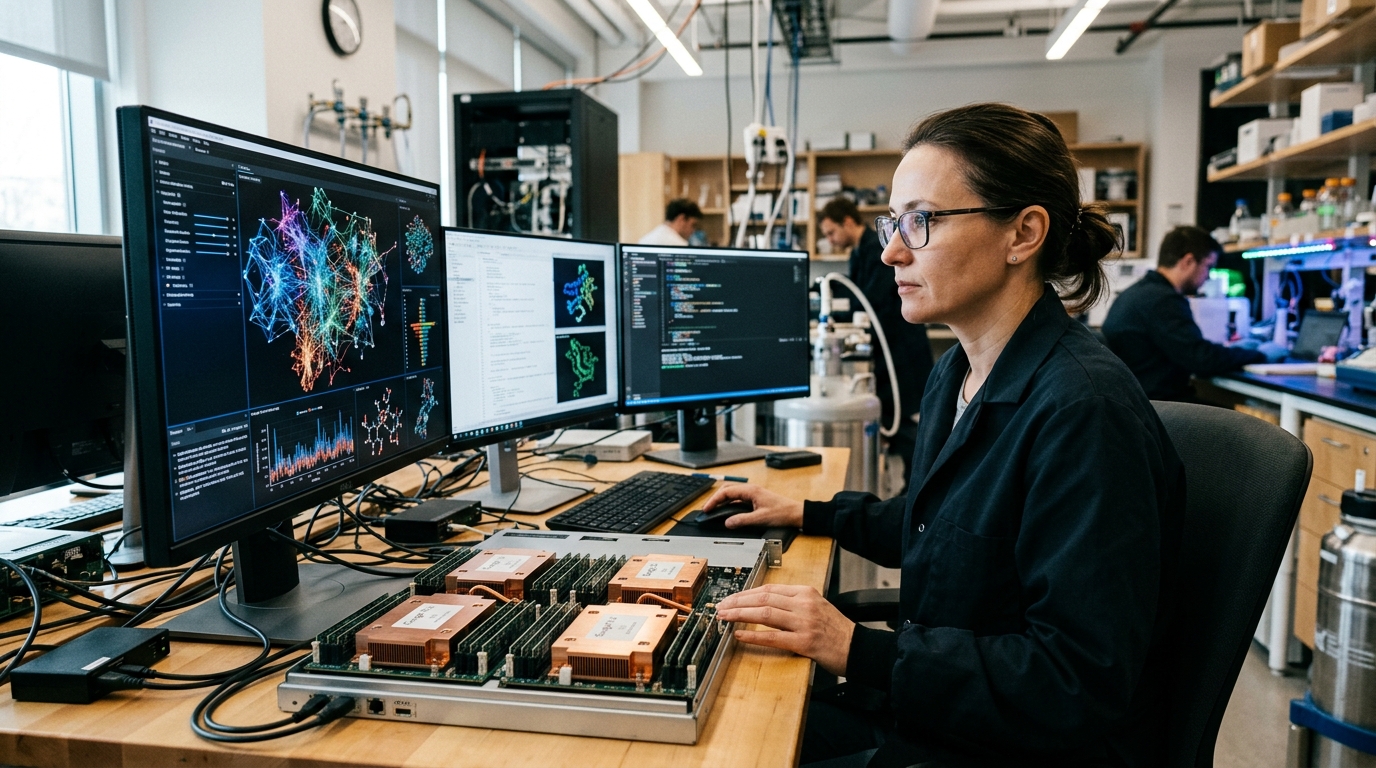
The era where artificial intelligence was viewed merely as a tool for generating text or images has passed. Today, we stand on the threshold of a new period where AI is becoming the central pillar of scientific discovery. Google's recent announcement regarding the development and deployment of specialized AI models, tailored to the rigorous demands of scientific research, marks a structural shift in how humanity approaches the most complex problems in biology, chemistry, and materials science.
From General Intelligence to Specialized Science
Until recently, Large Language Models (LLMs) like Gemini were primarily used for general tasks. However, Google DeepMind, under the leadership of Demis Hassabis, has taken it a step further. These new models don't just "read" scientific papers; they are trained to understand protein structures, chemical interactions, and the physical properties of materials with a precision that surpasses traditional simulations. The success of AlphaFold, which solved the protein folding problem—a decades-old biological puzzle—was just the beginning.
The newly introduced models incorporate reasoning capabilities that allow researchers to formulate hypotheses and receive answers based on vast volumes of data that a human would take decades to process. What makes this development unique is the models' ability to reduce "hallucinations," a critical issue for scientific validity. Through techniques like Retrieval-Augmented Generation (RAG) and direct links to authoritative scientific databases, Google promises a new era of reliability.
Accelerating Discovery: Drugs and New Materials
The impact of these models is already visible in the pharmaceutical industry. The process of developing a new drug traditionally requires over a decade and billions of dollars in investment. With Google's new tools, the time to identify candidate molecules is being reduced from years to weeks. The models can predict how a chemical compound will interact with a specific target in the human body, minimizing failures in clinical stages.
- Protein Design: Creating new enzymes to break down plastics.
- Materials Science: Discovering crystals for more efficient solid-state batteries.
- Climate Change: Modeling carbon capture using new porous materials.
According to market analysts, Google is not just selling software; it is offering a "computational discovery platform." This model allows universities and research centers to access supercomputer-level processing power via the cloud, somewhat democratizing high technology, although dependence on Google's infrastructure remains a point of contention.
Challenges and Ethical Dilemmas
Despite the excitement, the scientific community remains cautious regarding the "black box" problem. If an AI proposes a solution to a quantum physics problem but cannot explain the mathematical path to it, can that knowledge be considered true science? The scientific method is based on verifiability and explanation, two areas where AI often falls short.
"Artificial intelligence does not replace the scientist, but gives them a microscope that can see into the future of data," state Google DeepMind executives.
Furthermore, there is the risk of "dual-use." The same models that can design a life-saving vaccine could, in the wrong hands, be used to create new pathogens or chemical weapons. Google has implemented strict safety protocols, but the debate over whether such powerful tools should be controlled by a private corporation remains more relevant than ever. The geopolitical dimension is also present, as US dominance in AI for science creates a new divide with the rest of the world.
The Future: AI as a Co-Researcher
In the near future, we expect the creation of "self-driving labs," where AI will not only design experiments but also direct robotic systems to execute them. Google appears to be investing in this vision, transforming Gemini into a digital partner capable of synthesizing literature, writing code for simulations, and analyzing results in real-time. The challenge for humanity will be to maintain control of the ethical compass on a path that is accelerating at a geometric rate.