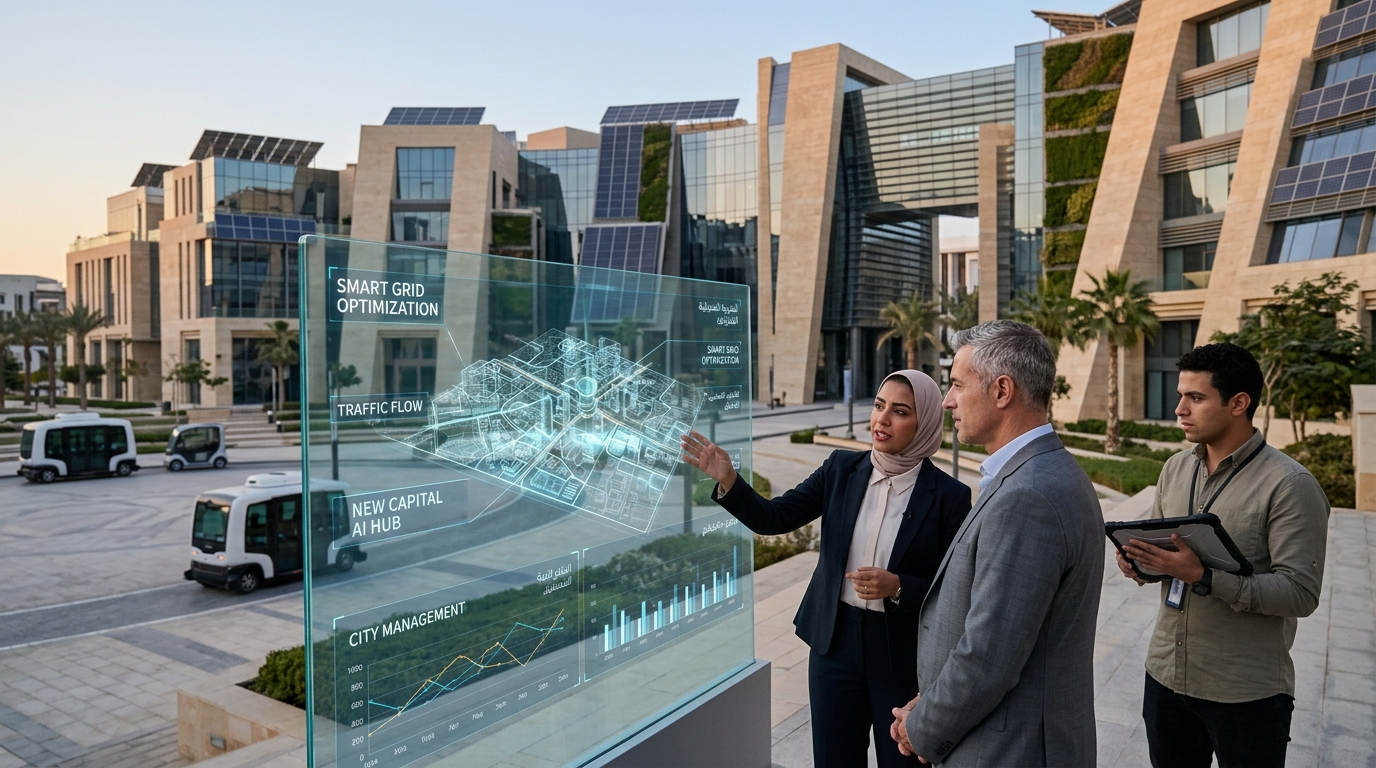
In a vast expanse once dominated by the shifting sands of the Sahara, 45 kilometers east of Cairo, one of the most ambitious urban and technological experiments of the 21st century is taking shape. Egypt’s New Administrative Capital (NAC) is not merely an attempt to decongest the overcrowded historic Cairo; it is a living laboratory for the application of Artificial Intelligence (AI) on an urban scale. With a budget reaching $27 billion for its initial phase, this project promises to transform Egypt into a technological beacon for the Middle East and Africa.
The Digital Backbone: Command and Control
At the heart of the new city lies the Command and Control Center (CCC), a facility that feels more like a scene from a high-budget sci-fi film than a municipal office. Here, AI is not a theoretical tool but the city’s central nervous system. Through an extensive network of IoT (Internet of Things) sensors and thousands of cameras equipped with facial recognition and motion detection, the system monitors the urban environment in real-time. AI algorithms analyze traffic data to adjust signals, reducing congestion and emissions, while simultaneously detecting accidents or suspicious activities, alerting authorities before an emergency call is even placed.
Resource management is equally sophisticated. Smart grids for electricity and water utilize predictive algorithms to identify leaks or faults before they are even noticed by residents. This "predictive maintenance" is expected to save millions of dollars annually, positioning the city as a model of sustainability in a region increasingly threatened by climate change and water scarcity.
Economic Stakes and International Partnerships
The NAC project is the cornerstone of the "Egypt Vision 2030" strategy. To bring it to life, the Egyptian government and the Administrative Capital for Urban Development (ACUD) have partnered with global tech giants. Companies such as Huawei, Orange, and Honeywell have been tasked with installing fiber-optic infrastructure, data centers, and advanced security systems. The choice of these partners reflects a strategic balance between Western expertise and Chinese infrastructure, placing Egypt at the center of global technological competition.
- Unified cloud services for all government departments to streamline bureaucracy.
- Implementation of "smart cards" for citizens, serving as ID, transit passes, and payment methods.
- Automated waste management systems with fill-level sensors to optimize collection routes.
However, the economic burden is substantial. Funding relies heavily on land sales and foreign investment, sparking debates over the sustainability of the nation’s debt. Proponents of the project argue that attracting multinational corporations and creating high-skilled jobs will offset the initial costs in the long run, turning the desert into a profitable tech hub.
Social Challenges and the Surveillance Debate
Despite the technological brilliance, the new capital is not without its critics. One of the primary concerns is privacy. The extensive use of cameras and AI for public surveillance raises significant questions about the boundaries between safety and state control. In a nation with a complex political history, the state's ability to monitor every movement in a "smart city" is viewed with skepticism by human rights advocates.
Furthermore, there is the risk of creating a digital social divide. While the NAC offers a high-tech environment for the elite and government officials, millions of Egyptians in old Cairo still face deficiencies in basic infrastructure. The challenge for the government is to ensure that the benefits of AI permeate the entire society rather than being confined to a "gilded bubble" in the desert. The ultimate success of the New Administrative Capital will be judged not by the speed of its processors, but by its ability to tangibly improve the life of the average citizen.