The history of art is punctuated by the tragedies of creators forced into premature silence by physical decline. From Beethoven’s deafness to Renoir’s crippling arthritis, the struggle between the creative spirit and the mortal frame has always been an uneven match. However, as we cross into mid-2026, technology is rewriting this ancient script. The recent story of a veteran musician who completed his final album with the aid of Artificial Intelligence (AI) after Parkinson’s disease stole his motor skills marks a profound milestone in the evolution of human expression.
The Cruel Silence of Parkinson’s
For a guitarist, the hands are not merely tools; they are the physical manifestation of the mind, the bridge through which emotion is translated into vibration. Parkinson’s disease, a neurodegenerative disorder affecting motor control, is the ultimate nemesis of this relationship. Tremors, rigidity, and the loss of fine motor skills make playing the guitar—an activity requiring micro-second precision—an impossibility. For the subject of our story, the diagnosis meant the end of a decades-long career and the abandonment of a half-finished album intended to be his magnum opus.
The despair was not just professional but existential. As he described it, “The music was still there, trapped inside my head, but the gates had been slammed shut.” This chasm between conception and execution is where AI found a meaningful role to play—not as a replacement for the artist, but as a sophisticated “cognitive prosthetic.”
Bridging the Neurological Gap: The Tech Behind the Music
Completing the album was not a simple matter of automated music generation. It involved bespoke machine learning models trained specifically on the artist’s extensive archive of past recordings. Sound engineers and data scientists collaborated to create a digital “DNA” of his style: his unique rhythmic pocket, the specific nuances of his vibrato, and his harmonic preferences.
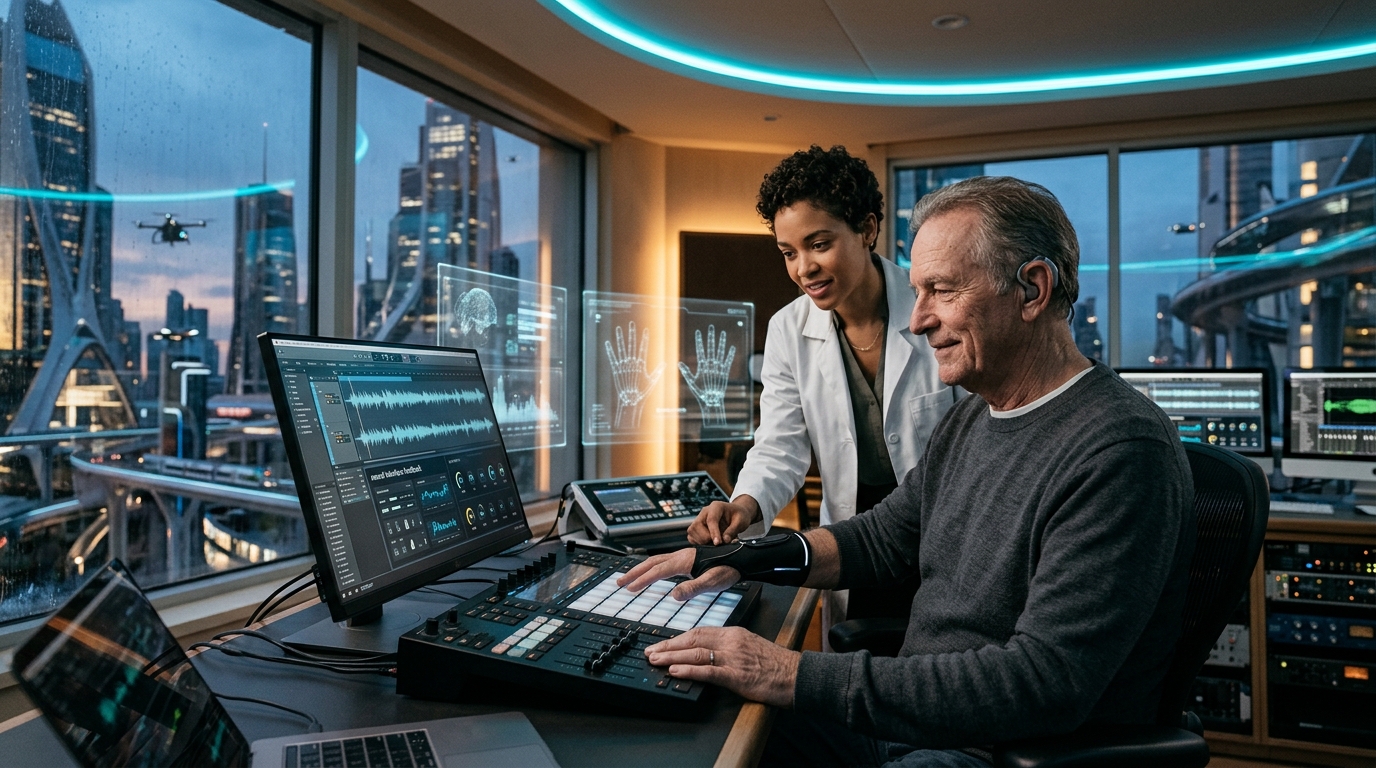
- Voice-to-MIDI Translation: While he could no longer manipulate the fretboard, the musician could still hum or vocalize melodies. AI converted these imperfect acoustic inputs into precise MIDI data, which were then “performed” by digital instruments modeled after his own guitars.
- Corrective Machine Learning: In instances where the artist attempted to play but was hindered by tremors, signal-processing algorithms filtered out the involuntary movements while preserving the artistic intent behind the notes.
- Synthetic Reconstruction: The final product was a seamless blend of archival recordings, new digital performances, and AI-enhanced tracks, resulting in a sonic landscape that was indistinguishably his.
Authenticity in the Age of Synthetic Creativity
The use of AI in the creative arts is often met with skepticism, viewed as a shortcut that devalues human effort. However, in this context, the ethical compass points in a different direction. Here, technology was not used to plagiarize or generate soulless content, but to restore human dignity and creative agency.
“The AI didn’t write the music. The AI gave me my hands back,” the musician noted, highlighting a crucial distinction.
This distinction is vital for the future of the industry. If art is defined by intent, vision, and the soul of the creator, then the tool used to manifest that vision—be it a wooden instrument or a neural network—is secondary. The challenge for critics and the public alike is to accept this “hybrid creativity” as a legitimate and authentic form of expression.
A New Frontier for Inclusive Artistry
The success of this project paves the way for thousands of other creators living with disabilities. We are entering an era where painters with paralysis can create via brain-computer interfaces (BCI) and generative AI, or where writers with aphasia can reclaim their voices through advanced language models. AI is becoming the ultimate equalizer of physical limitations.
As we move through 2026, the discourse surrounding AI must shift from the fear of replacement to the promise of empowerment. The story of this musician is not merely a tech headline; it is a testament to human resilience and a reminder that, given the right tools, the spirit will always find a way to be heard, no matter how profound the silence imposed by nature.