In the dawn of 2026, the medical community stands before a revolution that concerns not just new drugs, but how we perceive time and disease. Artificial Intelligence (AI) is no longer a futuristic promise in Silicon Valley labs, but a clinical partner reshaping cancer screening. The ability of algorithms to process vast amounts of data with speed and precision exceeding human vision offers the hope that cancer can finally be transformed from a lethal threat into a manageable chronic condition.
Digital Vision at the Service of Radiology
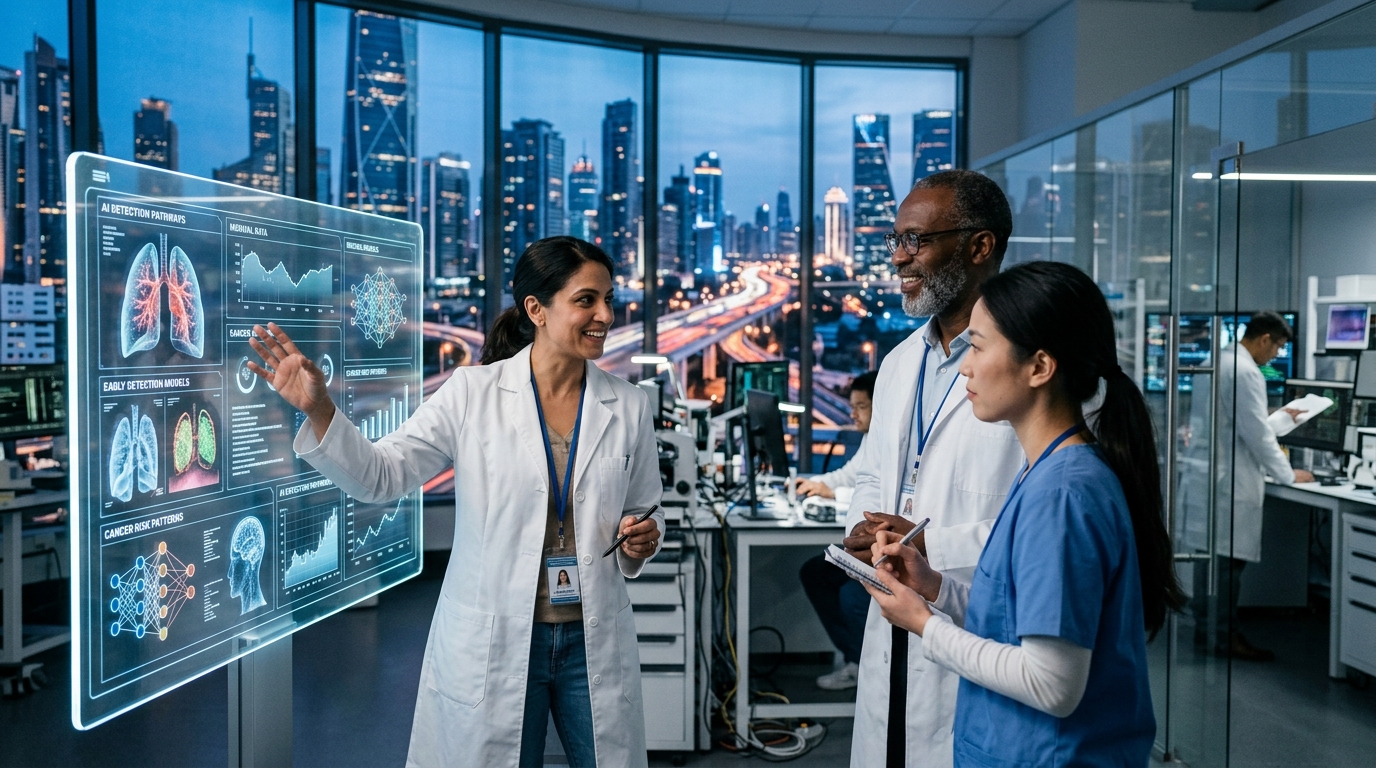
The most immediate and visible application of AI is in medical image analysis. For decades, radiologists have relied on their experience and eyesight to spot tiny abnormalities in mammograms, CT scans, and MRIs. However, fatigue and subjectivity have always been unpredictable factors. Today, Deep Learning systems are trained on millions of images, learning to recognize patterns that are invisible to the naked eye.
According to recent studies, the use of AI in mammography screening has reduced false positives by 20%, while simultaneously detecting cancerous tumors up to two years earlier than conventional methods. This "head start" in time is critical. When cancer is detected at Stage 1, survival rates often exceed 90%, whereas at Stage 4, they drop dramatically. AI does not replace the doctor; it acts as a "super-assistant" that flags high-risk areas, allowing specialists to focus where there is a real need.
Liquid Biopsy and Genomics: AI in the Microcosm
Beyond images, AI is penetrating our very DNA. One of the most promising developments is the "liquid biopsy," which searches for circulating tumor DNA (ctDNA) fragments in the blood. The challenge here is the sheer volume of data: for every drop of blood, there are billions of genetic data points. AI is the only tool capable of separating the "noise" from the actual signals of the disease.
Machine learning algorithms analyze DNA methylation profiles, identifying not only the presence of cancer but also its origin in the body—whether it stems from the pancreas, lungs, or colon. This approach promises an era where a simple annual blood check-up could detect dozens of types of cancer long before the first symptoms appear. The accuracy of these tests improves exponentially as more data is fed into AI systems, creating a virtuous cycle of learning and diagnosis.
Predictive Models and Personalized Prevention
Traditional medicine relied on general rules: "all women over 50 should have a mammogram." AI now enables the transition to personalized prevention. By analyzing a patient’s electronic health record (EHR), family history, lifestyle habits, and even environmental data, algorithms can calculate an individualized risk score.
- Risk Prediction: AI models can predict the likelihood of developing pancreatic cancer up to three years before diagnosis by analyzing subtle changes in weight or blood sugar levels that a human might consider insignificant.
- Resource Optimization: Health systems can focus their resources on high-risk populations, reducing costs and inconvenience for low-risk patients.
- Continuous Monitoring: Through wearables, AI can monitor biomarkers in real-time, alerting the user to any concerning deviations.
However, this technological explosion brings serious questions. Protecting personal health data remains a massive challenge. Who has access to these predictions? Could an insurance company raise premiums if an algorithm predicts a high risk of cancer in the future? Furthermore, there is the risk of "overdiagnosis"—detecting small tumors that might never have caused a problem, leading to unnecessary and painful treatments.
The Future: A Global Challenge
Integrating AI into oncology is not just a technical issue; it is a matter of equity. While developed nations invest billions, the developing world risks being left behind. Here, AI could play an equalizing role: cheaper, automated diagnostic systems could provide high-level services in areas where specialized oncologists are scarce. Technology is the tool, but political will will determine whether surviving cancer becomes a privilege of the few or a right for the many.
"AI will not replace the oncologist, but the oncologist who uses AI will replace the one who does not," the international medical community frequently notes.
In conclusion, AI is shaping a new reality in cancer prevention. Its ability to see the invisible and predict the future through data brings us closer to a world where a cancer diagnosis will no longer be a sentence, but the starting point for a successful cure.